Publications

HamSCI @ AGU 2018

This week, many HamSCI members are presenting their research at the American Geophysical Union (AGU) Fall Meeting in Washington, D.C. The AGU Fall meeting is one of the largest geoscience meetings in the world, and consists of about 24,000 attendees. The scientific program includes sessions pertaining to all areas of geophysics, including space weather, the solar wind, auroral activity, the ionosphere, and the neutral atmosphere. Below is a list of selected presentations and sessions being given by HamSCI members, or of general interest to ham radio operators. The complete scientific program is available here.


Selected Ham Radio AGU Presentations

Monday   December 10, 2018    
08:00-12:20 Convention Ctr–Hall A-C (Poster Hall) SH11C-2880:  Ionospheric Effects of the August 2017 Eclipse: Empirically Guided Modeling with Comparisons to Data Magda Moses, KM4EGE (Virginia Tech) Solar Eclipse Effects
08:00-10:00 Marquis - Marquis 1-2 ED11B:  STEM Education and Outreach: Building Effective Research Collaboration Models I Laura Lukes, KK4FYT (George Mason)  
08:30-08:45 Convention Ctr–206  SH11B-03: EclipseMob 2020/2024 Bluetooth-Based Kit for Crowdsourced Ionospheric Measurements Laura Lukes, KK4FYT (George Mason) Solar Eclipse Effects
08:45 - 09:00 Convention Center - 206 SH11B-04:  Wave Motions in the Ionosphere Associated with the August 2017 Solar Eclipse Terry Bullett, N0ASP (U of Colorado) Solar Eclipse Effects
09:07-09:22 Convention Ctr–202B SA11A-05: Concurrent Solar Flare and Geomagnetic Storm Effects on the Thermosphere and Ionosphere During September 2017 Liying Qian (NCAR/UCAR) Solar Flares and Storm Effects
11:24-11:38 Convention Ctr–202B SA12A-05: Causes and Effects of Small-Scale Plasma Density Irregularities in the Mid-Latitude Ionosphere  J. Michael Ruohoniemi (Virginia Tech) Small-Scale Mid Latitude Irregularities
12:06-12:20 Convention Ctr–202B SA12A-08: High Frequency Communications Response to Solar Activity of September 2017 as Observed by Amateur Radio Networks Nathaniel Frissell, W2NAF (NJIT) Solar Flares and Storm Effects
13:40-18:00 Convention Ctr–Hall A-C (Poster Hall) SM13B-2858: Comparison of Diffusion Region Proxy Parameters in the Geomagnetic Tail Anthony Rogers, AD0EN (UNH)  
13:40-18:00 Convention Ctr–Hall A-C (Poster Hall) SA13C-2786: Citizen Space Science: A Preliminary Systematic Study of HF Radio Propagation from a Source in the Subarctic Using HAARP and the Ham WSPR Network Christopher Fallen, KL3WX (UAF)  
Tuesday   December 11, 2018    
08:00-12:20 Convention Ctr–Hall A-C (Poster Hall) SA21A-3145: Ionospheric sounding using signal of opportunity Alex Cushley, VA3CUS (Royal Military College of Canada)  
08:00-12:20 Convention Ctr–Hall A-C (Poster Hall) SA21A-3165: New Daytime Thermosphere ionosphere observations during the HIWIND Flight in 2018 Qian Wu (NCAR)  
08:00-12:20 Convention Ctr–Hall A-C (Poster Hall) SA21A-3167: In Sutu Ion Density and Composition Measurements with the Radio Receiver Instrument on e-POP Using Excitation of Plasma Waves by Photo Electrons Paul Bernhardt, KF4FOR (NRL)  
10:32-10:44 Marriott Marquis - Marquis 1-2 PA22B-02: Modeling Amateur Radio Soundings of the Ionospheric Response to the 2017 Great American Eclipse (Invited) Nathaniel Frissell, W2NAF (NJIT) Solar Eclipse Effects
12:05-12:20 Convention Ctr–207B SH22B-08: Current and Future Community Integrative Science and Discovery Using Incoherent Scatter Radar Techniques (Invited) Phil Erickson, W1PJE (MIT Haystack)  
13:40-18:00 Convention Ctr–Hall A-C (Poster Hall) SA23A-3178: Electron-electron collision effects on ISR temperature measurements William Longley (Boston University)  
13:40-18:00 Convention Ctr–Hall A-C (Poster Hall) SA23A-3181: HF Propagation Experiments Through Ionospheric Heated Regions Using e-POP Stanley Briczinski (NRL)  
Wednesday   December 12, 2018    
13:40-18:00  Convention Ctr–Hall A-C (Poster Hall) SA33C-3501: Horizontal and Vertical Structures of Large- Scale Traveling Ionospheric Disturbances Observed with GNSS Receivers and Millstone Hill Incoherent Scatter Radar Shunrong Zhang (MIT Haystack) TIDs
13:40-18:00  Convention Ctr–Hall A-C (Poster Hall) SA33C-3491: Observations of Traveling Ionospheric Disturbances at Midlatitudes during Geomagnetic Storm of 1–3 September 2016 Sergii Panasenko (Institute of the Ionosphere) TIDs
13:40-18:00  Convention Ctr–Hall A-C (Poster Hall) SA33B-3470: Ionospheric Disturbances During the September 2017 Geomagnetic Storm Anastasia Newheart (Rice) Solar Flares and Storm Effects
13:40-18:00 Convention Ctr–Hall A-C (Poster Hall) SA33C-3504 Millstone Hill incoherent scatter radar fine-scale observations of traveling ionospheric disturbances using Langmuir mode techniques Lilias Gasque (Dartmouth) TIDs
13:40-18:00 Convention Ctr–Hall A-C (Poster Hall) SM33C-3586: Characteristics and Effects of Strong Subpacket Structure near 1/4 fce in VLF Chorus Risers John Foster (MIT Haystack)  
13:40-18:00 Convention Ctr–Hall A-C (Poster Hall) SA33C-3500 Inter-Hemispheric Coupling of Large Scale Travelling Ionospheric Disturbances During Geomagnetic Storms Olusegun Jonah (MIT Haystack) TIDs
13:40-18:00 Convention Ctr–Hall A-C (Poster Hall) SA33B-3479: Advances and Features of Meteor Radar Techniques for M-L-T Region Neutral Wind Characterization Phil Erickson, W1PJE (MIT Haystack)  
Thursday   December 13, 2018    
Friday   December 14, 2018    
08:00-12:20 Convention Ctr–Hall A-C (Poster Hall) ED51F: Citizen Science Showcase: Strategies to Engage Citizens and Students in Research I Posters Bill Liles, NQ6Z  
16:00-18:00 Marriott Marquis - Marquis 7-8
ED54A: Citizen Science Showcase: Strategies to Engage Citizens and Students in Research II
Bill Liles, NQ6Z  

Traveling Ionospheric Disturbances (TIDs)

Traveling ionospheric disturbances are space weather in nature and cause fluctuations in electron density that can have impacts on HF propagation.  Two techniques, GNSS based total electron content (integrated density through the ionosphere and plasmasphere), and incoherent scatter radar (direct altitude profiles of temperature, density, velocity), can provide spatial structure information on these disturbances.

Solar Flare and Storm Effects

Solar flares cause D region based HF blackouts, but have effects through the ionosphere and neutral atmosphere.  September 2017 was characterized by multiple solar flares as well as large geomagnetic storm perturbations.  Studying these helps understand the system's response to forcing.

Small-Scale Mid Latitude Irregularities

At mid-latitudes over North America, we have known for more than a decade that HF radars (SuperDARN) see almost constant backscatter from small-scale irregularities moving at slow ionospheric speeds.  The causes of these irregularities are still under investigation, but they are very useful as a remote diagnostic.  This will give updates on progress toward understanding the irregularity origins.  Their presence may cause short time period HF propagation path changes.

HamSCI Workshop 2019

hamsci savethedate.png


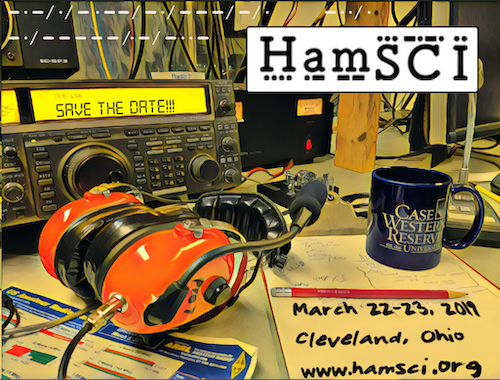
Come join HamSCI at its second annual workshop! The workshop will be held March 22-23, 2019 at Case Western Reserve University in Cleveland, OH and seeks to bring together the amateur radio community and professional scientists. Anyone interested in this workshop is invited to join.

Cost and Registration

  • Friday Registration: $100 (Includes Breakfast, Lunch, and Banquet Ticket)
  • Saturday Registration: $50 (Includes Breakfast, Lunch, and Dinner)
  • Friday Banquet Ticket Only: $50

Call for Speakers

We are especially looking for speakers with presentations showing analysis of ionospheric observations, ideas and proposals for the design of the Personal Space Weather Station and instrumentation for the 2024 eclipse. We will also accept other presentations related to amateur radio and science. Presentations will be in the form of oral talks, posters, lightning talks, and demo room tables. Abstract and acceptance and presentation format will be chosen by the Science Program Committee. If you would like to present, please e-mail your abstract to Nathaniel Frissell, W2NAF, at [email protected] by February 10, 2019. Presenters will be notified by March 1, 2019.

In your abstract e-mail to [email protected], please include:

  • Title of Presentation
  • Name of Presenter
  • Co-Author List with Call Signs and Affiliations
  • Abstract, limited to 1 paragraph and 350 words
  • Request of presentation or demo room table

You may request a poster presentation format. Due to time constraints requests for oral presentation slots are not guaranteed.

Program

This year’s theme will be “Ionospheric Effects and Sensing,” which includes the use of amateur radio techniques for the characterization and study of ionospheric phenomena such as traveling ionospheric disturbances, sporadic E, response to solar flares, geomagnetic storms, the 2024 total solar eclipse other space weather events. In order to facilitate this science, continued development of the HamSCI Personal Space Weather Station and discussion of integration of amateur radio into the collegiate curriculum will also take place. Featured speakers include well-known amateur radio author Ward Silver, N0AX, propagation specialist Carl Luetzelschwab, K9LA, and MIT Haystack Observatory Ionospheric Scientist Dr. Larisa Goncharenko. We will also accept presentations relating to amateur radio and science, particularly space and atmospheric science, space weather, and radio astronomy. 

On Saturday afternoon, after lunch, the conference proceedings will continue at CWRU's think[box], a student manufacturing facility and makerspace that is open to the public. Attendees will participate in tours of think[box] facilities; tours of the Case Amateur Radio Club, W8EDU; and an amateur radio licensing session. There will also betime available for breakout sessions and committee discussions. The conference will close on Saturday evening with a screening of Contact at CWRU Film Society. Tickets to the film are complimentary with a conference badge.

View Agenda, Videos, and Presentation PDFs


Friday Keynote: Ward Silver, N0AX, on "Ham Radio 2.0 - Science, Service, Skill"

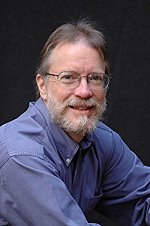
Ward Silver Photo
Ward is the Lead Editor of the ARRL Handbook and the ARRL Antenna Book. He is the author of all three ARRL License Manuals and the Q&A Study Guides.  He released the well-received "Grounding and Bonding for the Radio Amateur" in 2017.  His 15 years of the monthly QST column "Hands-On Radio" has  concluded but the columns are available in book form as a three-volume set. He also serves as a Contributing Editor to the ARRL and consults on a variety of projects and programs in the ARRL Contest Branch. He was awarded the ARRL's Bill Orr Technical Writing Award for a second time in 2016.  You will also find his byline in the popular Wiley "for Dummies" series; Ham Radio (with a 3rd edition released in 2018), Two-Way Radios and Scanners, and Circuitbuilding Do-It-Yourself.
 
An electrical engineer, he designed microprocessor-based products and medical devices for twenty years before beginning a second career as a teacher and writer. Ward was first licensed in 1972 as WNØGQP and enjoys DXing, contesting (elected to the CQ Contest Hall of Fame in 2015), and participating on his local emergency communications team.  He is a co-founder of the World Radiosport Team Championships and is President of the Yasme Foundation.

Invited Talk: Carl Luetzelschwab, K9LA, "Ham Radio for Space Scientists"

Carl Luetzelschwab Photo
Carl started his radio career as a shortwave listener in the late 1950s, and received his Novice license (WN9AVT) in October 1961. He selected K9LA in 1977. He enjoys propagation, DXing (he’s at the top of the Honor Roll), contesting (he was NCJ Editor from 2002-2007), playing with antennas and fixing/using vintage equipment. Carl is a graduate of Purdue University (BSEE 1969, MSEE 1972) and worked for Motorola and Magnavox/Raytheon as an RF design engineer (mostly designing solid-state RF power amplifiers). He retired in October 2013. He and his wife Vicky (AE9YL) reside in Fort Wayne and enjoy traveling, which has included DXpeditions to Syria, Market Reef and numerous trips to the Cayman Islands. Carl is currently the ARRL Central Division Vice Director. He has received the Bill Orr W6SAI Technical Writing Award, the YASME Foundation Excellence Award and the Indiana Radio Club Council Technical Excellence Award.

Invited Talk: Dr. Larisa Goncharenko, "Space Science for Ham Radio Operators"

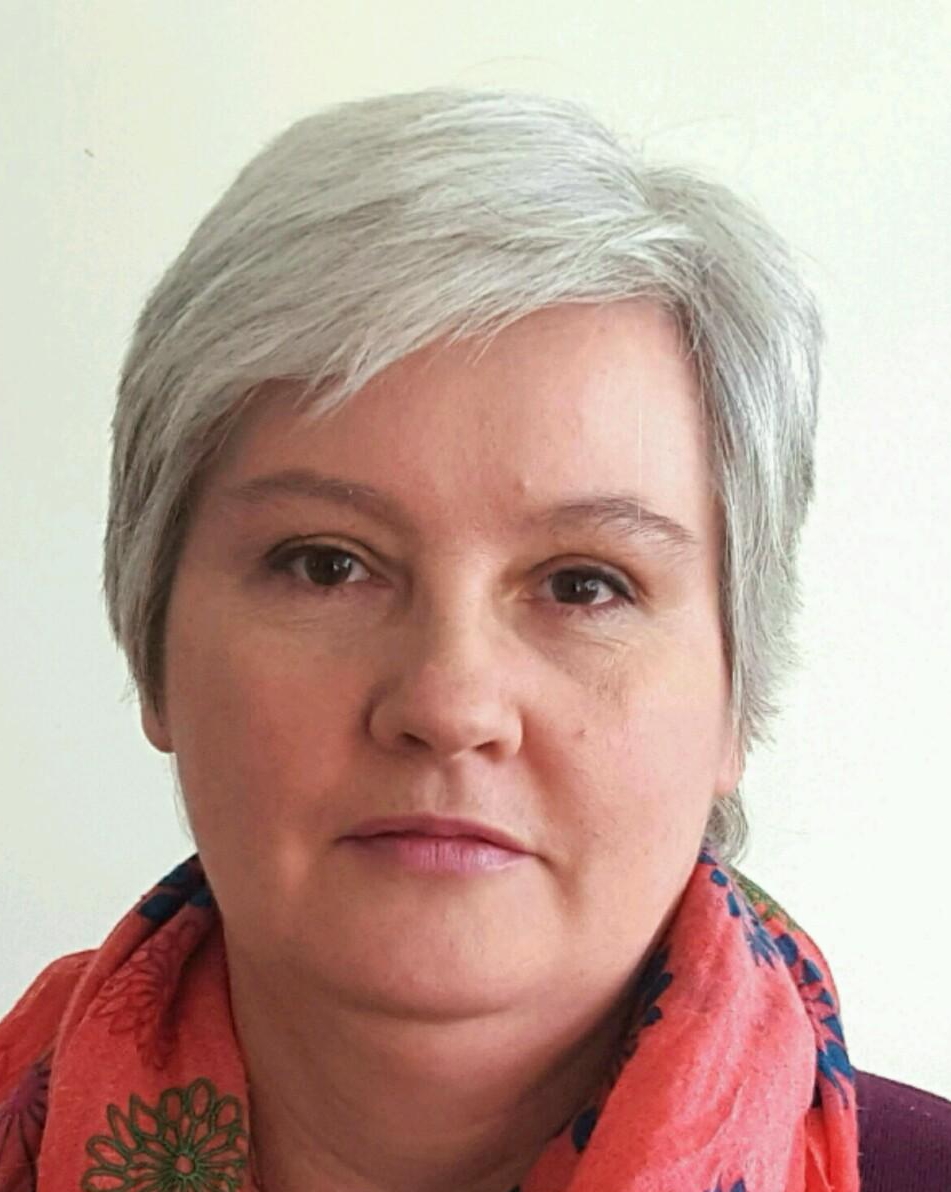
Larisa Goncharenko Photo
Dr. Larisa Goncharenko is a research scientist at the Haystack Observatory, Massachusetts Institute of Technology. Her major areas of interest are ionospheric-thermospheric coupling, and the dynamics and electrodynamics of the ionosphere and thermosphere, with an emphasis on processes in the lower thermosphere and coupling with lower altitudes. Goncharenko's undergraduate and graduate education was in Physics (High Honors), 1988, at Kharkiv National Polytechnic University, Kharkiv, Ukraine. She has held research positions at Kharkiv National Polytechnic University (1988-1996) and Haystack Observatory, MIT (Visiting Scientist, 1994-1995; Postdoctoral Fellow, 1996-1997; Research Scientist, 1997 to present). Goncharenko's research in Ukraine was focused on ionospheric modification by HF heating facility (similar to those in Arecibo or EISCAT) and diagnostics of modifications with the Kharkov incoherent scatter radar. Her research at MIT includes experimental studies using multiple incoherent scatter radars, GPS TEC data, ionosondes, satellite data, and collaborations with multiple modeling groups. She is the recipient of the CEDAR Prize Lecture award (2012), NASA Group Achievement Award (2008), and an MIT Excellence Award (2003). She is the author or coauthor of more than 70 refereed publications.

Meeting Location and Parking

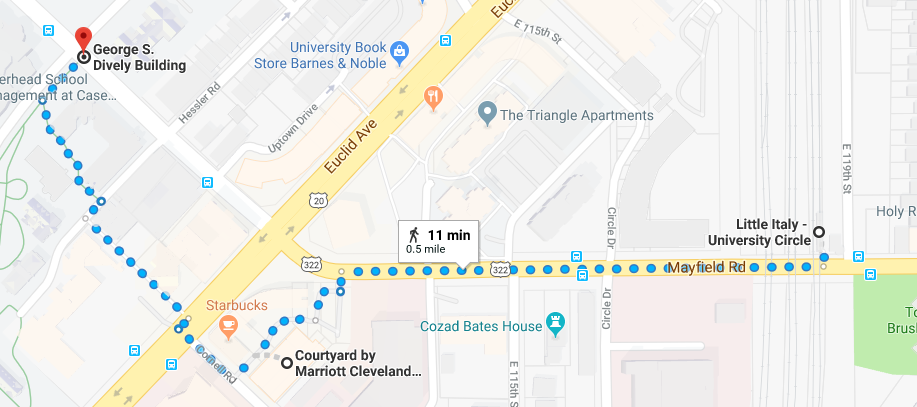
The Friday sessions and Saturday morning sessions will be held in the Premier Industrial Lecture Hall in the Dively Building on the CWRU campus. The Friday evening banquet will be held at Nighttown. On Saturday afternoon, proceedings will move to CWRU think[box] for workshops and demonstrations, as well as tours of the Case Amateur Radio Club, W8EDU. The conference will conclude with a screening of Contact at Strosacker Auditorium, presented by the CWRU Film Society.

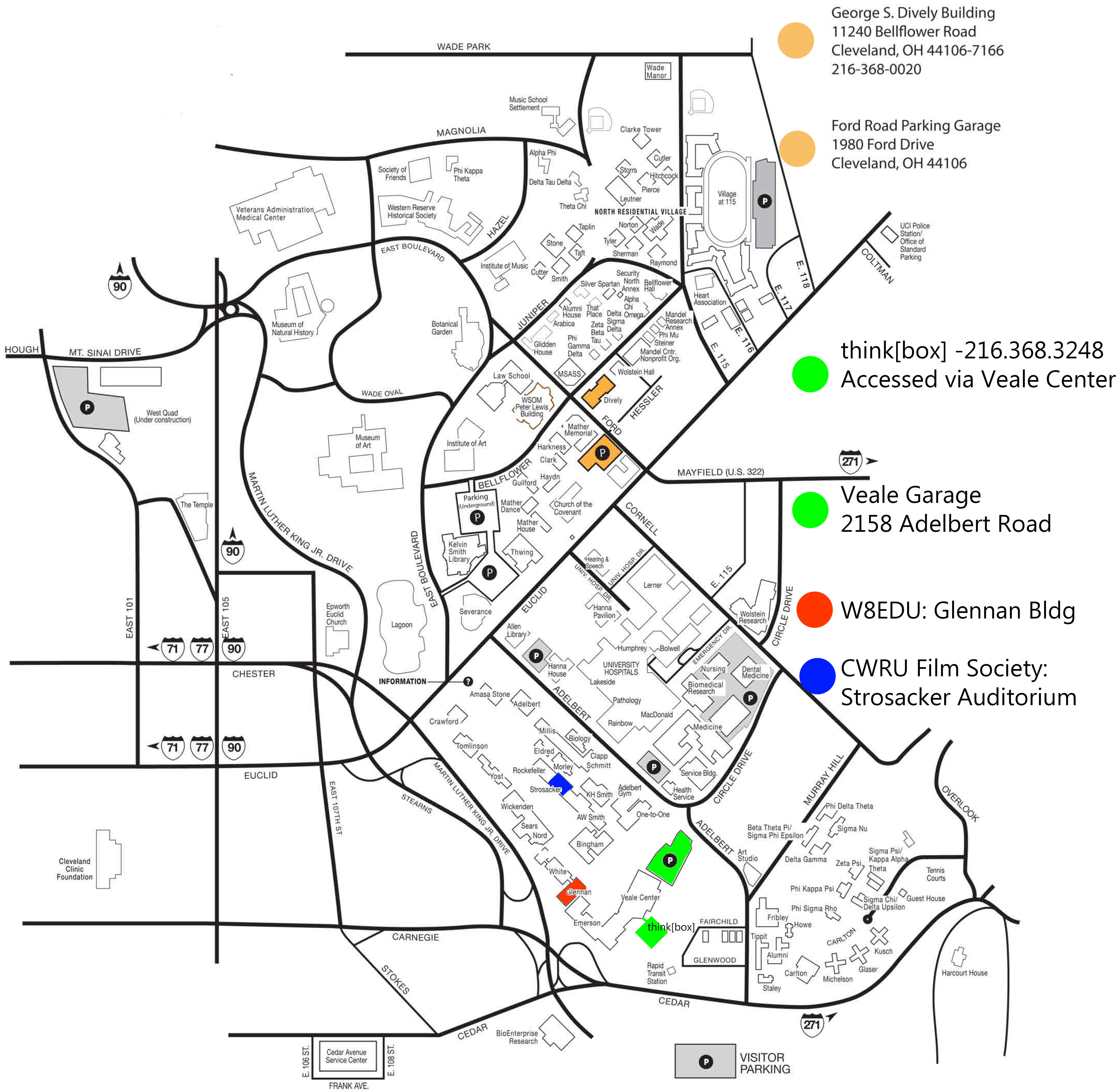
Paid parking is available near each venue. Near Dively, participants are advised to park in the Ford Garage. Parking for Nighttown is available next to the restaurant.  When visiting think[box] and the other destinations on the Case quad (W8EDU, Film Society), attendees should park in the Veale Garage and enter think[box] through Veale Center.

HamSCI_2019_CWRU_Parking.png

Breakfasts, Lunches, and Friday Banquet

Breakfasts, lunches, and coffee breaks are included with registration for both Friday and Saturday. Special dietary needs can be specified when registering.

The Friday Banquet Dinner will be hosted at Nighttown, with keynote speaker Ward Silver N0AX. Banquet tickets are included with Friday registration. Separate/additional banquet tickets may be purchased for $50 each.

Nighttown
12383 Cedar Rd
Cleveland, OH 44106


Lodging

A block of hotel rooms has been reserved at the Cleveland Courtyard by Marriott, a short walk from the Dively Building. For the nights of March 21, 22, and 23, rooms are available at the CWRU nightly rate of $165. Participants may reserve a room by calling 1-800-MARRIOTT and identifiying themselves as part of the HamSCI group under CWRU. Reservations must be placed by March 1, 2019 in order to receive the discounted rate.

Other nearby hotel options include Glidden House, a short walk from the conference, and the Tudor Arms Hotel, a short drive.

Flight Information and Ground Transportation

Easy access to CWRU and the HamSCI meeting is available through the RTA Red Line, which connects directly to Cleveland Hopkins International Airport. If coming from the airport, take the Red Line to the Little Italy station.

Talk-In Frequencies

Every party should have a call-in frequency; if you have an HT, check in en route to ask directions or say hello.

  • Primary Simplex: 146.55 MHz
  • Secondary Simplex: 432.10 MHz
  • Repeater: KD8LDE/R 442.28750 MHz + 131.8 Hz

Local Organizing Committee

  • Ms. Kristina Collins, KD8OXT, Chair
  • Dr. David Kazdan, AD8Y, Advisor
  • Mr. Nathaniel Vishner, KB1QHX

Science/Program Committee

  • Dr. Nathaniel Frissell, W2NAF, NJIT, Chair
  • Dr. Phil Erickson, W1PJE, MIT Haystack Observatory
  • Dr. Ethan Miller, K8GU, JHU/APL
  • Mr. Bill Liles, NQ6Z, HamSCI Community

Questions?

If you have questions, please e-mail [email protected]. Logistics questions will be directed to Kristina Collins, KD8OXT (216-368-3579) and science/program questions will be directed to Nathaniel Frissell, W2NAF (973-787-4506).


cwru_logo.png NSF Logo

NJIT_C_PF_noReg.jpg

The 2019 HamSCI Workshop is hosted by Case Western Reserve University in collaboration with the New Jersey Institute of Technology. Financial support is provided by the United States National Science Foundation.


WA5FRF Publishes Eclipse and FMT Results in QEX

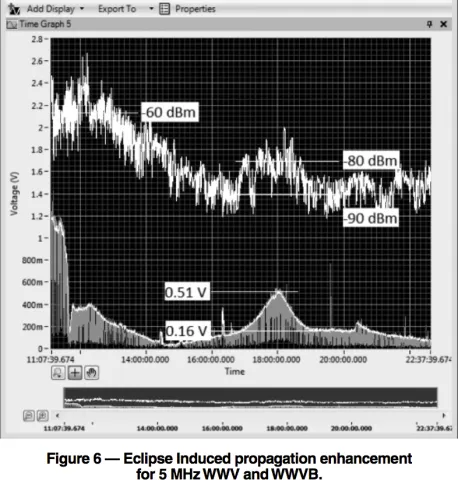
In his recent QEX article, “Ionospheric Disturbances at Dawn, Dusk, and During the 2017 Eclipse,” Steve Cerwin, WA5FRF published his analysis of observations of WWV (5 MHz) and WWVB (60 kHz) transmitters in Ft. Collins, CO as received at his home in San Antonio, TX.  Cerwin reports that during the August 21, 2017 eclipse, a definite and measurable enhancement of low frequency (LF) and high frequency (HF) signals from his station. In addition to eclipse observations, Cerwin also examined the dawn and dusk transitions on both frequencies. Notable findings include a propagation null on WWVB that is correlated in time with dusk and dawn, and is consistent with destructive interference from a combination of ionospheric skip and ground-wave multipath propagation. Cerwin also reports on increased frequency jitter at 5 MHz during these times, as well a radical positive frequency swing at dawn and a negative swing at dusk.

Full text of Steve Cerwin’s article is available here. This is from the September/October 2018 QEX, copyright ARRL. HamSCI thanks the ARRL for permission to reprint this article.


Space Weather Station Working Page

HF Receiver Project

There are currently many commerically available software defined radios (SDRs), but none seem to have all of the necessary features needed for an amateur personal space weather station, including cost, frequency accuracy/stability, timestamping, calibration, bandwidth, etc. We aim to create define the necesssary requirements and create an HF receiver suitable for amateur scientific work.

TangerineSDR

The HF SDR Receiver is being engineering by TAPR as the TangerineSDR. Please visit https://tangerinesdr.com/ for the latest information on this project.

tapr-logo.png

Resources

General References

GPS Disciplined Oscillators

Red Pitayas

The Red Pitaya is a (relatively) inexpensive multi-purpose development platform and lab instrument that can also be used as a 0.1-60 MHz SDR. While not entirely suited to radio science use, it provides a good starting point using commerically available hardware.

Data Recording

Ionosonde Receiver Project

Magnetometer Project

A magnetometer that is usable for space science/space weather needs to have a resolution > 5 nT to be useful. Inexpensive magnetometers, such as the ones found in cell phones, are typically hall effect or magnetoresistive magnetometers with resolutions > 100 nT and are only sensitive to the very largest (rare) space weather events. 

Planning Documents

Resources

Articles

Presentations

Page Maintained by Dr. Nathaniel Frissell, W2NAF

How to play an RRI raw IQ file on Gqrx

This is a how to page for Gqrx an "open source software defined radio receiver".  Gqrx has many bells and whistles, one of which is the ability to listen to "raw" IQ files, speficially, "raw" IQ files from RRI.  This page is desinged to help set-up and listen to "raw" RRI IQ files using Gqrx.

Currenlty, Gqrx is available for Linux, and some instance of Mac OS.  Information about that can be found here.  This instructions and screen captures shown here are from Ubutu 18.04 LTS.  These instructions will be very similar - if not identical - for a Mac Gqrx install.  Gqrx may be downloaded directrly from the site, or it may be installed through the normal Linux APT software.  Gqrx user support is provided via a Gqrx Google group.

As you will see, Gqrx has lots of options and settings.  Here we are only concerned with playing "raw" I/Q files assoicated with RRI's dataset.


Gqrx Startup

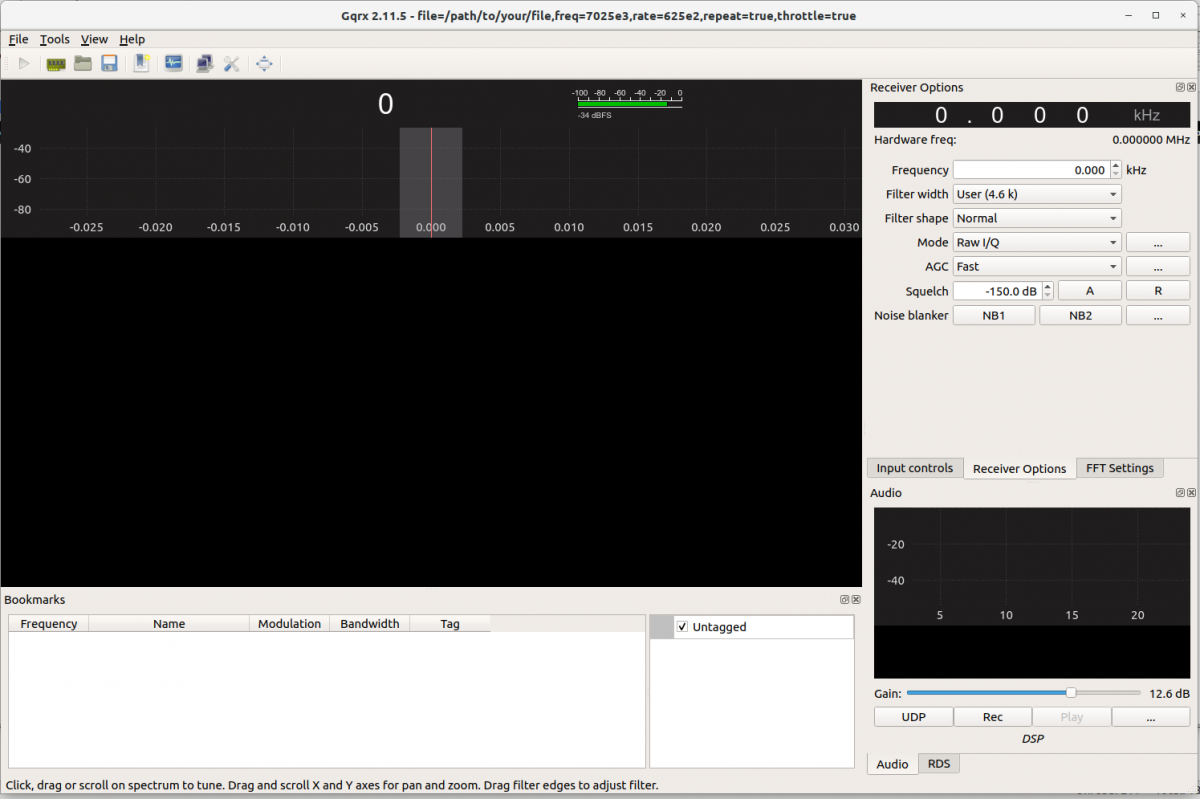
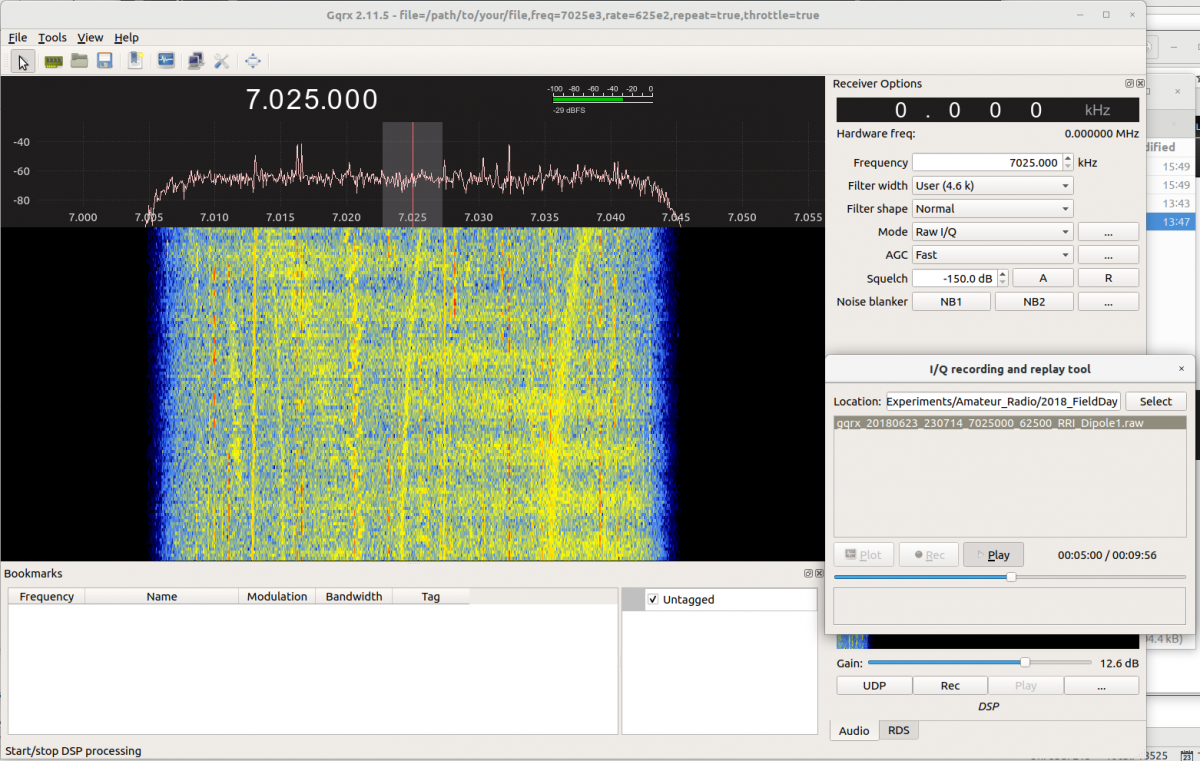
When starting up Gqrx (assuming that your install went smoothly) you should see something similar to the following screen-grab.

Gqrx_instructions_startup.png


Receiver settings

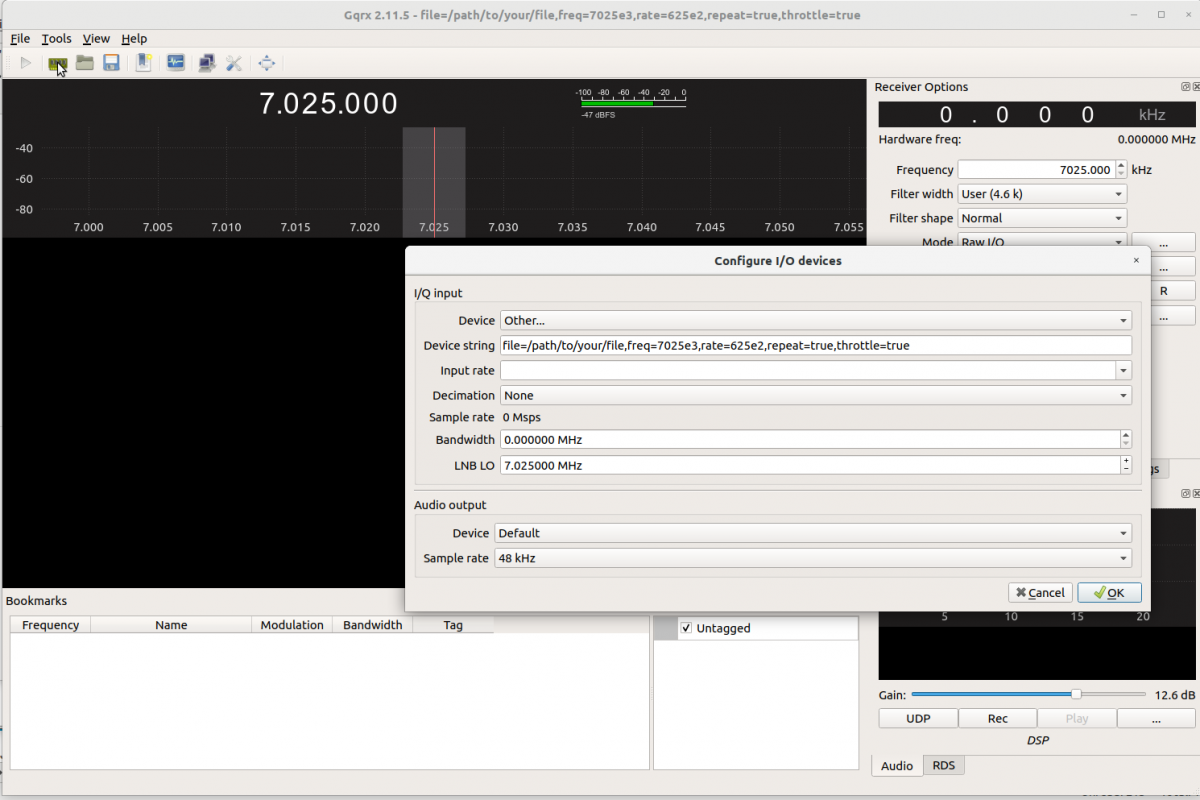
The raw I/Q files do not contain any metadata. RRI's settings related to the data file must be manually entered into Gqrx.  To do this, click on Configure I/O devices icon on the left side of the toolbar at the top of the window, as shown (the incon looks like a piece of computer hardware).  Then enter the important information contained in the file name of the RRI raw file into the Configure I/O devices window.  For example, here we have entered information for an RRI data file that was recorded at 7.025 MHz.  Under Device String, the field freq=7025e3 (7025 kHz = 7.025 MHz) and rate=625e2 (625E2 Hz = 62.5 kHz) are the only fields that have been changed.  Under LNB LO enter the tuned frequency RRI was at, in this example LNB LO = 7.025000 MHz.  Ensure the Audio Output settings are correct so that you'll be able to hear the audio.

Gqrx_instructions_settings.png


Selecting an RRI raw IQ file to play

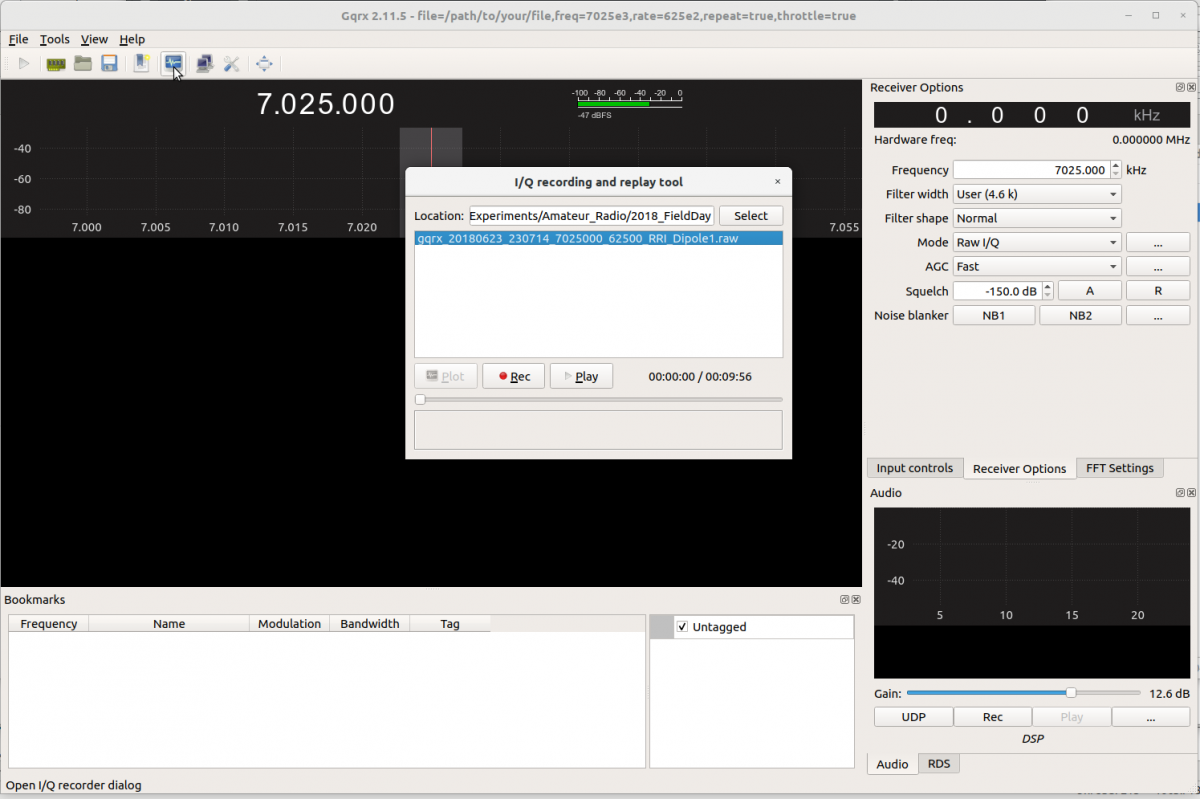
Next, to load up an RRI raw IQ file, click on the Record and play I/Q data icon on the top toolbar (the icon looks liek a screen with a voltage trace).  In the Record and play I/Q data window, be sure to set your path to the audio file correctly.  When this is done, you see all of the files in the *.raw format.  You will then be able to select the file you want to play.

Gqrx_instructions_load.png


Playing an RRI raw IQ file

To play the selected file, hit Play in the I/Q recording and replay tool.  Ensure that Mode in the Receiver Options panel to the right is set on Raw I/Q.  Then select the Start DSP processing icon in the top toolbar (the icon looks like a traditional 'play' button).  The raw IQ audio file should start playing.  You should see a waterfall plot similar to the one shown below.  Notice that the  I/Q recording and replay toohas a timer and a slider which allows you to locate and reposition your place in the audio file.

Gqrx_instructions-play.png


If you have any comments, questions, or suggestions, please do not hesitate to contact Gareth Perry.


Help wanted identifying hams in Swarm-E (e-POP) RRI data

In the spirit of making data from the Radio Receiver Instrument (RRI) onboard Swarm-E (formally known as e-POP) more accessible to the ham radio community, we have converted RRI's data into a ".raw" format so that it can be ingested into open source software such as Gqrx or GNU Radio.  We have done this for all RRI data related to the 2015, 2017, and 2018 ARRL Field Days.

We encourage everyone to help us identify hams in RRI's signal.  You can use the Gqrx tool discussed here, or you can use your own technique.  If you decode a ham's call sign, if you would like to share your technique, or if you have any comments or suggestion contact us and let us know! 

To help organize your findings, you can download a spreadhseet containing that you can fill out and send to us.  Feel free to create your own spreadsheet or modify this one.  

Swarm-E (e-POP) RRI

Swarm-E RRI is a digital radio receiver with 4 3-m monopole antennas.  In most cases, the monopoles are electronically configured into a crossed-diople configuration.  In this configuration, RRI records I/Q samples for the two dipoles.  RRI has a sampling rate of 62500.33933 Hz, and a ~40 kHz bandpass, and can be tuned to anywhere between 10 Hz and 18 MHz.  More information on Swarm-E RRI can be found in the Swarm-E RRI instrument paper or Gareth Perry's recent Radio Science article.

Data Format

Each data file contains raw 32 bit complex I/Q samples for a given RRI dipole at a given frequency.  The samples are interleaved, e.g., IQIQIQIQ... The data files do not contain any metadata.  Any information regarding the time, frequency, and corresponding RRI dipole is in the file name.  

Filename Format

The filename format gives information about the time and data of the recording, the tuned frequency, and which of RRI's dipoles the recording corresponds too.  For example, gqrx_20150628_011614_3525000_62500_RRI_Dipole1 contains data recorded on Dipole 1, starting at 01:16:14 UT on June 28, 2015, at 3525000 Hz (3.525 MHz), at a sampling rate of 62500 Hz (RRI's 62500.33933 Hz sampling rate).

Gqrx

We have opted to convert the data into the .raw format so that it can be ingested into Gqrx.  There are other ways of analyzing RRI's data; this is just one way which we felt was as easy first step.  We are open to posting about other techniques on the HamSCI site as well.  To help get started with Gqrx, we have developed a How to play an RRI raw IQ file on Gqrx page.

Data Files

The data files may be downloaded directly from the Zenodo repository here


Field Day - CASSIOPE 2015 Results Published in Radio Science

The results of the 2015 CASSIOPE ePOP - Field Day experiments have been published in the peer-reviewed American Geophysical Union journal Radio Science as "Citizen radio science: an analysis of Amateur Radio transmissions with e‐POP RRI" by Dr. Gareth Perry et al. From the plain language summary:

We report the results of an experiment in which we used a satellite‐based radio receiver to eavesdrop on Ham radio communications as the satellite passed over the United States. We identified 14 Ham radio users by their call signs, and used this information to determine their location during the experiment. We were able to identify unique signatures in the Hams' signals that are directly related to the nature of the how the Hams' radio waves traveled through the Earth's ionosphere up to the satellite. Furthermore, we used our knowledge of the position of the spacecraft, and the location of the Hams and their broadcast frequencies to deduce the structure of the Earth's ionosphere over the United States during the experiment. This experiment and its results show that Ham radio transmissions and Hams (amateur radio operators) can be valuable assets in determining the structure of the ionosphere over large geographic regions.

The version of record is available from https://doi.org/10.1029/2017RS006496. A free pre-print is available from http://hamsci.org/sites/default/files/publications/Perryetal_HamRadio_2017_rev2.1.pdf.

CASSIOPE spacecraft monitors 2018 ARRL Field Day

The Canadian CAScade, Smallsat and Ionospheric Polar Explorer (CASSIOPE) spacecraft once again eavesdropped in on the 2018 ARRL Field Day. Onboard CASSIOPE is the Enhanced Polar Outflow Probe (e-POP), a suite of eight science instruments studying spaceweather. The Radio Receiver Instrument (RRI), one of e-POP’s eight instruments, was tuned to 7.005 MHz (40 m), during 6 passes over the North American continent during the Field Day activities. “We’re really happy with our results this year” remarked Dr. Gareth Perry, a Postdoctoral Research Associate in the Department of Physics and Astronomy at the University of Calgary, CASSIOPE’s home institution. “RRI recorded plenty of chatter between Field Day participants, especially during our passes over the eastern and central United States on the evening of the 23rd”.

CASSIOPE also participated in the 2015 and 2017 Field Day; its activities for the latter were heavily advertised. “The 2017 response from the Ham radio community was overwhelming! RRI’s band was inundated with CW signals. It’s been tough to sort out the 2017 data, so we decided to use a different tactic this year.” Dr. Perry and members of the Ham Radio Science Citizen Investigation (HamSCI) group coordinated with the Nashoba Valley Amateur Radio Club (NVARC, N1NC) and the Hoosier DX And Contest Club (N9NS) and the Indianapolis Radio Club to “direct traffic” – asking their members to stick to pre-selected frequencies during the passes, and to record their transmitting logs. “We figured that it would be easier to assign frequencies ahead of time so that we know where to look in post-processing, which seems to have paid-off” added Dr. Perry.

Dr. Perry and the HamSCI group have been using the ARRL Field Day as a opportunity to study space weather and HF radio wave propagation. “Not only have the Field Day experiments been valuable scientifically, but they have also helped promote the relevancy of Ham radio to the greater scientific community.” This year, CASSIOPE also had extra support from one of the more important space science facilities in the country, “Thanks to Dr. Phil Erickon’s (W1PJE) efforts, we were able to get some ionospheric diagnostics from the Millstone Hill Incoherent Scatter Radar, a large ionospheric radar with wide coverage over the US east coast.  Millstone Hill ionospheric measurements during the CASSIOPE east coast passes will add another layer of critical information to our observations.” Dr. Perry hopes that CASSIOPE will participate in Field Day activities for as long as possible “we’re looking forward to next year already!”.

Dr. Perry is the lead-author on the first publication using data from the ARRL Field Day experiments, Citizen radio science: an analysis of Amateur Radio transmissions with e-POP RRI, which reports on CASSIOPE’s 2015’s ARRL Field Day activities. The article was recently accepted for publication in Radio Science. All e-POP data is available at the CASSIOPE/e-POP data portal at https://epop.phys.ucalgary.ca/data/.  Please note: the RRI dataset is in HDF5 format.  Preparations are underway to convert the RRI data to a more useable format for the Ham community. CASSIOPE/e-POP operations are funded by the European Space Agency (ESA) under the Third Party Mission Program.  Radar observations and analysis at Millstone Hill are supported by a US National Science Foundation grant to the Massachusetts Institute of Technology.

Swarm-E (formerly known as e-POP)

In the spirit of making data from the Radio Receiver Instrument (RRI) onboard Swarm-E (formally known as e-POP) more accessible to the ham radio community, we have converted RRI's data into a ".raw" format so that it can be ingested into open source software such as Gqrx or GNU Radio.  We have done this for all RRI data related to the 2015, 2017, and 2018 ARRL Field Days.

We encourage everyone to help us identify hams in RRI's signal.  You can use the Gqrx tool discussed here, or you can use your own technique.  If you decode a ham's call sign, if you would like to share your technique, or if you have any comments or suggestion contact us and let us know! 

To help organize your findings, you can download a spreadhseet containing that you can fill out and send to us.  Feel free to create your own spreadsheet or modify this one.  

Swarm-E (e-POP) RRI

Swarm-E RRI is a digital radio receiver with 4 3-m monopole antennas.  In most cases, the monopoles are electronically configured into a crossed-diople configuration.  In this configuration, RRI records I/Q samples for the two dipoles.  RRI has a sampling rate of 62500.33933 Hz, and a ~40 kHz bandpass, and can be tuned to anywhere between 10 Hz and 18 MHz.  More information on Swarm-E RRI can be found in the Swarm-E RRI instrument paper or Gareth Perry's recent Radio Science article.

Publications

  • Perry, G. W., Frissell, N. A., Miller, E. S., Moses, M., Shovkoplyas, A., Howarth, A. D., & Yau, A. W. (2018). Citizen radio science: An analysis of amateur radio transmissions with e-POP RRI. Radio Science, 53, 933– 947, https://doi.org/10.1029/2017RS006496.

Data Format

Each data file contains raw 32 bit complex I/Q samples for a given RRI dipole at a given frequency.  The samples are interleaved, e.g., IQIQIQIQ... The data files do not contain any metadata.  Any information regarding the time, frequency, and corresponding RRI dipole is in the file name.  

Filename Format

The filename format gives information about the time and data of the recording, the tuned frequency, and which of RRI's dipoles the recording corresponds too.  For example, gqrx_20150628_011614_3525000_62500_RRI_Dipole1 contains data recorded on Dipole 1, starting at 01:16:14 UT on June 28, 2015, at 3525000 Hz (3.525 MHz), at a sampling rate of 62500 Hz (RRI's 62500.33933 Hz sampling rate).

Gqrx

We have opted to convert the data into the .raw format so that it can be ingested into Gqrx.  There are other ways of analyzing RRI's data; this is just one way which we felt was as easy first step.  We are open to posting about other techniques on the HamSCI site as well.  To help get started with Gqrx, we have developed a How to play an RRI raw IQ file on Gqrx page.

Data Files

The data files may be downloaded directly from the Zenodo repository here


CQ Magazine Article on 2018 HamSCI Meeting

CQ Amateur Radio Magazine published an article by Rich Moseson, W2VU, about the 2018 HamSCI meeting in the May 2018 issue entitled, "A Virtuous Cycle: Hams and Scientists Helping Each Other". The 2018 HamSCI Workshop was held at the New Jersey Institute of Technology (NJIT) February 23-24, 2018 and brought together hams and space scientists from across the United States, Canada, and Great Britain. Over 60 people in attended, and presentations included results from the 2017 Great American Eclipse, ideas for a personal space weather station, and other amateur radio-space science experiments and projects. PDFs of most presentations from the workshop are available here. Full text of the CQ Article is available here (Copyright CQ Communications, Inc., Posted by permission).

SEQP Contest Results Announced

The SEQP was scored by Nathaniel Frissell, W2NAF and Spencer Gunning, K2AEM. The following text is by Ward Silver, N0AX, and is based on information published on the HamSCI website and the Feb 2018 QST article, “The Solar Eclipse QSO Party” by Ward Silver, NØAX.


The question, “Will anybody participate in the Solar Eclipse QSO Party (SEQP)?” Was answered loud and clear on eclipse day, August 21st. The HF bands were busy from the first minute of the SEQP at 1400 UTC to the closing bell at 2200 UTC. Logs were received from 566 stations. Some operated on all bands, others concentrated on one or two. In total, the SEQP generated over 618,000 RBN spots, 630,000 WSPRNet spots, 1.2 million PSKReporter spots, and 29,000 logged QSOs. The Sun may have taken a lunar nap but the bands were full of life!


How was propagation? Excellent for mid-August, actually! The Sun held off on generating any flares or CMEs so conditions were relatively quiet until well after the SEQP was done and the eclipse no longer visible in North America. During the SEQP, the smoothed sunspot number (SSN) was 44, solar flux hit 83, and KP was 3 or less — pretty good in summer near a solar minimum. These quiet geomagnetic conditions made the contact data more valuable since the effect of disturbances was minimized.


It was fairly conclusively demonstrated that the shadow of the eclipse stops ion production in the ionosphere. Amateurs observed Doppler shifts, phase shifts, and amplitude changes in WWV, WWVB, and AM radio station reception. The SEQP observations suggest the F layer rose and the D layer was depleted during the eclipse. While these effects weren’t unexpected, they have been observed in far greater detail than ever before. This data supports the finely-detailed validation of ionospheric and geomagnetic models against the recorded data. That is where “new science” often happens as unexpected subtle behavior of a natural phenomenon is examined and explained.


The first paper to be published was written by HamSCI founding member, Dr. Nathaniel Frissell, W2NAF — "Modeling Amateur Radio Soundings of the Ionospheric Response to the 2017 Great American Eclipse," in which Reverse Beacon Network (RBN) observations of the SEQP were compared with raytracings through an eclipsed version of the physics- based ionospheric model SAMI3. (The paper was published in the American Geophysical Union journal Geophysical Research Letters – see the HamSCI website for more information.)


This initial HamSCI event echoes the success of amateur-research collaboration reaching back nearly a century to the Listening Tests of the early 1920s establishing the ionosphere’s existence. Here we are again! Stay tuned for the next opportunity to contribute your skills as we “advance the radio art!” Thanks to all the stations who participated around the world, generating valuable data and a chance to learn more about how the ionosphere works.

SEQP Winners

SEQP Winners
  Single Op Total Score Multi-Op Total Score
1 AA3B
Bud Trench
Boyertown, PA
403,975 W0ECC
Elayer Contest Club
St. Charles, MO
(N0AX, N5OT, & KD0YJN)
191,625
2 K4BAI
John Laney, III
Columbus, GA
224,502 W0D
DeSoto, MO
(WB0SND & WB0TUA)
112,553
3 W1SJ
Mitchell Stern
Essex Junction, VT
180,882 W5GAD
Jefferson Amateur Radio Club
Metairie, LA
(N5LIT, KG5GJT, N5HZ, & NO5W)
93,651
Top RBN Receivers - 10,000+ Spots During SEQP
RBN Call # Spots Operator QTH
WE9V 54,874 Chad Kurszewski Bristol, WI
AA4VV 40,574 Thomas Berry

Lexington, NC

KU7T 31,762 Andreas Hofmann North Bend, WA
N4ZR-3 28,692 Pete Smith Phoenix, MD
NC7J 28,564 Utah Contest Club Layton, UT
W3OA 28,057 Dick Williams Mooresville, NC
N2GZ 18,623 Greg Zenger North Stonington, CT
N0TA 14,751 John Reilly Louisville, CO


Download the Full SEQP Contest Results

Visit the SEQP Home Page

SEQP Temp

SEQP Rules

Science Results

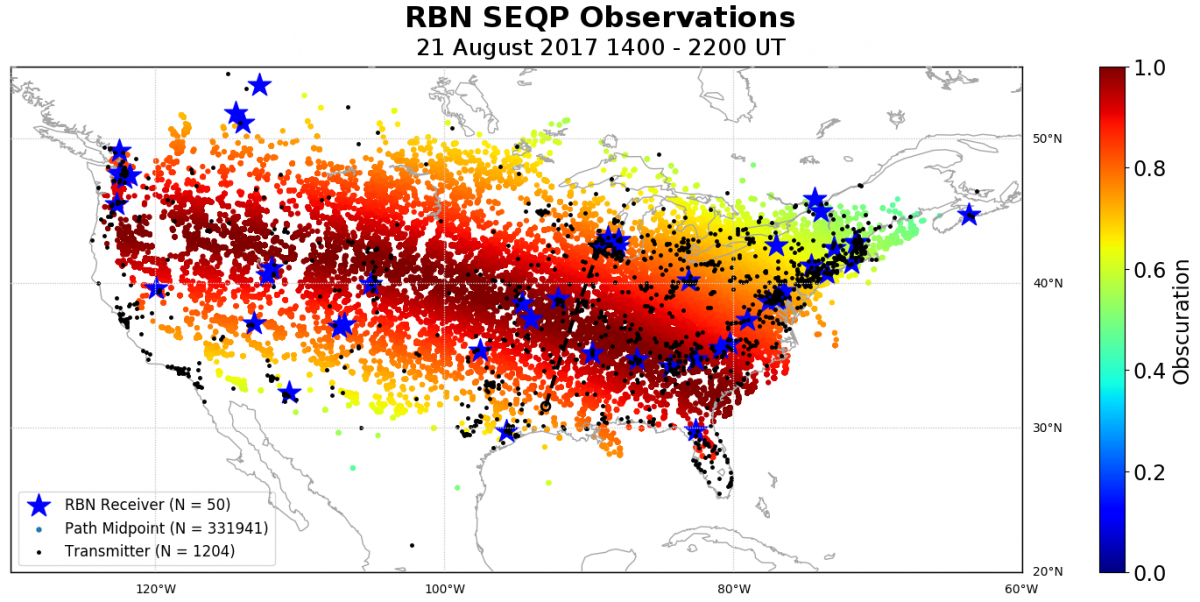
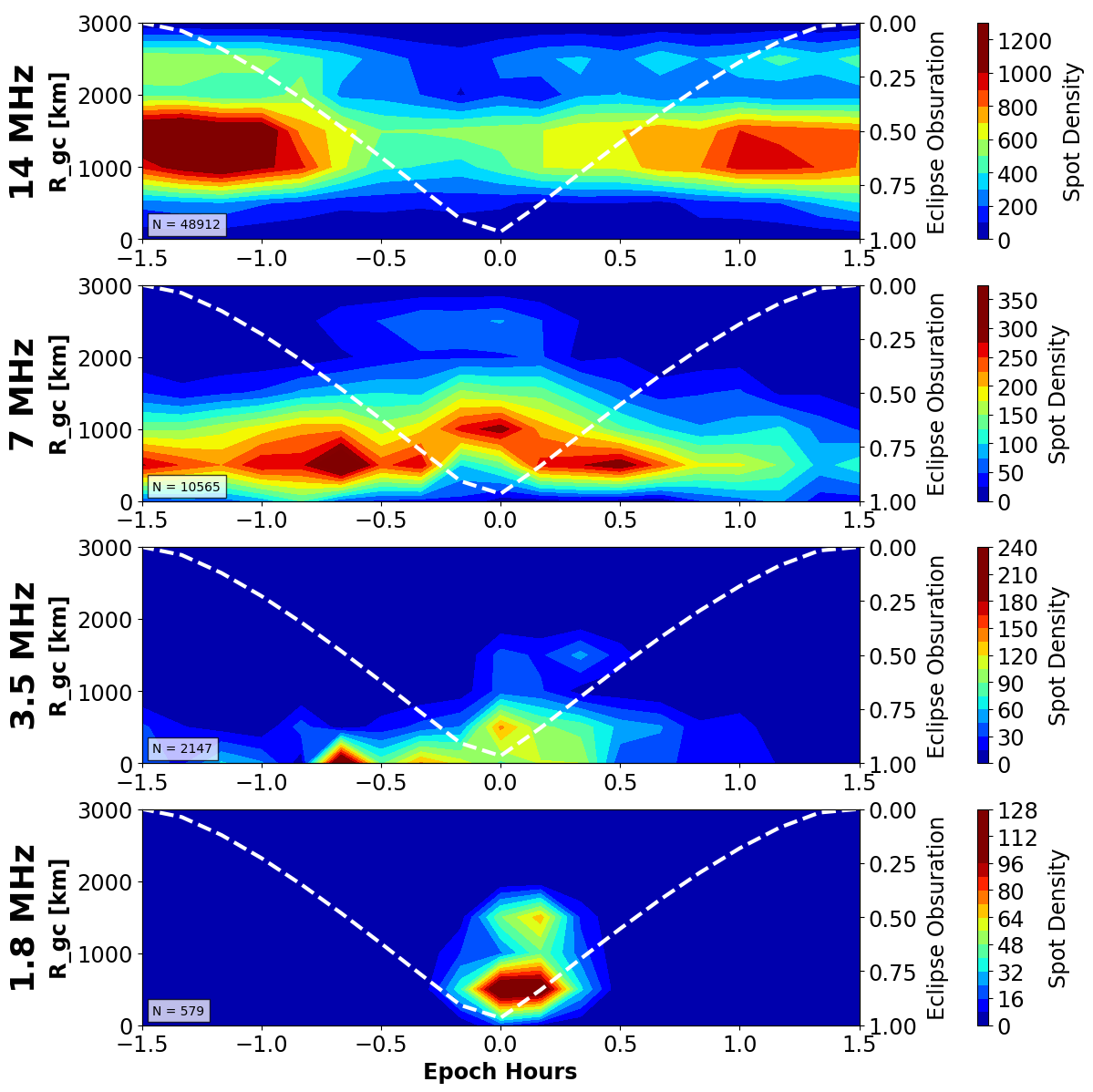
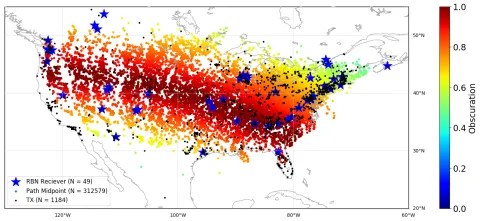
  • Initial SEQP Science Results using RBN data has been published by Frissell et al. (2018) in Geophysical Research Letters. The figures below are excerpts from the paper, showing RBN spot coverage during the SEQP and propapagtion effects relative to maximum eclipse time on the 1.8, 3.5, 7, and 14 MHz bands.

map.png

eclipse.png

SEQP Data and Software

Contest Results

The results are in! Congratulations to the top single operators, multi-operators, and RBN recievers. The SEQP was scored by W2NAF and K2AEM, with final write-up by N0AX. Thank you to all who participated!

Full results PDF: Solar Eclipse QSO Party - Full Results.pdf

SEQP Winners
  Single Op Total Score Multi-Op Total Score
1 AA3B
Bud Trench
Boyertown, PA
403,975 W0ECC
Elayer Contest Club
St. Charles, MO
(N0AX, N5OT, & KD0YJN)
191,625
2 K4BAI
John Laney, III
Columbus, GA
224,502 W0D
DeSoto, MO
(WB0SND & WB0TUA)
112,553
3 W1SJ
Mitchell Stern
Essex Junction, VT
180,882 W5GAD
Jefferson Amateur Radio Club
Metairie, LA
(N5LIT, KG5GJT, N5HZ, & NO5W)
93,651
Top RBN Receivers - 10,000+ Spots During SEQP
RBN Call # Spots Operator QTH
WE9V 54,874 Chad Kurszewski Bristol, WI
AA4VV 40,574 Thomas Berry

Lexington, NC

KU7T 31,762 Andreas Hofmann North Bend, WA
N4ZR-3 28,692 Pete Smith Phoenix, MD
NC7J 28,564 Utah Contest Club Layton, UT
W3OA 28,057 Dick Williams Mooresville, NC
N2GZ 18,623 Greg Zenger North Stonington, CT
N0TA 14,751 John Reilly Louisville, CO


The SEQP was coordinated by Nathaniel Frissell, W2NAF, at the New Jersey Institute for Technology Center for Solar Terrestrial Research (NJIT-CSTR) with support from the National Science Foundation grant AGS-1552188/479505-19C75 and the NJIT-CSTR. Thanks to the many collaborators, including those at Virginia Tech, Montclair State University, the MIT Haystack Observatory, the Johns Hopkins University Applied Physics Laboratory. Special thanks to the American Radio Relay League for publicizing the SEQP and the Reverse Beacon Network and PSKReporter for extra support in data collection.
njit_50h.jpg nsf_50h.jpg

Solar Eclipse QSO Party First Results Published

The first science results from the 21 August 2017 Solar Eclipse QSO Party have been published in the American Geophysical Union journal Geophysical Research LettersIn the paper, "Modeling Amateur Radio Soundings of the Ionospheric Response to the 2017 Great American Eclipse," Nathaniel Frissell, W2NAF, and team present Reverse Beacon Network (RBN) observations of the SEQP and compare them with raytracings through an eclipsed version of the physics-based ionospheric model SAMI3. On  14 MHz (20 m), eclipse effects were observed as a drop-off in communications for an hour before and after eclipse maximum. On 7 MHz (40 m), typical path lengths extended from about 500 km to 1000 km for 45 minutes before and after eclipse maximum. On 1.8 MHz (160 m) and 3.5 MHz (80 m), eclipse effects were observed as band openings 20 to 45 minutes around eclipse maximum.

By using raytracing to compare these observations with the SAMI3 model, it was found that the majority ofthe 14 MHz signals refracted off the ionosphere at heights less than 125 km (E region). On the lower bands, 1.8, 3.5, and 7 MHz, it was found that signals likely refracted off heights greater than 125 km (F region). These observations suggest an eclipse-induced weakening of the ionosphere, and are consistent with numerous prior HF radio eclipse ionospheric studies.

In total, the SEQP generated over 618,000 RBN spots, 630,000 WSPRNet spots, 1.2 million PSKReporter spots, and 29,000 log QSOs. This paper, along with the geolocated RBN data with solar eclipse obscuration values used in the paper, are being published under an open-access license to allow for further research. The data files can be found under the Supporting Information section of the paper. Additional HamSCI eclipse data can be found at https://zenodo.org/communities/hamsci.

Permanent link to SEQP Paper: https://doi.org/10.1029/2018GL077324

HamSCI at Hamvention 2018

UPDATE: Booth talk scheduled update 8 May 2018.

HamSCI will again be at the Dayton Hamvention, this year as part of the new Ham Radio 2.0: Innovation and Discovery area sponsored by the Yasme Foundation. Come visit the HamSCI Booth and Forum to learn about projects on the cutting of ham radio science and engineering research, including initial science results of the Solar Eclipse QSO Party (SEQP), the status of the Arecibo Observatory, the latest in understanding the causes of 6 meter sporadic E propagation, and how an inexpensive software defined radar for ionospheric studies works. Hamvention will be held May 18-20, 2018 at the Greene County Fairgrounds in Xenia, Ohio.

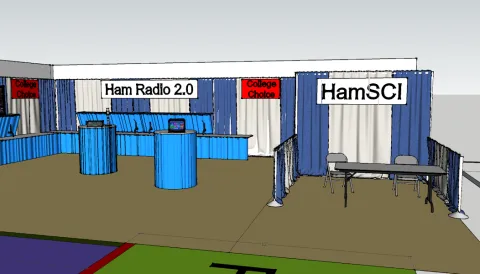
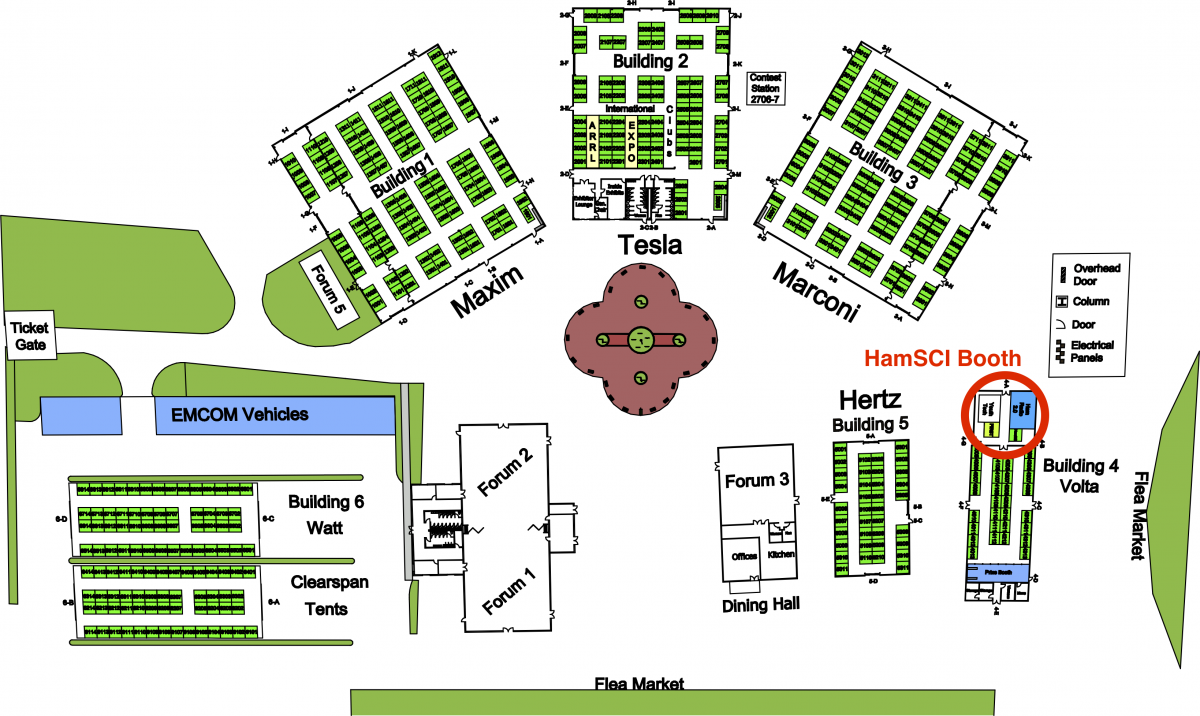
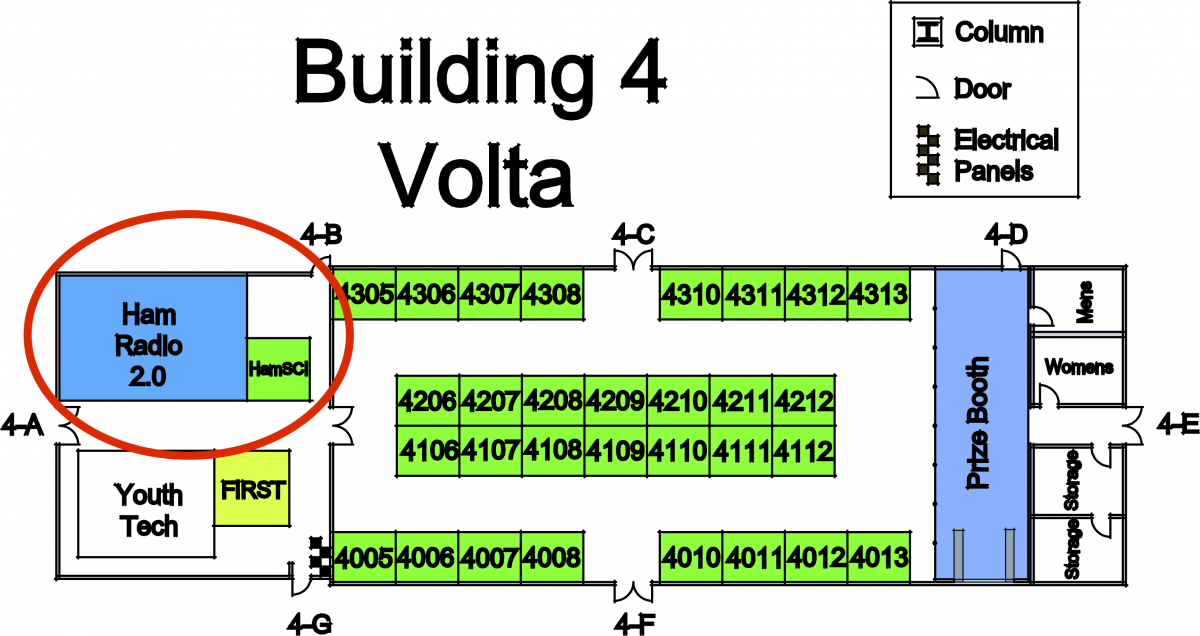
Most HamSCI activity will take place in at Booth 4304 in Building 4 (Volta), which is part of the Ham Radio 2.0: Innovation and Discovery area. Also known as 2.0 Row, this new area is intended to be a gathering spot for innovative groups and organizations. This year, both HamSCI and IARU Region 1 Youngsters on the Air (YOTA) are part of 2.0 Row, which is located close to the FIRST Robotics, the Society of Amateur Radio Astronomers, and the NASA Radio Jove Booths. You can meet many members of the HamSCI effort at the booth, including Nathaniel Frissell (W2NAF) of the New Jersey Institute of Technology, Carl (K9LA) and Vicky (AE9YL) Luetzelschwab, Phil Erickson (W1PJE) of the MIT Haystack Observatory, and Bob McGwier (N4HY) of Virginia Tech and AMSAT.

Booth talks will be a new feature this year, in which speakers will present on a diverse set of topics right in the Ham Radio 2.0 gathering area. Talks from both HamSCI and Ham Radio 2.0 will be interleaved. Some highlights include an eclipse ham radio ray tracing work by NJIT Student Josh Vega (WB2JSV), an eclipse SuperDARN study by Virginia Tech Student Magda Moses (KM4EGE), and the development of an inexpensive Software Defined Radar for Ionospheric Work by Bob McGwier (N4HY). Some additional topics include The FT8 Advantage by Carl Luetzelschwab (K9LA), ARHAB (Amateur Radio High Altitude Ballooning) and Balloon Data by William Brown (WB8ELK), and AMSAT Fox & Gold Satellites by AMSAT-NA Vice President for Engineering Jerry Buxton (N0JY). See below for the complete schedule.

On Saturday, the HamSCI Forum will take place in Forum Room 4 from 9:15 - 10:30 AM. Dr. Phil Erickson (W1PJE) of the MIT Haystack Observatory will present on the relationship between ham radio operators and space physicists, and how each can help each other. Angel Vazquez (WP3R), the Head of Telescope Operations and RFI and Spectrum Manager of the Arecibo Observatory will present on the status of Arecibo after the horrific hurricanes that took place in September 2017. Phil Erickson will present on Joe Dzekevich's (K1YOW) research on the relationship of winter 6 meter sporadic E and Jet Streams. Finally, Dr. Nathaniel Frissell (W2NAF) of NJIT will present on the initial scientific results of the 2017 Solar Eclipse QSO Party.

Support for the 2018 HamSCI Hamvention activities comes from the  New Jersey Institute of Technology Center for Solar-Terrestrial Research, the Yasme Foundation, the National Science Foundation, and the volunteers of HamSCI booth forum.

Hamvention 2017.jpg

HamSCI at Hamvention 2017


HamSCI Presentations

Booth Talks

Booth talks include both HamSCI and Ham Radio 2.0 Talks.

Friday Booth Talks

Friday, May 18, 2018 Group Title Presenter Organization Home QTH
9:15 AM HR 2.0 Broadband Digital Satellite Systems Michelle Thompson, W5NYV   San Diego, CA
10:00 AM HamSCI-50x11.png Ray Tracing and the Solar Eclipse QSO Party Josh Vega, WB2JSV NJIT Newark, NJ
11:00 AM HR 2.0 SatNOGS Automated Satellite Ground Stations Pierros Papadeas, SV1QVE SatNOGS Nea Filadelfeia, Greece
12:00 PM HR 2.0 The Internet Telegraph Scotty Cowling, WA2DFI TAPR Tempe, AZ
1:00 PM HR 2.0 NPOTA (National Parks On The Air) - First Steps Laura Steinberger, WZ8C   Traverse City, MI
2:00 PM HamSCI-50x11.png The FT8 Advantage Carl Luetzelschwab, K9LA   Fort Wayne, IN
3:00 PM HR 2.0 AMSAT Fox & Golf Satellites Jerry Buxton, N0JY AMSAT Granbury, TX
4:00 PM HR 2.0 Cool QSLs Jeffrey Murray, K1NSS   Saugerties, NY

Saturday Booth Talks

Saturday, May 19, 2018 Group Title Presenter Organization Home QTH
9:15 AM HR 2.0 Summits On The Air - SOTA Keith Schlottman, KR7RK   Tucson, AZ
10:00 AM HR 2.0 WSJT Modes
Ria Jairam, N2RJ
Dave Fisher, NX6D
 
Sussex, NJ
Pleasanton, CA
11:00 AM HR 2.0 ARDF with LIDAR data Matt Robbins, AA9YH   Cincinnati, OH
12:00 PM HamSCI-50x11.png SuperDARN Eclipse Results Magda Moses, KM4EGE Virginia Tech Blacksburg, VA
1:00 PM HR 2.0 ARHAB (Amateur Radio High Altitude Ballooning) and Balloon Data Bill Brown, WB8ELK ARHAB Madison, AL
2:00 PM HamSCI-50x11.png DX Display and the HARC Database Bill Engelke, AB4EJ University of Alabama Tuscaloosa, AL
3:00 PM HR 2.0 Real-time Contest Scoreboards Victor Androsov, VA2WA   Boucherville, QC
4:00 PM HamSCI-50x11.png Software Defined Ionospheric Radar Bob McGwier, N4HY Virginia Tech Blacksburg, VA

HamSCI Forum

Saturday, May 19, 2018, 9:15 AM - 10:30 AM, Forum Room 4
Saturday, May 19, 2018 Title Presenter Organization Home QTH
9:15 AM What is HamSCI? Nathaniel Frissell, W2NAF New Jersey Insititute of Technology Newark, NJ
9:20 AM The Bridge Between Radio Amateurs and Space Physicists Phil Erickson W1PJE MIT Haystack Observatory ​Westford, MA
9:35 AM After the Storms: Status of the Arecibo Radar/Radio Telescope Angel Vazquez, WP3R Arecibo Observatory Arecibo, Puerto Rico
9:50 AM 50 MHz Propagation: Winter Sporadic E and Jet Streams Joe Dzekevich K1YOW, Presented by Phil Erickson, W1PJE   Harvard, MA
10:05 AM Solar Eclipse QSO Party Results  Nathaniel Frissell, W2NAF New Jersey Institute of Technology Newark, NJ
10:25 AM Closing Remarks      

Booth Location

HamSCI will be at Booth 4304 in the Ham Radio 2.0: Innovation and Discovery Area.

Booths-Exhibits-Overview-2018v3-HamSCI.png

Booths-Building-4-2018v4-HamSCI.png

Questions?

If you have questions, please contact Nathaniel W2NAF at [email protected].

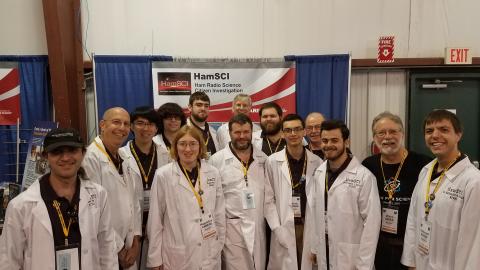
Hamvention 2018 HamSCI Team

Hamvention 2017.jpg

HamSCI at Hamvention 2017

Overview

HamSCI will be present at the 2018 Dayton Hamvention in order to further its goal of connecting the ham radio and scientific communities. Support for the 2018 HamSCI Hamvention activities comes from the  New Jersey Institute of Technology Center for Solar-Terrestrial Research, the Yasme Foundation, the National Science Foundation, and volunteers like you.

This year, HamSCI will host a booth in the new "Ham Radio 2.0: Innovation and Discovery" row, host booth talks and the HamSCI Forum, present Solar Eclipse QSO Party results at the Contest Dinner, and give a HamSCI overview in the TAPR Forum. To help out, please sign up to volunteer at the booth or offer to give a booth talk.

Booth Volunteering

Please use sign up to volunteer at the booth using the Doodle Poll. As a volunteer, we ask that you stand at the HamSCI booth and talk to booth vistors about HamSCI and your specific research interests. Feel free to bring demonstation items and materials and to talk about what you know best. The goal of HamSCI is to connect ham radio with scientific research. So, any topic that supports this goal is a good topic to talk about. The booth uniform are HamSCI labcoats, which can be purchased below.

Volunteer Sign-Up


Lab Coats

HamSCI labcoats may be ordered from http://www.allheart.com/product.aspx?p=nt1516. Please use custom logo code C_5163_Q5D and place the logo on the left chest. Put your whole name on Line 1, and your call sign on Line 2. Use block style lettering.

Example Order

Natural Uniforms Unisex 41" Lab Coat
Item #: NT-1516---WHTLGE
Color: WHT White
Size: LGE
Personalization - Left Chest
  Embroidery Style: Block Style
  Thread Color: Black
  Letter Height: 1/2 inch (25 characters)
  Text Line #1: Dr. Nathaniel A. Frissell
  Custom Emblem: C_5163_Q5D
  Text Line #2: W2NAF

Exhibitor Badges

If you are volunteering at the booth or giving a talk, you may purchase an exhibitor badge for $20. These badges give you full access to the Hamvention, including the set-up and break-down times. However, these badges will not enter you in the prize drawings the way a normal Hamvention ticket will. If you would like an exhibitor badge, please e-mail Nathaniel W2NAF at [email protected] to be added to the list. You can pay for and pick up your badge at the Inside Exhibits Office in Building 2 at the Hamvention. The Inside Exhibits Office hours can be found here: http://hamvention.org/wp-content/uploads/2018/03/Inside_Exhibits_Hours_2018_v1.pdf.

HamSCI Presentations

Booth Talks

Booth talks include both HamSCI and Ham Radio 2.0 Talks.

Friday Booth Talks

Friday, May 18, 2018 Group Title Presenter Organization Home QTH
9:15 AM HR 2.0 Broadband Digital Satellite Systems Michelle Thompson, W5NYV   San Diego, CA
10:00 AM HamSCI-50x11.png Ray Tracing and the Solar Eclipse QSO Party Josh Vega, WB2JSV NJIT Newark, NJ
11:00 AM HR 2.0 SatNOGS Automated Satellite Ground Stations Pierros Papadeas, SV1QVE SatNOGS Nea Filadelfeia, Greece
12:00 PM HR 2.0 The Internet Telegraph Scotty Cowling, WA2DFI TAPR Tempe, AZ
1:00 PM HR 2.0 NPOTA (National Parks On The Air) - First Steps Laura Steinberger, WZ8C   Traverse City, MI
2:00 PM HamSCI-50x11.png The FT8 Advantage Carl Luetzelschwab, K9LA   Fort Wayne, IN
3:00 PM HR 2.0 AMSAT Fox & Golf Satellites Jerry Buxton, N0JY AMSAT Granbury, TX
4:00 PM HR 2.0 Cool QSLs Jeffrey Murray, K1NSS   Saugerties, NY

Saturday Booth Talks

Saturday, May 19, 2018 Group Title Presenter Organization Home QTH
9:15 AM HR 2.0 Summits On The Air - SOTA Keith Schlottman, KR7RK   Tucson, AZ
10:00 AM HR 2.0 WSJT Modes
Ria Jairam, N2RJ
Dave Fisher, NX6D
 
Sussex, NJ
Pleasanton, CA
11:00 AM HR 2.0 ARDF with LIDAR data Matt Robbins, AA9YH   Cincinnati, OH
12:00 PM HamSCI-50x11.png SuperDARN Eclipse Results Magda Moses, KM4EGE Virginia Tech Blacksburg, VA
1:00 PM HR 2.0 ARHAB (Amateur Radio High Altitude Ballooning) and Balloon Data Bill Brown, WB8ELK ARHAB Madison, AL
2:00 PM HamSCI-50x11.png DX Display and the HARC Database Bill Engelke, AB4EJ University of Alabama Tuscaloosa, AL
3:00 PM HR 2.0 Real-time Contest Scoreboards Victor Androsov, VA2WA   Boucherville, QC
4:00 PM HamSCI-50x11.png Software Defined Ionospheric Radar Bob McGwier, N4HY Virginia Tech Blacksburg, VA
 

HamSCI Forum

Saturday, May 19, 2018, 9:15 AM - 10:30 AM, Forum Room 4
Saturday, May 19, 2018 Title Presenter Organization Home QTH
9:15 AM What is HamSCI? Nathaniel Frissell, W2NAF New Jersey Insititute of Technology Newark, NJ
9:20 AM The Bridge Between Radio Amateurs and Space Physicists
Phil Erickson W1PJE
MIT Haystack Observatory
Westford, MA
9:35 AM After the Storms: Status of the Arecibo Radar/Radio Telescope Angel Vazquez, WP3R Arecibo Observatory Arecibo, Puerto Rico
9:50 AM 50 MHz Propagation: Winter Sporadic E and Jet Streams Joe Dzekevich K1YOW, Presented by Phil Erickson, W1PJE   Harvard, MA
10:05 AM Solar Eclipse QSO Party Results  Nathaniel Frissell, W2NAF New Jersey Institute of Technology Newark, NJ
10:25 AM Closing Remarks      

Booth Location

HamSCI will be at Booth 4304 in the Ham Radio 2.0: Innovation and Discovery Area.

Booths-Exhibits-Overview-2018v3-HamSCI.png

Booths-Building-4-2018v4-HamSCI.png

Questions?

If you have questions, please contact Nathaniel W2NAF at [email protected].

Microwave Update 2018 Call for Papers

From John Ackermann, N8UR

Microwave Update (MUD) is an international conference dedicated to microwave equipment design, construction, and operation. It is focused on, but not limited to, amateur radio on the microwave bands. The Midwest VHF/UHF Society is pleased to host this year's event. The conference will be held at the Holiday Inn, 2800 Presidential Drive, Fairborn, Ohio 45324 from October 11 - 14, 2018.

Call for Presentations and Papers: The program committee is calling for papers and presentations on the technical and operational aspects of microwave amateur radio communications. Tell us about your latest project, design or operating adventures. Please e-mail your proposals, questions, and submissions to John Ackermann, N8UR, at [email protected]. Don't wait until the beginning of September to let us know what you're planning!

Presentations selected for the technical program may be given in person or by proxy. Please send an abstract and expected duration no later than August 25, 2018 so that we can determine and announce the program agenda the following week. Ideally, send your draft presentation by the same date. We encourage presenters to submit a companion paper for publication in the proceedings book. This paper would ideally be text based and expand on the presentation slides, but a simple copy of the slides is also okay. Either way, this material must be received no later than September 1, 2018 to be included in the book. Additional material (presentation slides, schematics, source code, more text, background info, etc.) to be included on the proceedings CD must arrive no later than September 25, 2018.  All conference attendees will receive a copy of the book and CD.

Full details, including suggested topics, paper guidelines, schedule, and hotel information can be found on the MUD website: www.microwaveupdate.org.

Microwave Update 2018
Dayton, Ohio, October 11 – 14, 2018
Holiday Inn, Fairborn, Ohio
www.microwaveupdate.org
 

NJIT Hosts 2018 HamSCI Workshop

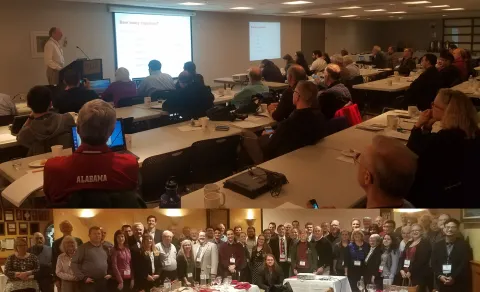
The 2018 HamSCI Workshop held at the New Jersey Institute of Technology (NJIT) February 23-24, 2018 brought together hams and space scientists from across the United States, Canada, and Great Britain. With over 60 people in attendance, presentations included results from the 2017 Great American Eclipse, ideas for a personal space weather station, and other amateur radio-space science experiments and projects.

Friday focused on techniques and methods for collecting and analyzing large-scale amateur radio data, as well as results of the eclipse experiments. Bill Engelke, AB4EJ, of the University of Alabama presented on the HamSCI Amateur Radio Communications (HARC) database and DX Display System that unifies Reverse Beacon Network (RBN), WSPRNet, and the NASA OMNI space physics databases. Philip Gladstone, N1DQ, the founder and owner of the PSKReporter system, shared insights into the PSKReporter system architecture and the impacts of the new FT8 digital mode. Dr. Ethan Miller, K8GU, of the Johns Hopkins University Applied Physics Laboratory, showed techniques for using RBN observations to estimate ionospheric maximum usable frequency (MUF) and foF2 critical frequencies.

The solar eclipse presentations included results that incorporated many different measurement techniques. The Solar Eclipse QSO party generated a number of studies of amateur HF propagation presented by NJIT, Virginia Tech, the Marshall Space Flight Center, and amateur contributors. These presentations showed that in addition to propagation effects related to the expected decrease in ionospheric densities during the eclipse such as a decrease in 14 MHz signal strengths, a lengthening of 7 MHz ray paths, and an increase in the number of 1.8 and 3.5 MHz contacts, subtler effects were also observed. This includes Doppler shifts at LF and HF relating to the changing propagation path lengths as the eclipse passed overhead. Presentations using professional instrumentation systems such as GPS Total Electron Content (GPS-TEC) Monitoring systems and Incoherent Scatter Radar (ISR) were presented by scientists Dr. Anthea Coster and Dr. Larisa Goncharenko from the MIT Haystack Observatory. They showed evidence of bow waves generation by the eclipse, as well as an upwelling of electrons from the ionosphere into the plasmasphere, which hours after the eclipse returned to the ionosphere to produce higher than normal electron densities.

On Friday night, Dr. Philip Erickson, W1PJE, of the MIT Haystack Observatory gave the keynote address at the workshop banquet. Dr. Erickson reviewed the science and engineering accomplishments of many of the key figures in the CQ Hall of Fame and presented open questions that could be addressed by future ham radio-science collaborations.

In order to help hams and scientists speak the same language, Ethan Miller opened the Saturday program with a tutorial entitled “Space Physics for Radio Amateurs and Ham Radio for Space Physicists.” This talk highlighted the capabilities of ham radio operators and the interesting propagation that they enjoy. Next, Dr. Ben Witvliet, PE5B/M0IJQ, a long-time ham who recently earned his Ph.D. studying Near Vertical Incidence Skywave (NVIS) propagation, summarized his findings in a talk entitled “NVIS Field research in Spain: Science or Adventure?” Following this, Dr. Gareth Perry of the University of Calgary present results from an experiment where he used the CASSIOPE satellite to listen to Field Day 2015 signals and provides an explanation for the fast variability observed in received signal power.

Saturday afternoon presentations presented ideas for developing a personal Space Weather Station. This is a device that a ham could install at their station to make measurements such as ionospheric absorption, geomagnetic field variation, lightning detection, HF propagation and phase measurements. Dr. Nathaniel Frissell, W2NAF, of NJIT presented an overview vision of what this station may look like. This was followed by presentations from the University of Oklahoma, Dartmouth College, NJIT, and the Tucson Amateur Packet Radio Corporation (TAPR) giving more detailed descriptions of how to make these measurements and why they should be made. Steve Bible, N7HPR, TAPR President, discussed the steps for bringing a product from idea to design to shippable product and provided examples from the TAPR history.

Case Western Reserve Amateur Radio Club, W8EDU, brought four students and two advisors to the HamSCI meeting. During the demo room period, they demonstrated the laboratory exercise they developed, “A Hut on Phasors Legs”. This lab is for the examination of analog signals simultaneously in the time, frequency and phasor domains, as well as demodulated audio. Students from the NJIT Amateur Radio Club provided tours of the NJIT ARC Station, K2MFF. Next, University of Iowa graduate student and amateur radio club president Arya Afshari, KE0CHS, presented his work on “Turbulence in the Magnetosheath: Solar Wind - Magnetosphere Interactions,” which showed hams science from the region of space where the solar wind encounters the Earth’s magnetosphere. To close out the meeting, Kai Chen, K2TRW, and Bill Engelke, AB4EJ, presented on the newer Digital Mobile Radio (DMR) and FT8 radio modes.

The 2018 HamSCI meeting was hosted by the New Jersey Institute of Technology Center for Solar-Terrestrial Research. Once collected from the presenters, PDFs of the presentations will be available for download at the 2018 HamSCI Workshop Agenda page.

Related:

Gain Measurement of a UHF Yagi Antenna

By Ben Witvliet, PE5B/M0IJQ

This method is very useful for radio amateurs that want to measure the absolute antenna gain of their high gain UHF Yagi antenna. It does NOT need a calibrated reference antenna and the measurement can be done with an SDR receiver or other measurement equipment. Also, the antenna "phase center" (equivalent power center would probably be more accurate) can been found directly from the measured data. No fancy calculations are needed, original calculations were all done in Excel. Measurement accuracy could be improved by creating a range with a laser distance meter, although time to do this was not available during the original development of this technique.

Personal Space Weather Station (archival - 2017-2024)

Please Note:  The current PSWS pages are here on the HamSCI.org website


PSWS Overview

ThePersonal Space Weather Station project ultimately aims to create a small, multi-instrument system that can make ground-based measurements of the space environment.  The observations from this project will not only be useful to the owner of the system, but also aggregated into a central database for space science and space weather research purporses. Initial work focuses on the development of a scientific-grade high frequency (HF) radio receiver, as well as the necessary software and network infrastructure. This project is led by the The University of Scranton, in collaboration with the Tucson Amateur Packet Radio, Inc. (TAPR)Case Western Reserve University / Case Amateur Radio Club W8EDU, the University of Alabama, the New Jersey Institute of Technology Center for Solar Terrestrial Research (NJIT-CSTR), and the Massachusetts Institute of Technology Haystack Observatory.

PSWS Components

The Personal Space Weather Station is a modular system, with each module being developed by a different team. Visit the links below to learn about the different parts of the PSWS.


Research Questions

The PSWS project is motivated by questions both from the amateur radio and science communities.

Science Questions

  • How does the ionosphere respond to inputs from space and from the neutral atmosphere?
  • How does the ionosphere couple with the neutral atmosphere and with space?
  • What are the sources of medium and large scale traveling ionospheric disturbances?
  • What are the causes of Sporadic E?

Amateur Radio Questions

  • How do disturbances such as solar flares, geomagnetic storms, and traveling ionospheric disturbances affect radio wave propagation?
  • How does ionospheric science help amateur radio operators improve communications?
  • How can I make measurements in my own backyard that will help improve my amateur radio operations?

Get Involved

We are always looking for new people to get involved! Projects include system design and testing, data acquistion, and data analysis. Visit our Get Involved page to learn how to join the HamSCI Community.

PSWS Resource Links

Please visit the Space Weather Station Working Page for a variety of links and resources related to the HamSCI PSWS Project.

Acknowledgments

We gratefully thank the many volunteers who make this project run, as well as the support of National Science Foundation Grants AGS-2002278, AGS-1932997, and AGS-1932972.


Bibliography of Ham Radio in Professional Scientific Literature

  • This page is only for peer-reviewed, scientific publications that use amateur radio data or techniques.
  • For a bibliography of HamSCI generated material, including conference presentations and magazine articles, please go to our Publications Page.
  • To submit a reference, please use the HamSCI Peer Reviewed Literature Search form.

Submit Article Recommendation


Peer Reviewed Journal Articles

Chartier, A., Steele, J., Sugar G., Themens, D., Vines, S., Huba, J., "Validating Ionospheric Models Against Technologically Relevant Metrics", Space Weather, vol. 21, no. 12, https://doi.org/10.1029/2023SW003590

Collins, K., A. Montare, N. Frissell and D. Kazdan, "Citizen Scientists Conduct Distributed Doppler Measurement for Ionospheric Remote Sensing," in IEEE Geoscience and Remote Sensing Letters, vol. 19, pp. 1-5, 2022, Art no. 3504605, doi: 10.1109/LGRS.2021.3063361.

Collins, K., Kazdan, D., and Frissell, N. A. (2021), Ham radio forms a planet-sized space weather sensor network, Eos, 102, https://doi.org/10.1029/2021EO154389.

Cushley, A. C., & Noel, J.-M. (2020). Ionospheric sounding and tomography using Automatic Identification System (AIS) and other signals of opportunity. Radio Science, 55, e2019RS006872. https://doi.org/10.1029/2019RS006872

Deacon, C., Witvliet, B. A., Mitchell, C., & Steendam, S. (2021). Rapid and Accurate Measurement of Polarization and Fading of Weak VHF Signals Obliquely Reflected from Sporadic-E Layers. IEEE Transactions on Antennas and Propagation, 69(7), 4033-4048. https://doi.org/10.1109/TAP.2020.3044654

Deacon, Chris, Cathryn Mitchell, and Robert Watson. 2022. "Consolidated Amateur Radio Signal Reports as Indicators of Intense Sporadic E Layers" Atmosphere 13, no. 6: 906. https://doi.org/10.3390/atmos13060906

Dora, V. della. (2023). From the Radio Shack to the Cosmos: Listening to Sputnik during the International Geophysical Year (1957–1958). Isis, 114(1), 123–149. https://doi.org/10.1086/723592

Robert T. Duquet (1959) Meteorology and Amateur Radio, Weatherwise, 12:3, 104-108, DOI: 10.1080/00431672.1959.10543798

Ferrell, O. Enhanced Trans-Equatorial Propagation following Geomagnetic Storms. Nature 167, 811–812 (1951). https://doi.org/10.1038/167811a0

Frissell, N. A., E. S. Miller, S. R. Kaeppler, F. Ceglia, D. Pascoe, N. Sinanis, P. Smith, R. Williams, and A. Shovkoplyas (2014), Ionospheric sounding using real-time amateur radio reporting networks, Space Weather, doi:10.1002/2014SW001132.

Frissell N.A. et al.. (2018), Modeling Amateur Radio Soundings of the Ionospheric Response to the 2017 Great American Eclipse, Geophys. Res. Lett., 45, doi:10.1029/2018GL077324.

Frissell, N. A., Vega, J. S., Markowitz, E., Gerrard, A. J., Engelke, W. D., Erickson, P. J., et al (2019). High Frequency Communications Response to Solar Activity in September 2017 as Observed by Amateur Radio Networks. Space Weather, 17. https://doi.org/10.1029/2018SW002008.

Frissell, N. A., Kaeppler, S. R., Sanchez, D. F., Perry, G. W., Engelke, W. D., Erickson, P. J., et al. (2022). First observations of large scale traveling ionospheric disturbances using automated amateur radio receiving networks. Geophysical Research Letters, 49, e2022GL097879. https://doi.org/10.1029/2022GL097879.

Gerson, N.C.,Sporadic E propagation, Journal of Atmospheric and Terrestrial Physics, Volume 6, Issues 1–6, 1955, Pages 113-116,ISSN 0021-9169, doi:10.1016/0021-9169(55)90016-7.

Gibbons, J., Collins, K., Kazdan, D., & Frissell, N. (2022). Grape Version 1: First prototype of the low-cost personal space weather station receiver. HardwareX, 11, e00289. https://doi.org/10.1016/J.OHX.2022.E00289

Kennedy, J. R., and J. J. Schauble (1970), Preliminary results of a radio absorption study at 3.5 mhz, Nature, 226, 1118, doi:10.1038/2261118a0.

Lo, Sam, Nikola Rankov, Cathryn Mitchell, Benjamin Axel Witvliet, Talini Pinto Jayawardena, Gary Bust, William Liles, and Gwyn Griffiths. 2022. "A Systematic Study of 7 MHz Greyline Propagation Using Amateur Radio Beacon Signals" Atmosphere 13, no. 8: 1340. https://doi.org/10.3390/atmos13081340https://www.mdpi.com/2073-4433/13/8/1340

Perry, G. W., Frissell, N. A., Miller, E. S., Moses, M., Shovkoplyas, A., Howarth, A. D., & Yau, A. W. (2018). Citizen radio science: an analysis of Amateur Radio transmissions with e‐POP RRI. Radio Science, 53. https://doi.org/10.1029/2017RS006496. Free preprint: http://hamsci.org/sites/default/files/publications/Perryetal_HamRadio_2017_rev2.1.pdf.

Smith Jr. Ernest K., (1968), A Suggested Conjugate Point Dependence for Intense Temperate Latitude Sporadic E, Radio Science, 3, doi:10.1002/rds196837687. (See Figure 1.)

Southworth, M. P. (1960), Night-time equatorial propagation at 50 Mc/s: First results from an IGY amateur observing program, J. Geophys. Res., 65( 2), 601– 607, doi:10.1029/JZ065i002p00601.

Vanhamel, Jurgen, Walter Machiels, Hervé Lamy, "Using the WSPR Mode for Antenna Performance Evaluation and Propagation Assessment on the 160-m Band", International Journal of Antennas and Propagation, vol. 2022, Article ID 4809313, 10 pages, 2022. https://doi.org/10.1155/2022/4809313.

Walden, M. C. (2012), Comparison of propagation predictions and measurements for midlatitude HF near-vertical incidence sky wave links at 5 MHz, Radio Sci., 47, RS0L09, doi:10.1029/2011RS004914.

Walden, M. C. "High-Frequency Near Vertical Incidence Skywave Propagation: Findings associated with the 5 MHz Experiment.," in IEEE Antennas and Propagation Magazine, vol. 58, no. 6, pp. 16-28, Dec. 2016, doi:10.1109/MAP.2016.2609798.

Witvliet, BA, RM Alsina-Pagès, "Radio communication via Near Vertical Incidence Skywave propagation: an overview," Springer Telecommunication Systems, 2017, doi:10.1007/s11235-017-0287-2.

Witvliet, BA, E van Maanen, GJ Petersen, AJ Westenberg, "Impact of a solar X-flare on NVIS propagation: daytime characteristic wave refraction and nighttime scattering," IEEE Antennas and Propagation Magazine 58 (6): 29-37, 2016, doi:10.1109/MAP.2016.2609678.
 
Witvliet, BA, E van Maanen, GJ Petersen, AJ Westenberg, MJ Bentum, "Near Vertical Incidence Skywave propagation: elevation angles and optimum antenna height for horizontal dipole antennas," IEEE Antennas and Propagation Magazine 57 (1): 129-146, 2015, doi:10.1109/MAP.2015.2397071.

Witvliet, BA, E van Maanen, GJ Petersen, AJ Westenberg, MJ Bentum, "Measuring the isolation of the circularly polarized characteristic waves in NVIS propagation [Measurements Corner]," IEEE Antennas and Propagation Magazine 57 (3): 120-145, 2015, doi:10.1109/MAP.2015.2445633.

Peer Reviewed Conference Papers

Liles, W., Mitchell, C., Cohen, M., Earle, G., Frissell, N., Kirby-Patel, K., Lukes, L., Miller, E., Moses, M., Nelson, J., and Rockway, J., “On the use of solar eclipses to study the ionosphere”, in 15th International Ionospheric Effects Symposium IES2017, Alexandria, VA, 2017, URL: http://hamsci.org/publications/use-solar-eclipses-study-ionosphere.

Walden, MC, "Comparison of Propagation Predictions and Measurements for Mid-Latitude HF NVIS Links at 5 MHz", 13th International Ionospheric Effects Symposium (IES2011), Alexandria, VA, USA, 17-19 May 2011 (This conference paper formed the basis for the paper in Radio Science.)

Walden, MC, "A comparison of measurements and propagation simulations for mid-latitude HF NVIS links at 5 MHz during sunspot minima", 9th Nordic HF Conference (HF 10), Faro, Sweden, 17-19 August 2010, URI: http://www.nordichf.org/index.htm?hf10/invitation.htm&2.

Walden, MC, "The extraordinary wave mode: Neglected in current practical literature for HF NVIS communications", IET 11th International Conference on Ionospheric Radio Systems and Techniques (IRST 2009), Edinburgh, UK, 28-30 April 2009.
doi:10.1049/cp.2009.0028.

Witvliet, BA, GJ Laanstra, E van Maanen, RM Alsina-Pagès, MJ Bentum, CH Slump, R Schiphorst, "A transportable hybrid antenna-transmitter system for the generation of elliptically polarized waves for NVIS propagation research," European Conference on Antennas and Propagation (EuCAP), Davos, Switzerland, 2016, doi:10.1109/EuCAP.2016.7481549.

Witvliet, BA, E van Maanen, GJ Petersen, AJ Westenberg, MJ Bentum, "Characteristic wave diversity in Near Vertical Incidence Skywave propagation," European Conference on Antennas and Propagation (EuCAP), Lisbon, Portugal, 2015, URI: http://ieeexplore.ieee.org/document/7228318.
 
Witvliet, BA, E van Maanen, MJ Bentum, CH Slump, R Schiphorst, "A novel method for the evaluation of polarization and hemisphere coverage of HF radio noise measurement antennas," IEEE International Symposium on Electromagnetic Compatibility (EMC), Dresden, Germany, 2015, doi:10.1109/ISEMC.2015.7256174.
 
Witvliet, BA, E van Maanen, GJ Petersen, AJ Westenberg, MJ Bentum, "The  importance of circular polarization for diversity reception and MIMO in NVIS propagation," European Conference on Antennas and Propagation (EuCAP), The Hague, The Netherlands, 2014, doi:10.1109/EuCAP.2014.6902407.

Witvliet, BA, E van Maanen, MJ Bentum, CH Slump, R Schiphorst, "Novel method to measure the gain of UHF directional antennas using distance scan," European Conference on Antennas and Propagation (EuCAP), Den Haag, The Netherlands, 2014, doi:10.1109/EuCAP.2014.6901775.

PhD Dissertations

Frissell, N.A., Ionospheric Disturbances: Midlatitude Pi2 Magnetospheric ULF Pulsations and Medium Scale Traveling Ionospheric Disturbances, PhD Dissertation, Virginia Tech, Blacksburg, Virginia, 2016, URI: https://vtechworks.lib.vt.edu/handle/10919/74976.

Witvliet, BA, Near Vertical Incidence Skywave - Interaction of antenna and propagation mechanism, PhD dissertation, University of Twente, Enschede, The Netherlands: 1-200, 2015, doi:10.3990/1.9789036539388.

Masters Theses

Kasturi, Prajwal M., "Determination of Ionospheric Current Systems by Measuring the Phase Shift on Amateur Satellite Frequencies" (2013). All Graduate Theses and Dissertations. 1521, https://digitalcommons.usu.edu/etd/1521.

Other Professional Publications

Collins, K.,Kazdan, D., and Frissell, N. A. (2021), Ham radio forms a planet-sized space weather sensor network, Eos, 102, https://doi.org/10.1029/2021EO154389. Published on 09 February 2021.

HamSCI Workshop 2018 Registration Open

Registration for the 2018 HamSCI Workshop is now open! The workshop will be held February 23-24, 2018 at the New Jersey Institute of Technology in Newark, NJ and seeks to bring together the amateur radio community and professional scientists. Anyone interested in this workshop is invited to join. This year, the workshop will focus on results of the 2017 Great American Eclipse ham radio ionospheric experiments (including SEQP results) and the development of a Personal Space Weather station.
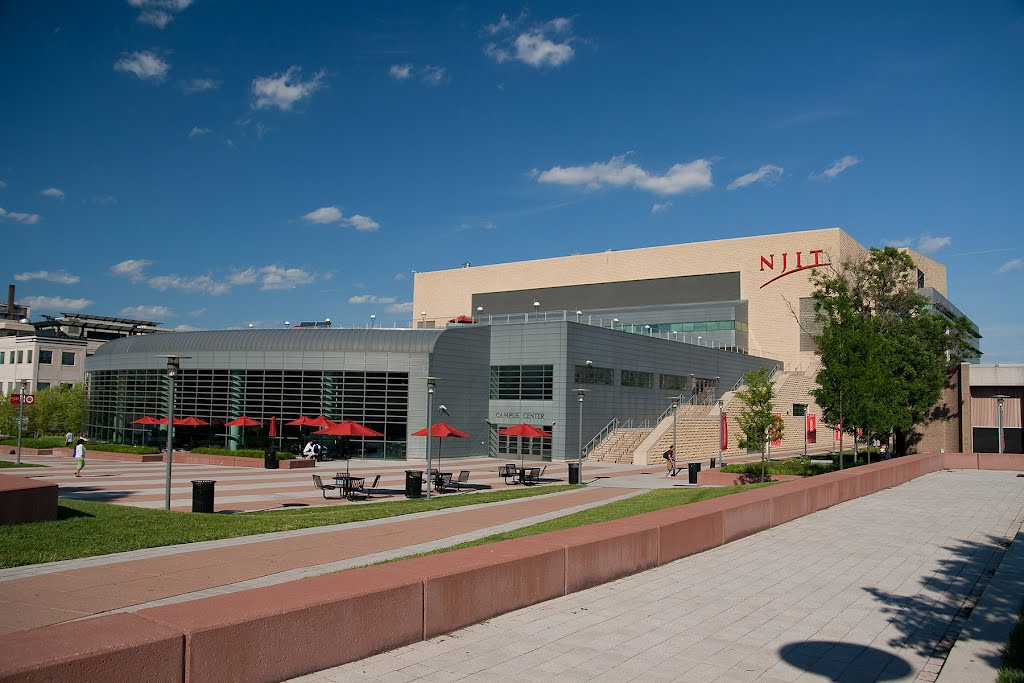
Do you have something to present? We are especially looking for speakers with presentations showing analysis of 2017 Great American Eclipse ionospheric observations, ideas and proposals for the design and implementation of a personal space weather station. We will also accept other presentations related to amateur radio and science. Presentations will likely be between 20 to 30 minutes long. If you would like to present, please e-mail your abstract to Nathaniel Frissell, W2NAF at [email protected] by February 15, 2018.

For more information and to register, please visit the HamSCI Workshop 2018 page.


Visit the HamSCI Workshop 2018 Homepage

HamSCI Workshop 2018 Agenda

Main workshop page: http://hamsci.org/hamsci2018

Location: NJIT Campus Center, 2nd Floor, Ballroom B

Friday, February 23, 2018

Friday, February 23, 2018 Title Presenter Organization Home QTH
7:30 AM Breakfast/Registration - Campus Center Ballroom B      
8:30 AM Welcome Nathaniel A. Frissell, W2NAF and Andrew J. Gerrard, KD2MCQ NJIT Center for Solar-Terrestrial Research Newark, NJ
9:00 AM DX Spots and NASA OMNI Data: First Look at H.A.R.C. Database William Engelke, AB4EJ University of Alabama Tuscaloosa, AL
9:20 AM PSKReporter and the Impact of FT8 Philip Gladstone, N1DQ PSKReporter Carlisle, MA
9:40 AM Learning About Propagation Using 40m WSPR and Flat-Earth Calculations Jay Taft, K1EHZ   Bedford, NH
10:00 AM The Ionosphere's Pocket Litter: Sounding the Ionosphere with the RBN Ethan S. Miller, K8GU Johns Hopkins University Applied Physics Laboratory Laurel, MD
10:20 AM Coffee Break      
10:40 AM Citizen Science Observations of Ionospheric Propagation Effects During the 21 August 2017 Great American Eclipse Nathaniel A. Frissell, W2NAF NJIT Center for Solar-Terrestrial Research Newark, NJ
11:00 AM Eclipse Radio Science at Marshall Space Flight Center Ghee Fry, WL7C NASA Marshall Space Flight Center Huntsville, AL
11:20 AM Ham Radio Activities at Marshall Space Flight Center during the 2017 Total Solar Eclipse Jesse McTernan, KN4EZR NASA Marshall Space Flight Center Huntsville, AL
11:40 AM Wideband Recording of the Solar Eclipse: Listen Now, Analyze Later John Ackermann, N8UR TAPR Dayton, OH
12:00 PM Lunch - Campus Center Atrium      
1:10 PM Eclipse Science at the Club Level: A local radio club's experiences in and around the eclipse J. W. "Skip" Youngberg, K1NKR Nashoba Valley ARC Tyngsborough, MA
1:30 PM Observing the 2017 Great American Eclipse with Simple HF Sensors Ethan S. Miller, K8GU Johns Hopkins University Applied Physics Laboratory Laurel, MD
1:50 PM WSPR Propagation During the 2017 Solar Eclipse Jay Taft, K1EHZ   Bedford, NH
2:10 PM A Brief Review of Ray Tracers and Ionospheric Models Stephen R. Kaeppler, AD0AE Clemson University Clemson, SC
2:30 PM Developing a Solar Eclipse Simulation for Greater Good: The Next Iteration Joshua S. Vega, WB2JSV NJIT Center for Solar-Terrestrial Research Newark, NJ
2:50 PM Coffee Break      
3:20 PM Crowdsourced Lessons Learned from the 2017 Solar Eclipse LF Exercise William Liles, NQ6Z   Reston, VA
3:40 PM

Solar Eclipse Effects on LF Propagation

John A. Magliacane, KD2BD   Sea Girt, NJ
4:00 PM

Ionospheric Signatures of the 21 August 2017 Solar Eclipse

Anthea Coster Haystack Observatory, Massachusetts Institute of Technology Westford, MA
4:20 PM Mid-Latitude Ionospheric Response to the Solar Eclipse of August 21, 2017: What do we learn from solar eclipse studies? Larisa Goncharenko Haystack Observatory, Massachusetts Institute of Technology Westford, MA
4:40 PM HF Band Observations and Modeling of the 2017 Eclipse Lee Kordella, KM4MBL Virginia Tech Blacksburg, VA
7:00 PM Banquet at Iberia Peninsula      
  Keynote Address: Toward A New Frontier: Advancing Radio Remote Sensing and Geospace Science With The Help of Amateur Radio, Then, Now, and in the Future Philip J. Erickson, W1PJE Haystack Observatory, Massachusetts Institute of Technology Westford, MA

Saturday, February 24, 2018

Saturday, February 24, 2018 Title Presenter Organization Home QTH
7:30 AM Breakfast/Registration - Campus Center Ballroom B      
8:30 AM Welcome Nathaniel A. Frissell, W2NAF NJIT Center for Solar-Terrestrial Research Newark, NJ
9:00 AM Invited Tutorial: Space Physics for Radio Amateurs and Ham Radio for Space Physicists Ethan S. Miller, K8GU Johns Hopkins University Applied Physics Laboratory Laurel, MD
10:00 AM NVIS Field research in Spain: Science or Adventure? Ben A. Witvliet, PE5B/M0IJQ University of Bath Bath, United Kingdom
10:30 AM Coffee Break      
10:50 AM Citizen radio science: An analysis of Amateur Radio transmissions with e-POP RRI Gareth Perry Department of Physics and Astronomy, University of Calgary Calgary, AB, Canada
11:10 AM Ideas for a Personal Space Weather Station Nathaniel A. Frissell, W2NAF NJIT Center for Solar-Terrestrial Research Newark, NJ
11:30 AM Lightning Detection Techniques and Objectives Gerry Creager, N5JXS Cooperative Institute for Mesoscale Meteorological Studies, University of Oklahoma Norman, OK
11:50 AM What can ground magnetometers tell us? Hyomin Kim, KD2MCR NJIT Center for Solar-Terrestrial Research Newark, NJ
12:10 PM What is the NJIT Center for Solar-Terrestrial Research? Andrew J. Gerrard, KD2MCQ NJIT Center for Solar-Terrestrial Research Newark, NJ
12:30 PM Lunch - Campus Center Atrium      
1:00 PM K2MFF Open House and Demo Rooms      
  Tour of K2MFF (Campus Center Room 230) K2MFF Club Members New Jersey Institute of Technology Newark, NJ
  Lab Demonstration: The Hut on Phasor's Legs (Campus Center Room 235) Kristina Collins, KD8OXT Case Western Reserve University Cleveland, OH
  Lab Demonstration (Campus Center Room 230) Bob Melville (WB3EFT) and Andy Stillinger (WA2DKJ) NJIT Center for Solar-Terrestrial Research Newark, NJ
2:00 PM A Low-Cost SDR Platform for Receiving AM Broadcast Stations for Ionospheric Research David McGaw, N1HAC Dartmouth College Hanover, NH
2:20 PM Wideband Recording Tools, VHF Beacon Net, and Pitaya Frequency Stability John Ackermann, N8UR TAPR Dayton, OH
2:40 PM

From Idea to Manufacturing: Uncovering the steps for success

Steve Bible, N7HPR TAPR Chandler, AZ
3:00 PM Lessons Learned from the Citizens Weather Observing Program (CWOP) Gerry Creager, N5JXS Cooperative Institute for Mesoscale Meteorological Studies, University of Oklahoma Norman, OK
3:20 PM Coffee Break      
3:40 PM Turbulence in the Magnetosheath: Solar Wind - Magnetosphere Interactions Arya S. Afshari, KE0CHS University of Iowa Iowa City, IA
4:00 PM DMR as an Emerging Digital Voice Communications Mode via Amateur Radio Kai Chen, K2TRW   Dumont, NJ
4:20 PM FT8 Image Mode William Engelke, AB4EJ University of Alabama Tuscaloosa, AL
4:40 PM Presentation/Discussion      
5:00 PM Closing Remarks Nathaniel A. Frissell, W2NAF New Jersey Institute of Technology Newark, NJ

HamSCI Workshop 2018

k2mff.png


Come join HamSCI at its inaugeral workshop! The workshop will be held February 23-24, 2018 at the New Jersey Institute of Technology in Newark, NJ and seeks to bring together the amateur radio community and professional scientists. Anyone interested in this workshop is invited to join.

Cost and Registration

  • Friday Registration: $100 (Includes Breakfast, Lunch, and Banquet Ticket)
  • Saturday Registration: $25 (Includes Breakfast, Lunch)
  • Friday Banquet Ticket Only: $50

Register Now!

Program

The 2018 HamSCI workshop will focus on results of the 2017 Great American Eclipse and the development of a Personal Space Weather station.

View Agenda and PDFs of Talks

Call for Speakers

We are especially looking for speakers with presentations showing analysis of 2017 Great American Eclipse ionospheric observations, ideas and proposals for the design and implementation of a personal space weather station. We will also accept other presentations related to amateur radio and science. Presentations will likely be between 20 to 30 minutes long. If you would like to present, please e-mail your abstract to Nathaniel Frissell, W2NAF at [email protected] by February 15, 2018.


Meeting Location and Parking

The 2018 HamSCI Workshop will be held in the NJIT Campus Center Ballroom. Complimentary parking parking is available at the NJIT Parking Deck at 154 Summit Street, Newark, NJ 07102. To access the deck, turn onto Colden Street (one way) from Warrren Street. Once you enter the deck, press the red call button and tell the attendant you are here for the HamSCI meeting.

hamsci2018-map.png

View Full NJIT Maps


njit_campus_center.jpg

NJIT Campus Center (Photo by Kung-E Cheng)

Breakfasts, Lunches, and Friday Banquet

Breakfasts, lunches, and coffee breaks are included with registration for both Friday and Saturday. Special dietary needs can be specified when registering.

The Friday Banquet Dinner begins at 7:00 PM at the fine local Iberia Peninsula Restaurant, with keynote speaker Dr. Philip Erickson, W1PJE, of the MIT Haystack Observatory. Banquet tickets are included with Friday registration. Separate/additional banquet tickets may be purchased for $50 each.

The banquet menu includes:

  • Shrimp Garlic
  • Paella Marinheira
  • Stuffed Fillet of Fish
  • Portuguese Roast Pork
  • BBQ Chicken
  • Portuguese Sausage "Flambe"
  • Clams Casino
  • Jumbo Octopus Salad
  • Roast Potatoes
  • Mixed Vegetables
  • Rice
  • Fried Calamari
  • Tossed Salad
  • Chicken Marsala
  • Baked Ziti
  • Flan
  • Fruit Basket
  • Cheesecake
  • House Desserts
  • Sangria
  • Wine
  • Beer
  • Soft Drinks
  • Coffee & Tea

Lodging

A block of hotel rooms has been reserved at the Robert Treat Hotel, a 0.8 mile walk from the NJIT Campus Center. You may also take the Newark Light Rail from the Miliary Park Station to the Warren Street (NJIT) station for the $0.75 undergound station fare.

For the nights of February 22, 23, and 24, 2018, rooms at the Robert Treat Hotel are available at the NJIT nightly rate of $109 plus 15.125% tax for a King or Queen room. To reserve a room, please call (973) 622-1000 and reference the group by name “HamSCI Workshop" (Group #1219). To guarantee lodging at this rate, please reserve by Februrary 2, 2018.

Flight Information and Ground Transportation

Easy access to NJIT and the HamSCI meeting is available through Newark Liberty International Airport (EWR). Numerous ground transportation options from the airport exists, including taxi and train. To access the meeting by from EWR by train, take the Air Train from EWR to Penn Station Newark (15 minutes) and then transfer to the Newark Light Rail. You can then take the light to the Millitary Park Station for the Robert Treat Hotel, or Warren Street Station for NJIT.

Questions?

If you have questions, please contact Nathaniel Frissell, W2NAF, at [email protected] or (937) 787-4506.

"Upper-Level Lows and 6-Meter Sporadic E" Published in QST

Using 6-meter QSO spot data from www.dxmaps.com, HamSCI member Joe Dzekevich, K1YOW, has found correlations of 6-meter sporadic E and Upper-Level Low pressure systems. His findings are now published in the December 2012 QST (reprinted with permission from the ARRL).
 
In his article, amateur radio is used to explore possible correlations between weather storm systems and sporadic E clouds to see if they are collocated. While some of the main causes of sporadic E propagation are wind shear, meteor strikes and upper atmospheric tides (ultimately coming from solar EUV energy inputs), radio operators have noticed that sporadic E propagation is also changed significantly by hurricanes and storms.  Specific cases where K1YOW used amateur radio to investigate the effects of low pressure weather storms on the formation and/or enhancement of 6 meter sporadic E clouds are presented. DX Maps and earth wide weather model charts combined with operations on 6 meters are used to examine possible correlations between the location of the sporadic E clouds and the low pressure weather storm systems.  Initial findings show a high degree of correlation when magnetic field strength is taken into consideration.