Publications

GRAPE 2 fldigi - Overview, Specifications, Sourcing

G2 Complete Asbly 2024-02-15 cropped.png 2024-04-08 AF8A Grape 1 Total Eclipse Grape1 fldigi plot.jpg

Overview

The three-channel GRAPE 2 Doppler Monitor (fldigi version) is a key component of the HamSCI Personal Space Weather Station (PSWS).  It could be considered the 'next generation' of GRAPE receiver, released just prior to the April 8, 2024 North American solar Eclipse.   It is used for receiving, analyzing and recording of signals from frequency standard stations such as WWV/H and CHU. The PSWS project involves monitoring changes in the Earth's ionosphere through measurements of Doppler frequency shifts on a 24/7 basis. 

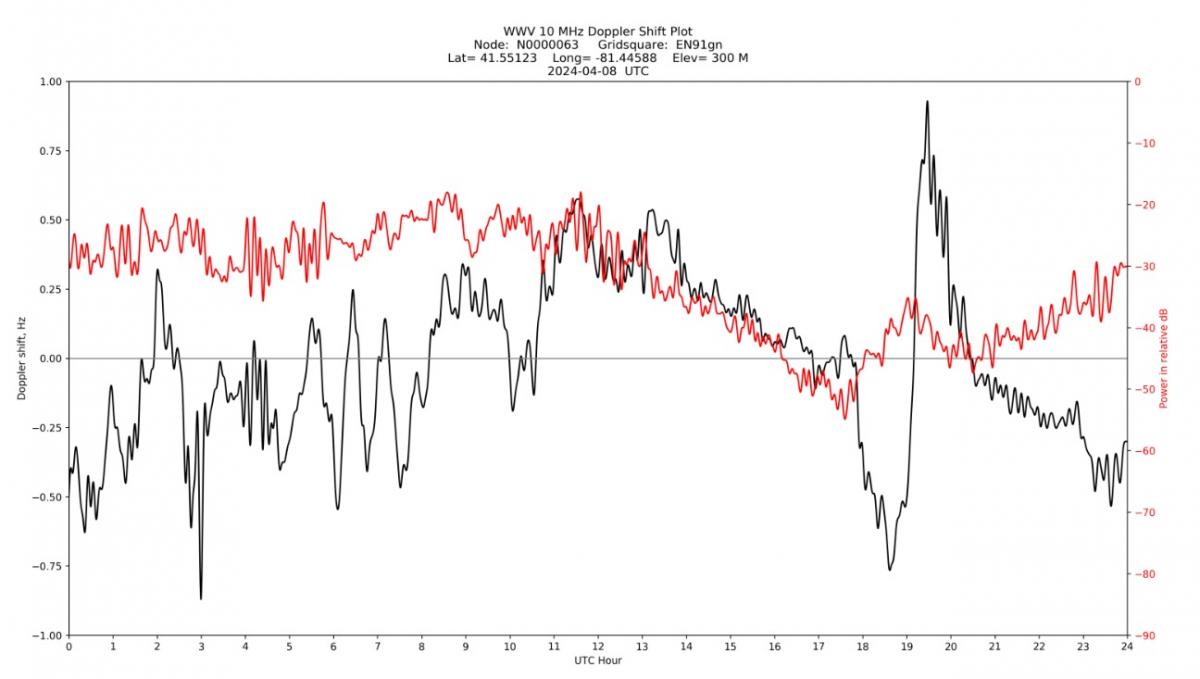
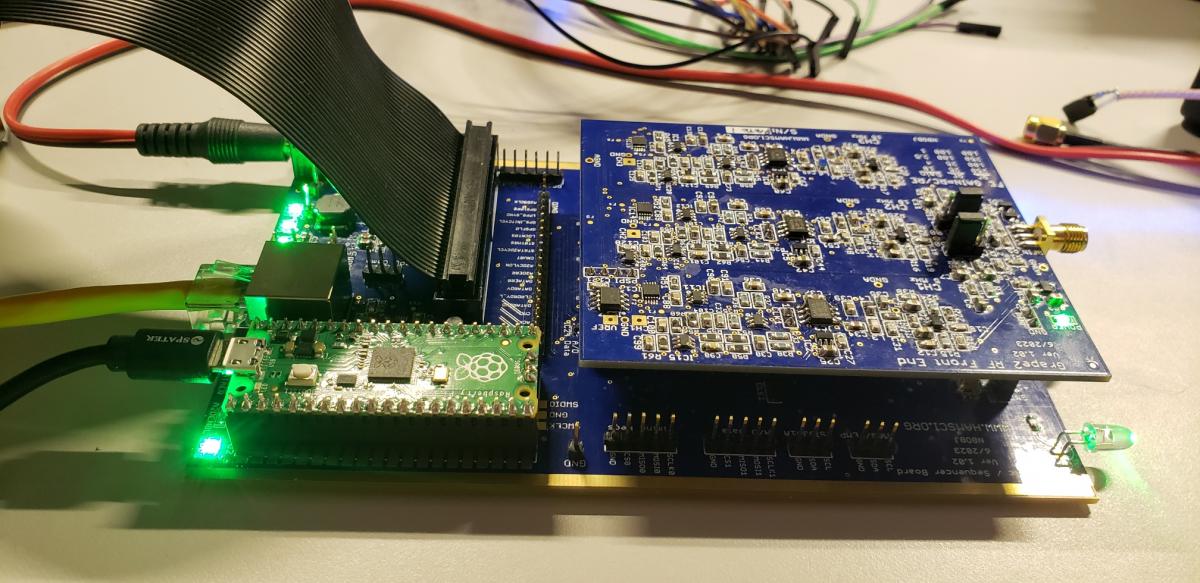
The Grape 2 could be considered the 'big brother' of the GRAPE PSWS family. It is capable of receiving three frequencies simultaneously, utilizing a GPS disciplined oscillator for making precise frequency measurements.  A complete GRAPE 2 PSWS system (as pictured above) consists of the following: Grape 2 Receiver and Logic PC boards, Teensy microcontroller, Raspberry Pi 4, external hard drive, power supply and two antennas, one for the GPS and one for the time standard frequencies. Ideally, every Grape 2 should have access to a reasonably fast (>100Mb/S) Internet connection for data uploads. There is a provision to buffer and transmit buffered data at a later time if the connection is lost. Data collected by the GRAPE 2 is intended to be uploaded on a daily basis to a HamSCI server.   The data collected by a Grape 2 can be used to generate plots of Doppler shift vs. UTC hour.  A sample plot from  April 8, 2024 (the date of the recent North American total solar eclipse) appears above.  (The solar eclipse's effect on the ionosphere is clearly visible between about 1800 and 2100 UTC.)

Specifications

Purpose Three frequency, low-IF receiver, used for measuring Doppler shift while receiving frequency standard stations such as WWV/H or CHU.  Data is useful for studying bottom side motion of the ionosphere.
Frequency Selections 2.5, 5.0, 10.0 or 15.0 MHz (reduced though very acceptable performance on 3.33, 7.58 or 14.36 MHz)
Frequency Stability As stable as the Leo Bodnar GPS disciplined oscillator, approaching 1x10-12 
Sensitivity Under review
Dynamic Range Under review
Received Bandwidth Under review
Current Hardware Version 1.0.  No further revisions or production is planned.
Required Computer Raspberry Pi 4B, 8 GB memory
Operating System Raspbian OS
Required software fldigi, a ham radio modem application, numerous GRAPE-specific shell scripts
Data Repository The GRAPE 2 fldigi data is freely accessible, available in the HamSCI Community on Zenodo.org 


Grape 2 User Manual

The Grape 2 User Manual Version 1.2 was sent out in March of 2024, as part of the original deployment. It can be found here on the HamSCI website.

Sourcing

Approximately 30 GRAPE 2s were manufactured and tested late in Q1, 2024. They were deployed in accordance with terms of the grants which funded the project: A map of the stations appears on this page. They were on line and uploading data during the April 8, 2024 North American total solar eclipse. It is HamSCI's expectation that all will be kept running, on a 24/7/365 basis, for years to come, studying the behavior of the ionosphere during Solar Cycle 25. Further, some GRAPE 2 installations included remote magnetometer boards, used to measure minute changes in the Earth's magnetic field. That data was sent to the same HamSCI server.

Occasionally, units are returned to HamSCI for redeployment.  If you are interested in hosting a grand-funded GRAPE 2, please send your contact info, including location (grid square and city/state/province) to [email protected].  Note that grantees are expected to have basic Linux experience, an HF (shortwave) antenna, and common computing peripherals (USB keyboard/mouse, monitor) and an Internet connection for daily data uploads. Of course, we can't guarantee availability but we are very interested in having as many systems running as possible.

Grape 2 Update - Disk Drive Swap - March/April, 2025

While some data was uploaded to HamSCI data collection servers on a daily basis (a very narrow band of digitized audio, centered 1 kHz below the three time station carriers received) a great deal more data (~3KHz bandwidth, ~10.4GB per day) was captured and stored locally on each Grape 2's hard drive.  The 4TB drives are filling up, so new drives are being provided to each Grape 2 host.  We ask that you follow this procedure to make the swap.  Questions are best raised to the HamSCI Grape Google Group.  Provisions have been made for hosts to ship the old drives to the University of Alabama, where the data will be extracted and uploaded to the PSWS Central Control System.

Further Information


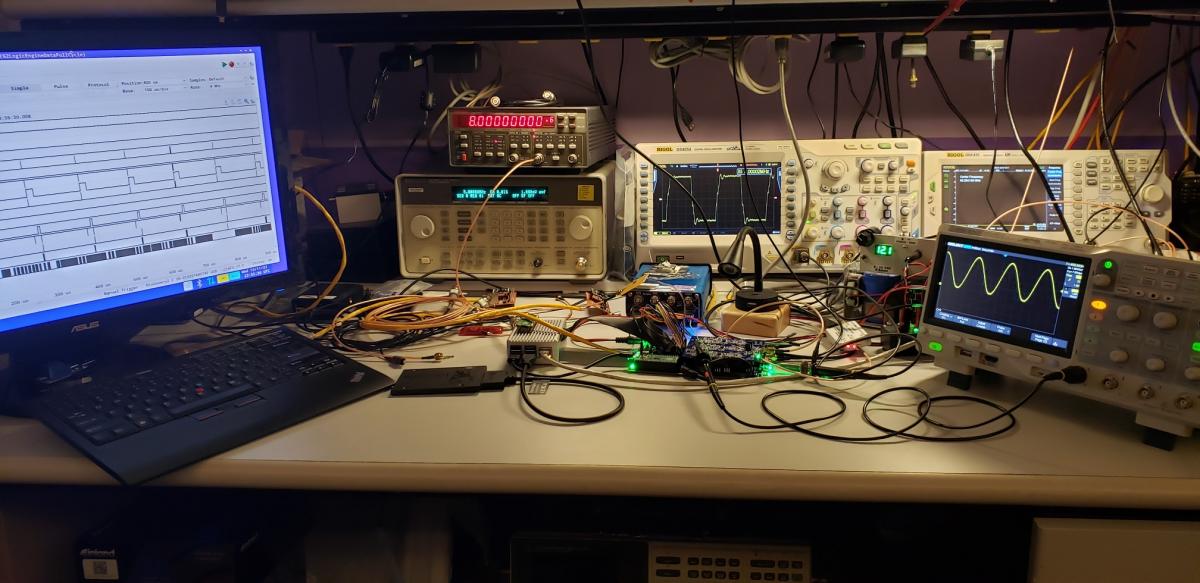
Images of the Grape 2 under development at the bench of John Gibbons, N8OBJ:

G2DevSetup.jpeg
G2Running.jpeg


Grape 2 Hosts

30 Grape Version 2s were deployed prior to the April 8, 2024 total solar eclipse over North America.  The host stations are shown on this map.


Credits

The Grape Version 2 was designed by John Gibbons, N8OBJ, Lab Director of the Sears Undergraduate Electrical Design Lab, Case Western Reserve University, Department of Electrical Engineering. Software applications were written by Bill Blackwell, AB1XB and Cuong Nguyen, KC3UAX. The remote magnetometer board was designed, built and provided to host stations by David Witten, KD0EAG. Dr. Nathaniel Frissell, W2NAF, was the Principal Investigator on National Science Foundation grant 2230345 ('Collaborative Research: CEDAR: Measuring Daily Ionospheric Variability and the 2023 & 2024 Solar Eclipse Ionospheric Impacts Using HamSCI HF Doppler Shift Receivers'). Their efforts were supported by additional NSF grants (2002278, 1922972, 1932997, 2230346) and these institutions:

hamsci_collaboration.png


17 October 2025:  Updated PSWS CCS URL - af8a

Design/Build Details for the Grape 1 Low IF Radio Receiver

This page accompanies descriptions of the following PSWS components

Design Documentation for the GRAPE 1 Low IF Receiver PC Board

​Grape V1.11 Block Diagram: PSWS_GrapeLowCostBlockDiagram.pdf

Grape V1.12 Schematic:  WWV_Radio_V1_12_sch.pdf

Additional design details are on this Mendeley site:  data.mendeley.com/datasets/nbbhy2yxmz.  It holds mostly 'low level' documentation, such as PC board manufacturing files (top, bottom traces, solder mask, lettering), PSWS File Name Requirements, Fldigi source code, the Python routines which make the Grape 1 PSWS 'run' on a daily basis, and more.   Some of the details are for earlier versions of hardware and software, so read carefully if you visit this site.

Building the GRAPE 1 PSWS

Building the a GRAPE 1 PSWS is not as easy as the old HealthKits used to be.  For starters, there is no kit of components.  The instructions are fairly complete, but they are not 'cookbook style'.  It will take some digging and planning on the part of the builder.  Fortunately, help is not far away:  Join the hamsci-psws Google group and you'll find many others who've 'been there, done that' and who can help you if you get stuck.  You can also navigate over to the Google group and 'search' on any topic or question you might have.  It's possible that the answer you are looking for will appear in the search results!

Note:  The Grape 1, like many open source projects, is a work in progress.  The Grape documentation was begun in 2022 and has been updated many times (for new hardware, new software) right up to today.  Here it is separated into the most current (Grape 1.12) and older documentation, which, while not correct in every detail, is still quite useful.  See note above on hamsci-psws Google group - the group members are a wonderful resource.

Grape V1.12: Bare PC Board Ordering Link from OSHPark.com:  oshpark.com/shared_projects/9Z2fhMYW

Grape V1.12: PC Board Bill of Material (BOM):  WWV_Radio_V1_12_bom.txt

Grape V1.12: PC Board BOM Components Order Link from DigiKey.com:  www.digikey.com/short/cqdvrhjf

Grape V1.12: How to Request a Node Number: See Step #65 in this document:  MakeGrape1OSImageV1_05.pdf

Grape V1.12: STL File for a 3D printed case to hold a Grape 1.12 receiver PC board, courtesy of John Hysell, K2HJ:  Grape Case rev2.1.stl (most resent mod as of 29 March, added opening for frequency selection jumper)

Grape V1.12: One Ham's Perspective on Building a Grape from scratch. This paper contains good explanations of the fldigi waterfall and the daily graph of Doppler shift and received signal strengthK4BSE_Grape 1.12 Document v1-2.pdf

Grape PSWS Fldigi System Component List(GPSDO, Audio interface, Raspberry Pi, cabling, etc.): GrapeGen1_SuppliesList.pdf

Obtaining the Grape PSWS Raspberry Pi Image File:  Navigate to Zenodo, www.doi.org/10.5281/zenodo.8305995   You will find a very large file called Grape1_OSGen1E.img. Download the file and follow Installing the Gen1E Grape Image instructions (see below) to burn the image onto an SD Card.

Installing the Gen1E Grape 1 Image and Configuring the Raspberry Pi: A step by step procedure that covers everything from burning the image onto an SD card to setting up your Raspberry Pi on a wifi network to uploading data to the Grape1 fldigi data repository: MakeGrape1OSImageV1_05.pdf

Grape Build Instructions, Testing, System Assembly and Operation:   Hardware X Paper on Grape 1 (2022). NOTE:  This document was written for a previous hardware version, so the PC board component lists, schematics and file names are not accurate for the V1.12 PCB.  However, the majority of the instructions in Sections 5, 6 and 7 do apply to version 1.12. (An on-line version of the paper is available at doi.org/10.1016/j.ohx.2022.e00289 )

Credits

The Grape Version 1 was designed by John Gibbons, N8OBJ, Lab Director of the Sears Undergraduate Electrical Design Lab, Case Western Reserve University, Department of Electrical Engineering. Please see the Grape 1 Contributors page for acknowledgement of the entire Grape 1 team.

The HamSCI Personal Space Weather Station project is led The University of Scranton Department of Physics and Engineering W3USR, in collaboration with Case Western Reserve University W8EDU, the University of Alabama, the New Jersey Institute of Technology Center for Solar Terrestrial Physics K2MFF, the MIT Haystack ObservatoryTAPR, additional collaborating universities and institutions, and volunteer members of the amateur radio and citizen science communities. HamSCI wishes to acknowledge National Science Foundation grants AGS-2002278, AGS-2230345, AGS-1932997, AGS-2230346, AGS-1932972 for support of the PSWS project.

Grape Institutions.png


The Grape Personal Space Weather Station (PSWS) (Archival)

This page is an archival copy of the GRAPE PSWS page from the 2020-2023 era.  We suggest you visit the latest HamSCI PSWS pages for current information


The Grape* PSWS Project - A Distributed Array of Software Defined Receivers 

The HamSCI Personal Space Weather Station (PSWS) Project is making available, to the radio hobbyist and space physics communities, a distributed array of Low IF radio receivers. They are designed with a specific purpose in mind:  Recording changes in the Earth's ionosphere through measurements of Doppler frequency shifts observed by monitoring, on a 24/7 basis, frequency standard stations such as WWV/H and CHU.

Ham radio operators and other shortwave enthusiasts are encouraged to host Grape receivers at their stations from now until well after the total North American solar eclipse on April 8, 2024.  Hosting involves providing reliable power, space for an antenna and an Internet connection.  Other factors come into play, such as the need for visibility to the constellation of GPS satellites.

The science behind the Grape PSWS project is described below.  In short, the array of Grape PSWS receive signals from the frequency standard stations, make extremely accurate measurements of the received frequency, record and then upload the data.  Measurements accuracies are in the milliHertz range.  Space physicists and citizen scientists can then use those measurements to study the effects of solar phenomena (e.g., flares, CMEs and eclipses) on the ionosphere.   

*Why is it called 'Grape'?  Because it is the Great Radio Amateur Propagation Experiment, and because Grapes work best in 'bunches' - the more deployed to the field, the better!


Grape 1 fldigi and Grape 1 DRF:  Single-Channel Receivers

Grape 1s are designed for DIY enthusiasts. The single-frequency receiver portion is built by the user on a PC board using surface mount components. The user then has to obtain and assemble the system components, such as a GPS disciplined oscillator, a Raspberry Pi, USB audio interface, power supply, storage medium and antenna. All components are readily available and thoroughly documented. Note that Grapes are like any hardware/software based product; they have evolved  over time and there are multiple versions in use. 

  1. The first Grape systems run a highly modified version of fldigi software.  Dozens are in use, collecting data on a 24/7/365 basis. Each system uploads data, once per day, to a server hosted by the WWV ARC. Grape fldigi data has been collected since 2019. Those Grapes provide valuable data and are expected to keep running throughout 2023 and 2024.  Construction and software details, along with information on initiating the data collection and uploading processes, are on the Grape 1 page. 
  2. Grape 1 systems running GNU Radio software, collecting data in the Digital Radio Format, was released in September of 2023.  It is the first Grape model to upload data to the Personal Space Weather Station Central Control System.  Construction details are located on the Grape 1 page, while guides to the software, data collection methods and more are on the Grape 1 DRF documentation page.  

The Grape 2 Multi-Channel Receiver

The Grape 2 is more sophisticated 3-channel receiver. However, the extra complexity requires that the PC boards be commercially built. Over 30 Grape 2s were deployed prior to the April 8, 2024 total solar eclipse over North America.  Details, photos and a map of the host stations are on the Grape 2 web page.


Please note that the Grape Low IF radios are not general purpose receivers. They are designed to receive signals only on frequencies pertinent to the research.


How Can I Participate?

HamSCI strongly encourages anyone with interest and/or experience in the areas of shortwave radio reception, kit building, system assembly, single-board computer application to read through the details on the Grape 1 and 2 and decide which approach would be best for you.

  1. Grape 1 sites require no registration beyond requesting a node number for uploading data to the a central server (data repository). Directions for obtaining a node number are on the Grape 1 page.
  2. Approximately 30 Grape 2 sites were funded through research grants.  All have been deployed.  There are no plans for building additional units, though that could change in the future. 

All Grape participants should join the hamsci-grape Google Group.  All are welcome to participate in weekly Grape Zoom calls to share hints, hacks, and results.  Questions are always welcome - if you have a question, chances are that many others have the same question - the community is very welcoming in that regard.  (The Zoom calls are recorded and made available on the HamSCI YouTube channel.)

The Science Behind the Grape PSWS Project

The following is an abbreviated summary of the science behind the Grape PSWS network and how the Grape creates valuable data for scientific study.  It is recommended that the reader follow the links at the end of this section to gain a full understanding of the concepts described here.   Before diving in, it would be helpful to understand Doppler effect, and also to be aware of the HamSCI glossary.

Scientific Interests

The PSWS network has proven to be useful in the study of short-term (lasting hours to days) geophysical and solar events, such as traveling ionospheric disturbances, solar flares, solar eclipses and geomagnetic storms.  It does so by observing the bottom side of the ionosphere.  Data from PSWS member stations, often combined with observations from other scientific instruments, yields clues as to how and why those events impact HF (high-frequency, 3–30 MHz) radio wave propagation.  The data can also be used to improve mathematical models of the ionosphere, which should result in more accurate predictions of HF propagation (such as maps of the MUF and critical frequencies). 

Role of the Grape PSWS

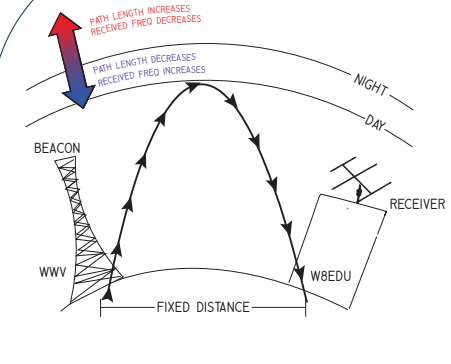
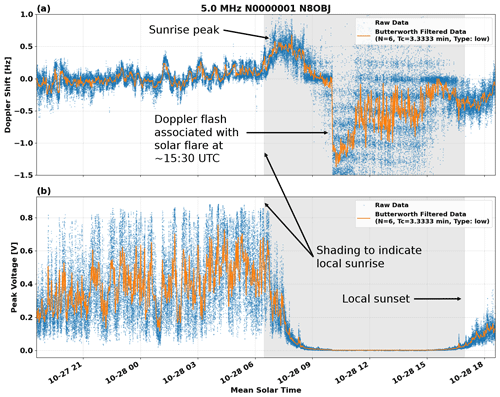
HF Doppler sounding is an established means of observing the bottom side of the ionosphere. Its principle of operation is straightforward: A shift in signal path length causes a corresponding Doppler shift (Figure 1). The Grape receiver performs Doppler measurements by measuring the carrier freqency of frequency standard stations such as WWV/H (or CHU). Their transmit frequency accuracy and stability is less than one part in 10^13 - an incredibly small value.  Measurements of the WWV/H frequency at a distant receiver site is limited by a few factors, one of which is the receiver’s accuracy and stability, the other is the propagation path.  The former is well accounted for in the design of the PSWS, the latter is the primary measurement of interest.  In other words, those who study the PSWS measurements are not overly concerned about the absolute value of the receive frequency, but they are extremely interested in the variation of the received frequency over time (typical PSWS datasets are broken into 24 hour periods) (Figure 2).

dopplercartoon.png

Figure 1: A simplified illustration of the relationship between rate of change in ionospheric layer height and received frequency shift. Precision frequency standards are required at both beacon and receiver in order to make an effective comparison. Frequency variation is generally on the order of ±1 Hz. Multihop propagation (multiple reflections between ionosphere and ground), Pedersen modes (internal ionospheric reflections), asymmetric paths, and other factors impacting path length are not shown. Reproduced from Collins et al. (2022).

essd-15-1403-2023-f05-thumb.png

Figure 2:  Annotated frequency and amplitude plots of Node 1's 5 MHz data from 28 October 2021, with sunrise and sunset indicated by background shading. The filtered result is superimposed on the raw data. The day's sunrise peak is clearly visible. The horizontal axis is plotted in mean solar time, rather than UTC, in order to emphasize the effects of the 24-hour day/night cycle. A Doppler flash associated with an X-class solar flare is evident around 15:30 UTC. Reproduced from Collins et al. (2022).


For further information, please review these papers, presentations and posters.  More on this subject can be found in the Publications on this site.


Grape PSWS Project Sponsors and Supporters

hamsci_collaboration.png

17 October 2025:  Updated PSWS CCS URL - af8a

2024 Solar Eclipse TDOA Event

Ver 1.2  (10 May 2024 - Removed 'day of event' info.  Added doc on results analysis)

Updates:  Download the new document on TDOA Chirp Analysis  and see comments on Reporting Results

Background

The April 8, 2024 annular solar eclipse offered a unique opportunity to study an eclipse's influence on ionospheric dynamics, particularly on the layers of the ionosphere which are responsible for the propagation of radio waves in the HF (3-30 MHz) band. The science questions pertinent to this event:

  • What is the observed change in effective F2 ionization layer height caused by the momentary blockage of solar radiation?
  • Is symmetry observed in layer height changes when comparing 'before eclipse' and 'after eclipse' layer heights?   

General Methodology 

Over propagation paths that support transmission of multiple hops, test waveforms were used to measure HF signals' Time Difference of Arrival (TDOA) between multipath modes. For this event it was the 1- and 2- hop modes from the F2 layer that were of interest because:

  • F2 layer height is most sensitive to sunlight variations,
  • Simultaneous propagation of both modes frequently occurs on frequencies below 10 MHz, 
  • TDOA information can be used to infer F2 layer height. 

The test waveforms consisted of very short pulses plus an audio chirp. They were reasonably simple to transmit, receive and analyze by amateur radio operators.  A full explanation (theory, methods, on-air validation) of the TDOA technique is here on the HamSCI site.  The last page of that document contains references for further exploration.

HamSCI recruited dozens of stations capable of transmitting, receiving and recording WAV or MP3 files on 40, 60, 75 and 160 meters using SSB signals during the eclipse, looking for pairs of stations operating across North America.  Pairs were located such that the stations were on opposite sides of the eclipse path, parallel to the eclipse path and at some distance from the eclipse path.   A sample of the pre-registrants is listed below.  

Operational Details (Manual method, transmit and receive)

  • Dawn transition measurements:  Look for WA5FRF and others on 7250, at 1200 UTC on 8 Apr 2024.  
  • Eclipse measurements:  Look for WA5FRF and others on 7250, at 1600 UTC on 8 Apr 2024
  • If the frequency is busy, the group will slide up a few kHz.  If a major shift is needed, it will be announced on HamSCI's Google Group.  Other bands may come into play after the initial tests on 40 meters.  Connect to the day-of-event Zoom meeting for updates.
  • Participating stations will be asked to work in pairs or small groups.   
  • QSOs will established between at least two members of the group.  Others can simply listen, recording the chip audio, or they may choose to transmit their own chirp signals for others to receive/record, as in a 'roundtable' QSO.
  • A chirp waveform will be transmitted from one station to another multiple times during the solar eclipse period.  (Use enough power to consistently maintain a good signal.)
  • Options:  One station does the chirp transmitting (T), the other(s) the receiving/recording (R).  Even better would be to alternate:  Station A transmits, Station B receives.  Then, Station B transmits and Station A receives
  • Multiple T/R sessions are needed throughout the eclipse period.  A station should be prepared to transmit a chirp signal every 6 to 10 minutes, over 2 or more hours - for at least an hour prior to maximum annularity near your QTH, and for at least an hour after.
  • Save received files with callsign, date and time stamps in their names (eg W5XXX-14 Oct-1650Z.WAV)
  • Help the HamSCI science team with the results analysis.  Here is a paper on a manual method for analyzing TDOA results: 2024-05-04 TDOA Chirp Analysis for NVIS.docx

Operating Tips - for Successful Transmitting and Receiving 

Preparation - Before the Solar Eclipse (8 April 2024)

  1. Please pre-register as a TDOA Event participant.  There is no obligation for pre-registration, but doing so helps the study authors gage interest and the geographic dispersion of interested parties.  You are welcome to identify the stations with whom you would like to operate during the TDOA Event.
  2. Verify that your station can cleanly transmit and/or receive WAV or MP3 files.  A sound card interface (eg SignaLink, microHAM), or a radio which appears as an audio device over USB (eg Icom 7300, 7610, Elecraft K4 series, Kenwood TS-590SG) will work equally well.
  3. For transmitting stations, create and test to be sure your computer (or HF transmitter) can load and play the Science Payload files noted in #4, below
  4. If you will be participating in the HamSCI TDOA as a transmitting station during the upcoming eclipse, please generate this new personalized .wav file for your use.  This file has many modifications made from the previous file we used during the 2023 annular eclipse.  The changes were made to permit a more robust data recovery.  The link to create the new .wav file can be found by clicking on the README file at the bottom of:  https://github.com/jtm5/HamSCI_TDOA_SigGen
  5. For receiving stations, prepare a directory on your shack computer for storing the recordings (which we will ask you to upload to the HamSCI/TDOA data repository after the eclipse).
  6. Plan your solar eclipse operating around the time when the eclipse path is closest to your QTH.  NASA's Eclipse Explorer can provide detailed path information. 

Here you can listen to a test waveform (~18 seconds long) consisting of a 1 KHz 'calibration' tone, white noise, short pulses, ten repetitions of the 'chirp' signals, more white noise and another 1KHz calibration tone.  We suggest right clicking the appropriate link, and choosing 'Open in a new browser tab (or window) to listen or download.

Mac OS:   SEQP Test Signal_v5_Science-payload.wav

Windows OS:  SEQP Test Signal_v5_Science-payload.mp3


Interest List

The following is a sampling of stations who expressed an interest in participating. 

Callsign Location Grid Band(s)
WA5FRF Mico, TX EL09nn 40, 75
TI4JWC Santa Barbara, Heredia EK70wb 40
KD8RV Grosse Pointe Park, MI EN82mj 40
K1FR Alexandria, VA FM18kt 40
DL4AD Fuerth, Bavaria, Germany JN59ii 40
KG5AHJ Austin, TX EM10ag 40
KK7MVD Burlen, WA CN87uk 40
K4GWA Rochester, NY FN13ed 40
N3BEV Indiana EN60wl 40
K9OTA Carbondale, IL EM75jr 40
W7CAM Wisconsin EN52fu 40
KC1IWA Vermont FN34tp 75
N5DUP Texas EM02ch 40
N1OG NH FN42ft 40
W8EDU Cleveland, OH EN91em ?
W3USR Scranton, PA FN21ej ?


Reporting Results

The research community uses various public databases to store data collected in these events.  They allow for open access, and long-term (many years') storage.  Once the database has been chosen and upload procedures established, they will be shared with all participants via email.  If you have questions about where or how to upload data, please contact Steve Cerwin or [email protected]

Scoring and Post-Event Recognition

Unlike other the other events to be held during the Festivals of Eclipse Ionospheric Science (add link), the TDOA Event is not a competition.  All participants will be acknowledged via listings on the HamSCI website.  There is the possibility that one or more participating stations will receive mention in future studies, presentations and research papers.  Regardless, everyone will earn the gratitude of the ionospheric science community.  Only through experimentation, data gathering, rigorous analysis and sharing of results can we make progress towards understanding the physical world in which we live and operate our stations.

Credits

  • The TDOA Event stems from work originated by Steve Cerwin WA5FRF with assistance from the WWV/H Scientific Modulation Working Group.
  • Code for generating the chirp file is courtesy of Aidan Montare KB3UMD and Dr. Kristina Collins KD8OXT
  • Web page authored by Gary Mikitin AF8A

Hamvention 2023 HamSCI Team

HamventionGroup2022.jpg

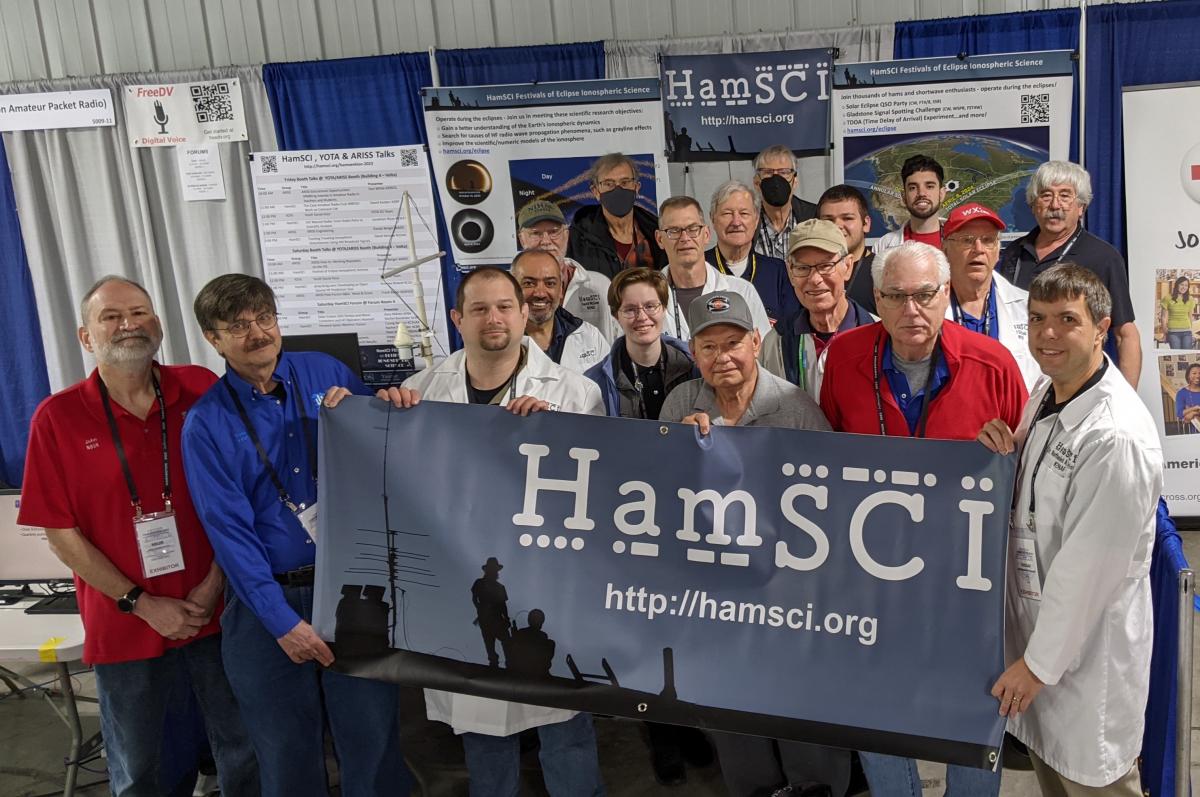
HamSCI at Hamvention 2022

Overview

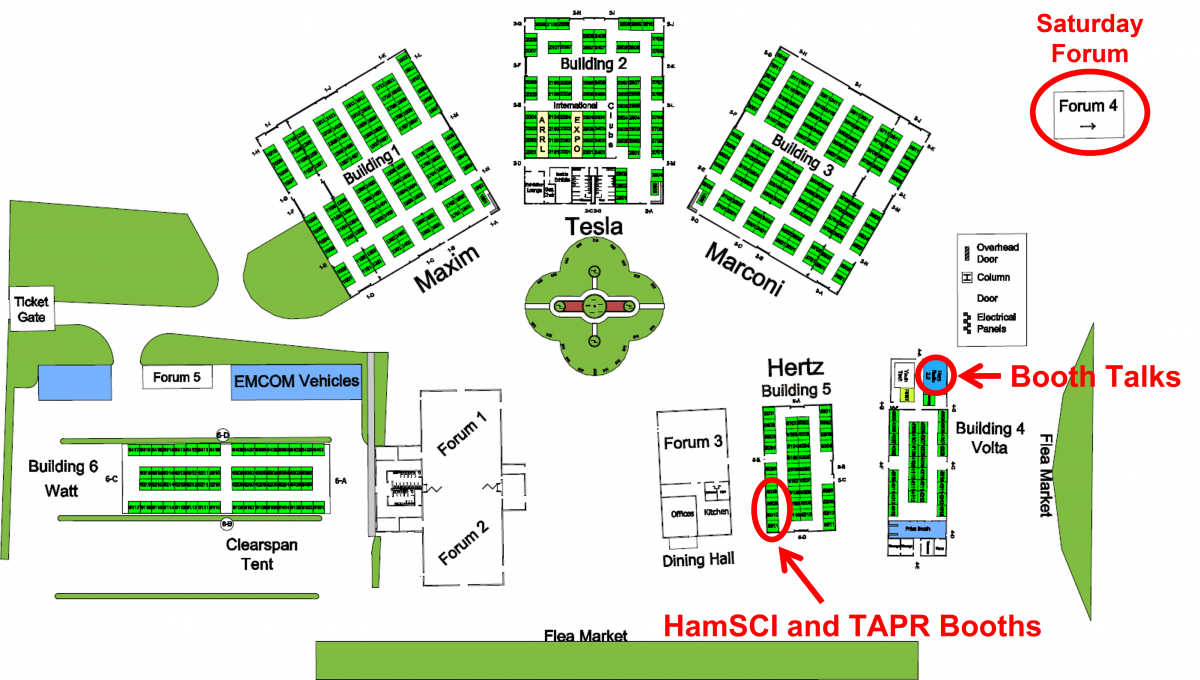
HamSCI will be present at the 2023 Dayton/Xenia Hamvention in order to further its goal of connecting the ham radio and scientific communities. Support for the 2023 HamSCI Hamvention activities comes from The University of Scranton, The Yasme FoundationTAPRThe National Science Foundation, NASA, and volunteers like you. Per long standing tradition, HamSCI will be hosting booth  5008 (next to TAPR in Building 5, the Hertz Building, map below), hosting the HamSCI Forum and giving booth talks in the ARISS/YOTA area (map below). To help out, please sign up to volunteer at the booth.

Booth Volunteering

The 2023 HamSCI booth location will be in Building 5, the Hertz Building, same as in years past. Please use the button below to sign up as a booth volunteer using NeedToMeet. (NOTE:  NeedToMeet adjusts its calendars to your time zone based on your web browser settings.  Please be aware that the HamSCI booth will be staffed from 9AM-5PM Friday and Saturday, and 9AM-1PM on Sunday.  If you are in the Western time zone, the NeedToMeet calendar will probably show the days as starting at 6AM.  Please know that translates to an actual Hamvention start time of 9AM.) (That's a NeedToMeet feature, not a bug!) As a volunteer, we ask that you be present in the HamSCI booth during your scheduled time slot, welcoming visitors, talking with them about HamSCI in general, HamSCI projects and your specific research interests. Feel free to bring demonstration items and materials and to talk about what you know best. The goal of HamSCI is to connect ham radio with scientific research. So, any topic that supports this goal is a good topic to talk about. The booth uniforms, are, by tradition, HamSCI labcoats.  Purchase details below.


Volunteer Sign-Up

Lab Coats

HamSCI labcoats may be ordered from https://www.allheart.com/lab-coats. Please use custom logo code C_5163_Q5D and place the logo on the left chest. Put your whole name on Line 1, and your call sign on Line 2. Use block style lettering.

Recommended Styles for 2023

Note that allheart.com changes their available styles on a regular basis. The important thing is to pick a white lab coat that fits you and put the custom logo code C_5163_Q5D and place the logo on the left chest.

Sample Order - Information confirmed March, 2023

Natural Uniforms Unisex 41" Lab Coat
Item #: AH-8200---WHTLGE
Color: WHT White
Size: LGE
Personalization - Left Chest
  Embroidery Style: Block Style
  Thread Color: Black
  Letter Height: 1/2 inch (25 characters)
  Text Line #1: Dr. Nathaniel A. Frissell
  Custom Emblem: C_5163_Q5D
  Text Line #2: W2NAF


Exhibitor Badges

If you are volunteering at the booth or giving a talk, HamSCI will supply an exhibitor badge. These badges give you full access to the Hamvention, including the set-up and break-down times. However, these badges will not enter you in the prize drawings the way a normal Hamvention ticket will. Please coordinate requests for exhibitor badges with Gary Mikitin AF8A via [email protected].  

Group Photo - Please note the date/time change

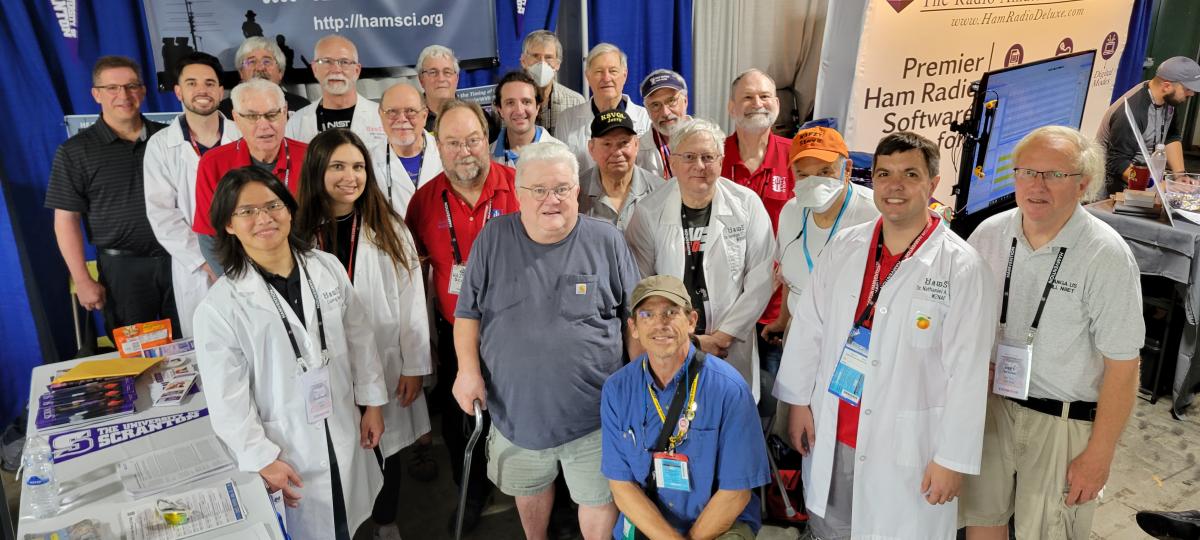
A HamSCI group photo will be taken during the Hamvention on Saturday at 9:30 AM (1330 UTC) at the HamSCI booth. Wear your labcoats!

HamSCI Presentations, Talks and Demonstrations

Members of HamSCI will be presenting at many events throughout the Hamvention weekend, beginning Thursday evening.  Some talks will be at offsite events, while others will be held on the Hamvention grounds.  A complete list of talks, presenters and dates/times can be found on the HamSCI Hamvention 2023 page.

Questions?

If you have questions about HamSCI's 2023 Hamvention plans, please contact the HamSCI Team at [email protected].

Booth Location

HamSCI will be at Booth 5008, next to TAPR, in Building 5, the Hertz Building.

Hamvention 2022 Maps.png

Paper on Grape Personal Space Weather Station HF Doppler Observations Published

Dr. Kristina Collins, KD8OXT, is the lead author on a new paper published in the peer-reviewed journal Earth System Science Data entitled Crowdsourced Doppler measurements of time standard stations demonstrating ionospheric variability. The Grape Personal Space Weather Station is a low-cost, high frequency (HF) receiver designed to make precision measurements of signals received from frequency standards stations such as WWV, WWVH, and CHU. Because these standards stations transmit carriers with atomic-clock grade frequency stability, and the Grape receiver achieves similar frequency stability through the use of a GNSS Disciplined Oscillator, variations in the received signal can be attributed to changes in the ionosphere. The new paper demonstrates this in multiple ways, including showing changes in Doppler frequency due to the dawn and dusk terminators, seasonal variations, wave signatures with Medium Scale Traveling Ionospheric Disturbance periods, and the ionospheric response to solar flares. The paper also explains how to access Grape data and the open-source software used to conduct the analysis. The co-author team consists of professionals, students, and HamSCI volunteers, including Kristina Collins KD8OXT, John Gibbons N8OBJ, Nathaniel Frissell W2NAF, Aidan Montare KB3UMD, David Kazdan AD8Y, Darren Kalmbach KC0ZIE, David Swartz W0DAS, Robert Benedict KD8CGH, Veronica Romanek KD2UHN, Rachel Boedicker AC8XY, William Liles NQ6Z, William Engelke AB4EJ, David G. McGaw N1HAC, James Farmer K4BSE, Gary Mikitin AF8A, Joseph Hobart W7LUX, George Kavanagh KB1HFT, and Shibaji Chakraborty KN4BMT. The Grape receivers are the focus of an NSF-funded experiment to study the upcoming 2023 annular and 2024 total solar eclipses. More information on building your own Grape receiver is available at hamsci.org/grape.

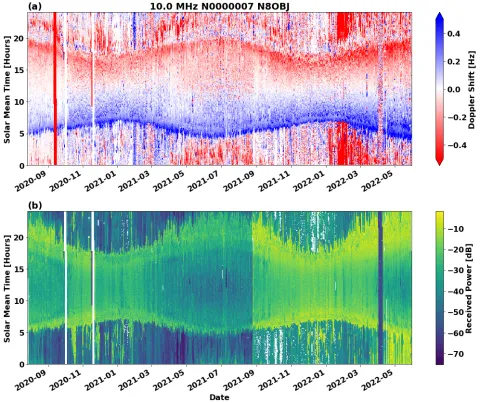
Figure from Paper: Heat maps of frequency (a) and amplitude (b) of 10 MHz WWV received by N8OBJ in Macedonia, OH. Each day represents a line of pixels from top to bottom, with corresponding UTC times lined up across the plots horizontally. Diel variation, and the seasonal shift of sunrise and sunset times per Fig. 7, is clearly visible in both plots. A new antenna and preamplifier were installed on 26 August 2021, resulting in higher received power.

Collins, K., Gibbons, J., Frissell, N., Montare, A., Kazdan, D., Kalmbach, D., Swartz, D., Benedict, R., Romanek, V., Boedicker, R., Liles, W., Engelke, W., McGaw, D. G., Farmer, J., Mikitin, G., Hobart, J., Kavanagh, G., and Chakraborty, S.: Crowdsourced Doppler measurements of time standard stations demonstrating ionospheric variability, Earth Syst. Sci. Data, 15, 1403–1418, https://doi.org/10.5194/essd-15-1403-2023, 2023.

N6NC Publishes Propagation Research Articles in QEX

A key component of the HamSCI mission is to encourage amateurs to conduct and share their own research and experiments. Larry Serra N6NC recently published two articles in QEX Magazine from his trans-North Pacific 40m propagation projects: The first, "Why Summer 40m Propagation Is So Good Between Japan and the US Pacific Coast" (QEX SEPT/OCT 2022 p.14), examined 12 years of July JA-US 40m propagation conditions and CW Skimmer results on days of JA domestic CW contests and proposed that the relatively calm water under the almost wall-to-wall summertime North Pacific HIGH pressure centers provided nearly +12dBm enhanced low-angle signal strength due to a reduction of surface reflection absorptions in the 3-ionospheric refraction, 2-sea surface reflection propagation path.

The second article, "A Make-Do Ham Interferometer To Determine Elevation Angles of Arriving RF Signals" (QEX MAR/APR 2023 p.17) explained how a simple digital calculating oscilloscope, measured coax lines and two small, inexpensive PA0RDT active antennas can be used with some math to calculate and confirm the angles of arrival (AoAs) of shortwave signals.

We thank the ARRL for permission to post  "Why Summer 40m Propagation Is So Good Between Japan and the US Pacific Coast" (QEX SEPT/OCT 2022 p.14) to hamsci.org. Full access to QEX is provided as an ARRL membership benefit. Both articles are also translated and published in the Japanese CQ HAM RADIO/QEX MAGAZINE.

Congratulations on your articles, Larry!

Hamvention 2023

HamSCI will be playing a major role at the 2023 Dayton Hamvention.  It will be held in Xenia, Ohio May 19-21, 2023 at the Greene County Fairgrounds.  It is the world's largest ham radio gathering, having over 30,000 attendees in 2022. The Hamvention, sponsored by the Dayton Amateur Radio Association (DARA), is an extremely important event for engaging with the amateur radio community, sharing ideas, developing collaborations, and sharing scientific results. The Hamvention 2023 theme is Innovation!, an excellent fit for HamSCI's goals.  HamSCI will be hosting Booth 5008 in the Hertz Building, giving presentations in the ARISS/YOTA area and hosting the HamSCI Forum..  Support for the 2023 HamSCI Hamvention activities comes from The University of Scranton, the Yasme FoundationTAPR, the National Science FoundationNASA, and volunteers like you. 

HamSCI will be in Booth 5008, next to TAPR, in Building 5, the Hertz Building (map below).  Stop by to learn about HamSCI's mission, our space weather projects and how you can play a role in our citizen science activities.  HamSCI members will be hard to miss - just look for our white lab coats!

HamSCI Presentations

Members of HamSCI will be speaking and taking questions at various forums throughout Hamvention Weekend.  Consult the links below, your Hamvention program or  Hamvention phone app for details on how and where to attend.

Date & Time Sponsor/Venue Title Presenter(s) Organization Home QTH(s)
Thursday, May 18th
1:00 PM
Contest University Contesting for Ionospheric Science During the 2023 and 2024 North American Solar Eclipses Nathaniel Frissell
W2NAF
HamSCI-50x11.png Scranton, PA
Thursday, May 18th
8:00 PM
FlexRadio Banquet HamSCI, The Personal Space Weather Station and the 2023 and 2024 North American Solar Eclipses Nathaniel Frissell
W2NAF
HamSCI-50x11.png Scranton, PA
Friday, May 19th
12:00 PM
Hamvention Innovation Forum Working Title: From Boy Scout to HamSCI Lead - W2NAF's Innovation Journey
Final Title: TBD (to be determined)
Nathaniel Frissell
W2NAF
HamSCI-50x11.png Scranton, PA
Friday, May 19th
Time TBD
Hamvention Antenna Forum HamSCI Festivals of Eclipse Ionospheric Science Nathaniel Frissell
W2NAF
HamSCI-50x11.png Scranton, PA
Friday, May 19th
Time TBD
TAPR/AMSAT Banquet Working Title: HamSCI/TAPR Collaboration.
Final Title: TBD (to be determined)
Nathaniel Frissell
W2NAF
HamSCI-50x11.png Scranton, PA

HamSCI Forum

Date & Time Sponsor/Venue Title Presenter(s) Organization Home QTH(s)

Saturday, May 20th
2:50 PM

HamSCI-50x11.png
Forum Room 4
Solar Eclipse QSO Parties and More: Contesters and HF Operators Wanted! Gary Mikitin AF8A HamSCI-50x11.png
 
Cleveland, OH

Saturday, May 20th
3:05 PM

HamSCI-50x11.png
Forum Room 4

Measuring Ionospheric Variability with Grape Receivers Rachel Boedicker AC8XY CWRU Cleveland, OH
 
Saturday, May 20th
3:20 PM
HamSCI-50x11.png
Forum Room 4
Climatology of Large Scale Traveling Ionospheric Disturbances (LSTIDs) Observed with Amateur Radio Networks

Diego Sanchez KD2RLM

NJIT

Nutley, NJ

Saturday, May 20th
3:35 PM
HamSCI-50x11.png
Forum Room 4
Automated Techniques for Detecting and Measuring LSTIDs

Bill Engelke AB4EJ

UAlabama

Tuscaloosa, AL

Booth Talks

Booth talks, social hours and demonstrations will be given by ARISS (Amateur Radio on the International Space Station), HamSCI and YOTA (Youth on the Air).  They will take place at Booth 4303 in the Building 4, the Volta Building (map below). If you would like to give a demonstration on HamSCI's behalf, please e-mail [email protected].  The HamSCI Team will review all proposals and get back to you with questions (if any), scheduling details, etc.

Date & Time Sponsor Title Presenter(s) Organization Home QTH(s)
Friday, May 19th
10:00 AM
ARISS* ARISS Educational Opportunities:  SPARKing Interest in Amateur Radio in Teachers and Students Dan White AD0CQ ARISS-USA
Valparaiso University
Valparaiso, IN
Friday, May 19th
11:00 AM
HamSCI-50x11.png The Case Amateur Radio Club W8EDU Work on Coherent CW David Kazdan AD8Y Case Western Reserve University Cleveland, OH
Friday, May 19th
12:00 PM
YOTA* Youth Social Hour YOTA  team YOTA Americas
Friday, May 19th
1:00 PM
HamSCI-50x11.png VLF Natural Radio: From Radio Parts to Scientific Analysis Jonathan Rizzo KC3EEY University of Scranton Scranton, PA
Friday, May 19th
2:00 PM
ARISS ARISS Engineering Randy Berger WA0D ARISS-USA Ft. Worth, TX
Friday, May 19th
3:00 PM
HamSCI-50x11.png Tracking Traveling Ionospheric Disturbances Using AM Broadcast Signals David McGaw N1HAC Dartmouth College Hanover, NH
Saturday, May 20th
10:00 AM
ARISS ARISS How-To:  Intro to Working Repeaters on the ISS Randy Berger WA0D ARISS-USA Ft. Worth, TX
Saturday, May 20th
11:00 AM
HamSCI-50x11.png Festival of Eclipse Ionospheric Science Gary Mikitin AF8A HamSCI Cleveland, OH
Saturday, May 20th
12:00 PM
YOTA Youth Social Hour YOTA  team YOTA Americas
Saturday, May 20th
1:00 PM
HamSCI-50x11.png prop.kc2g.com: Developing an Open-Source HF Prediction Tool Andrew Rodland KC2G HamSCI Allendale, NJ
Saturday, May 20th
2:00 PM
ARISS ARISS Post-Forum Q&A:  Meet & Greet Frank Bauer KA3HDO ARISS-Int'l Baltimore, MD

*YOTA = Youth On The Air (youthontheair.org), ARISS = Amateur Radio on the International Space Station (ariss.org)


Booth Location

HamSCI will be at Booth 5008, next to TAPR, in the Building 5, the Hertz Building.

Hamvention 2022 Maps.png


HamventionGroup2022.jpg

HamSCI Booth Photo 2023


Festivals of Eclipse Ionospheric Science - Media Hits

Author Title / Link Media Month, Year
G. Mikitin Solar Eclipse QSO Party Solid Copy (The CW Operators Club newsletter) Feb, 2023
N. Rapp 2023 HamSCI Conference and the Solar Eclipse QSO Parties Ham Talk Live!  (podcast about amateur {ham} radio) Feb, 2023
NASA Ham Radio Operators, We Need Your Help During Solar Eclipses! NASA | Science News | Citizen Science Feb, 2023
Hackaday.com NASA Help Wanted:  Ham Radio Operators Please Apply hackaday.com (Fresh hacks everyday from around the Internet) Feb, 2023
 
M. Lombardi Measuring the Frequency Accuracy and Stability of WWV and WWVH  QST, the Monthly Membership Journal of the ARRL Mar, 2023
K. Bolus Amateur Radio Workshop Coming to Scranton Radio Station WVIA / PBS / NPR, Scranton, PA Mar, 2023
C. Butler NASA and the HamSCI Solar Eclipse QSO Party ICQ Podcast Episode 398 (podcast for and by amateur {ham} radio operators) Mar, 2023
A. Norstrom Grape Version 1.12 at HamSCI Workshop 2023 American Radio Relay League YouTube Channel Mar, 2023
G. Mikitin HamSCI Festivals of Eclipse Ionospheric Science SciStarter:  Science We can do Together Apr, 2023
J. Johnston NASA Wants You - HELP WANTED from ham radio ops Ham Radio 2.0 YouTube channel May, 2023
N. Frissell Festivals of Eclipse Ionospheric Science at Contest University Contest University - YouTube (begins at the 5:01:00 mark) May, 2023
N. Frissell HamSCI and the 2023 and 2024 Solar Eclipses TAPR Banquet - Hamvention 2023 - YouTube May, 2023
Eurasia Review Science in the Shadows: NASA Selects 5 Experiments for 2024 Total Eclipse Eurasia Review - News & Analysis Jun, 2023
S. Hale HRC Episode #117: NASA Needs Ham Radio? Ham Radio Clubhouse - YouTube Jun, 2023
G. Hasrouni HamSCI - Ham Radio Science Citizen Investigation NASA xD - Cross Divisional Research Jun, 2023
R. Wilcox Forging Amateur-Professional Bonds - An Overview of the HamSCI 2023 Workshop and Upcoming Solar Eclipses CQ - Amateur Radio - Communications and Technology Jul, 2023
N. Hall-Patch

How DXers Can Contribute to Ionospheric Research During the 14 October 2023 Eclipse

2024 Solar Eclipse DXing

DX Monitor - The Official Publication of the International Radio Club of America

The SWL'ing Post

Aug, 2023

Apr, 2024

E. Efchak HamSCI Presents the Solar Eclipse QSO Party - October 14, 2023 QRZ.com - Amateur Radio News Forum Aug, 2023
HamSCI HamSCI Solar Eclipse QSO Parties:  Save the Dates! Amateur Radio Daily Aug, 2023
Y. Ritz 14 October 2023 Annular Eclipse MW DXProject Ydun's Medium Wave Info Aug, 2023
R. Wilcox  Basic Understandings of the Ionosphere, Part 1 and Part 2 (Q&A) Fairlawn ARC Kawfee Talk Aug, 2023
K. Reitz RF Current:  News from the World of Communications:  Solar Eclipse QSO Party The Spectrum Monitor Sep, 2023
C. Butler HamSCI Solar Eclipse QSO Parties ICQ Amateur / Ham Radio Podcast News Aug, 2023
S. Whitt, Editor Eclipses in the Americas - Join in with Citizen Science Medium Wave News Vol 69 No.4, newsletter of the Medium Wave Circle Aug, 2023
N. Hall-Patch How DXers Can Contribute to Ionospheric Research During the 14 October 2023 Eclipse The SWLing Post Aug, 2023
A. Griffith NASA Seeks Help from Radio Amateurs During Solar Eclipses Radio Amateurs of Canada (homepage) Sep, 2023
S. Harvey HamSCI Festivals of Eclipse Ionospheric Science Canadian International DX Club Messenger  Sep, 2023
G. Mikitin The Solar Eclipse QSO Party:  A Fun Way to Support Radio Science On The Air, Radio Communications, Get Active, Get Involved (ARRL) Sep/Oct, 2023
G. Mikitin HamSCI Workshop 2023:  A Radio Science Collaboration QST, the Monthly Membership Journal of the ARRL Oct, 2023
R. Wilcox HamSCI and the Upcoming Solar Eclipses The Spectrum Monitor, Amateur, Shortwave, AM/FM/TV, WiFi, Scanning, Satellites, Vintage Radio and more Oct, 2023
M. Denton

The Impact of Solar Eclipses on the Structure and Dynamics of Earth's Upper Atmosphere 

NASA Solar System News

​PHYS.ORG News

Sep, 2023
ARRL Solar Eclipse QSO Party Seeks Amateurs and Radio Enthusiasts for Global Experiment ARRL Special Bulletin ARLX013 Oct, 2023
P. Bourque HamSCI Solar Eclipse QSO Party ARRL Contest Update Sep, 2023
C. Baraniuk Eclipses do odd things to radio waves. An army of amateur broadcasters wants to find out why. BBC Future Oct, 2023
T. Skov A Ring of Fire and a Bumpy Ride Space Weather News Oct, 2023
K. Bolus University of Scranton professor will study upcoming eclipses through grant Radio Station WVIA / PBS / NPR, Scranton, PA Oct, 2023
K. Cartier Ham Radios Crowdsourced Ionospheric Science During Eclipse Eos, Science News Published by the AGU Oct, 2023
N. Frissell Igniting the Fire of Radio Science at the University of Scranton Connections, Online Magazine of AJCU Oct, 2023
N. Frissell, J. Ng Study Total Solar Eclipses with Ham Radio NASA Scientific Visualization Studio, GSFC Oct, 2023
E.L. Gometz How Ham Radio Operators do Radio Science Science Friday Oct, 2023
D. Witt HAM Radio Experiment Planned for Solar Eclipse WTVG Television, Toledo, OH Oct, 2023
T. Skov A Ring of Fire and a Bumpy Ride Space Weather News Oct, 2023
Hackaday.com Ham Radio Operators' Ionospheric Science During the Solar Eclipse hackaday.com (Fresh hacks everyday from around the Internet) Oct, 2023
C. Butler HamSCI Releases First Solar Eclipse Findings ICQ Amateur / Ham Radio Podcast News Dec, 2023
J. O'Callaghan The Science of 2024’s Epic Solar Eclipse, the Last for a Generation Scientific American (Daily Newsletter) Jan, 2024
T. Medlin  Amateur Radio Roundtable 01 16 24:  HamSCI Amateur Radio Roundtable - YouTube Jan, 2024
S. Scoles How you Can Participate in Solar Eclipse Research Scientific American (Daily Newsletter) Feb, 2024
A. Garcia Four Ways to Participate in Research During the Solar Eclipse The Chron, The Houston Chronicle Newsletter Feb, 2024
E. Efchak 2024 Eclipse:  HamSCI Roundtable Event The SWLing Post Mar, 2024
K. Patel What this solar eclipse can teach us about our planet and beyond Washington Post Mar, 2024
C. Duncan

Five Fascinating Science Projects Using the Total Solar Eclipse to Illuminate New Discoveries

Smithsonian Magazine Smart News Mar, 2024
K. Miller A Total Solar Eclipse Is Coming. Here’s What You Need to Know. New York Times Mar. 2024
M. Butler Amateur Radio Stands Ready to Support Eclipse Operations ICQ Amateur / Ham Radio Podcast News Mar, 2024
K. Kornei Eclipse Science Along the Path of Totality Eos, Science News Published by the AGU Mar, 2024
M. Denton Get On the Air April 8 for the Solar Eclipse QSO Party QST, the Monthly Membership Journal of the ARRL Apr, 2024
E. Weise Plan to Watch the April 2024 Total Solar Eclipse?  Scientists Need Your Help USA Today
Palm Beach Post
Apr, 2024
C. LePard Monitoring the Moon When it Happens: Ham Radio Scientists to Monitor Eclipse News5 (ABC), Cleveland Apr, 2024
N. Hall-Patch Eclipse Preparation Medium Wave News Vol 70 No.1, newsletter of the Medium Wave Circle Apr, 2024
J. Carter NASA Reveals Plan to Point Huge Telescope at the Solar Eclipse (Eclipse Radio) Forbes Apr, 2024
D. Brooks Granite Geek:  Studying Results of the Eclipse with Balloons and Ham Radios Concord (NH) Monitor  Apr, 2024
F. Lapin Eclipse 2024 Ham Science Tank Radio Podcast Apr, 2024
U. of Scranton Scranton Professor Leads NASA-Selected Eclipse Study RoyalNews Apr, 2024
D. Huxley South Students watch eclipse: High schoolers viewing the eclipse with help from Amateur radio operators Marietta Times Apr, 2024
J. Thompson Solar Eclipse to See Citizen Scientists Probe Upper Atmosphere Newsweek Apr, 2024
O. Burlaka Amateur Scientists Will Conduct a Study of the Ionosphere During a Solar Eclipse Universe Magazine (Ukraine) Apr, 2024
G. Raynard

Total Solar Eclipse: The 4-Minute Window into the Sun's Secrets

BBC.com

The Saudi Gazette

The Star (Kenya)

Apr, 2024
A. Marbone Hamming it Up at the Eclipse - Amateur Radio Operators to Compete in Radiosport, Provide Data to NASA Adirondack Daily Enterprise Apr, 2024
G. Dvorsky All the Citizen Science Projects You Can Participate in During the Eclipse Gizmodo.com Apr, 2024
M. Denton The April 2024 Solar Eclipse QSO Party On The Air, Radio Communications, Get Active, Get Involved (ARRL) Mar/Apr, 2024
R. Wilcox Solar Eclipse Observations:  Fall 2023, Spring 2024 The Spectrum Monitor, Amateur, Shortwave, AM/FM/TV, WiFi, Scanning, Satellites, Vintage Radio and more Apr, 2024
C. DeSantis Eclipse Offers Unique Opportunity for STEAM Students Rhode Island Catholic Apr, 2024
J. Jenkins NJIT Undergrads Explore Space Weather During 2024 Total Eclipse NJIT News Apr, 2024
N. Frissell Festivals of Eclipse Ionospheric Science - First Results Dayton Hamvention / Antenna Forum May, 2024
G. Mikitin SEQP and GSSC Results for 2023 Dayton Hamvention / HamSCI Forum May, 2024
R. Boedicker Solar Eclipse Observations Using the HamSCI Grape Personal Space Weather  Network (begins ~5:25:00 into the video) Dayton Hamvention / HamSCI Forum May, 2024

R. Robinette                         P. Elliott

WSPRDaemon and Doppler Shift Measurements Made During the October, 2023 Eclipse and Introducing the WSPRsonde (begins ~5:33:00 into the video

Dayton Hamvention / HamSCI Forum May, 2024
G. Mikitin, N. Frissell What Solar Eclipses Have to Tell Us QST, the Monthly Membership Journal of the ARRL November, 2024
A. Interrante, V. Thomas

Scientists Share Early Results from NASA's Solar Eclipse Experiments

NASA's Solar Eclipse Experiments Yield Intriguing Data

SCIENCE.NASA.GOV

PHYS.ORG

December, 2024

The WWV Frequency Celebration: Live Stream March 2, 2023

Join the WWV Amateur Radio Club, the National Institute of Standards and Technology (NIST), the Fort Collins Museum of Discovery (FCMoD), and the HamSCI for two excellent lectures to be live streamed on March 2, 2023 at 5:00PM Mountain Std Time (0000 UTC):

  • The History of WWV Frequency Broadcasts - Glenn Nelson, WWV Staff, National Institute of Standards and Technology (NIST)
  • WWV as a Beacon for Citizen Science - Dr. David Kazdan and Rachel Boedicker - Case Western Reserve University/HamSCI  Aidan Montare - NIST Boulder/HamSCI

The event will be streamed via the Northern Colorado ARC YouTube channel:  https://www.youtube.com/NCARC. Follow and choose the LIVE link, sit back, and enjoy!  (Note:  The lectures may not start exactly at the top of the hour - so be prepared to 'stand by' until the speakers take the stage.)

The lectures are being presented as part of Tune In: The WWV Frequency Celebration, being held on March 2-4 at the Fort Collins Museum of Discovery, 408 Mason Ct, Fort Collins, Colorado.

Additional details on the activities from Fort Collins, as well as announcement of a week long on-the-air event featuring the WW0WWV callsign, can be found here: https://wwvarc.org/WWVFrequencyCelebration


QST Article on Measuring the Frequency Accuracy and Stability of WWV and WWVH Published

Mike Lombardi, K0WWX, HamSCI member and Director of the National Institute of Standards and Technology (NIST) Time Realization and Distribution Group published the article Measuring the Frequency Accuracy and Stability of WWV and WWVH in ARRL's March 2023 QST. WWV and WWVH are the United States' National Time and Frequency Standards broadcast stations and are of critical importance to the HamSCI Personal Space Weather Station Project. This article is the follow-on to Mike's 2022 HamSCI Workshop presentation. Special thanks to the ARRL for permission to post this article on hamsci.org.

Kiwi SDR Firmware Settings

How to Check and Update Your KiwiSDR Firmware:

For superior frequency accuracy, ensure that your KiwiSDR has firmware version v1.574 or later. 
 
The version can be determined without logging in as Admin. It's on the 'Stats' tab of the user console, third row beneath the colored buttons:


Do an admin login and go to the status tab - it lists the installed FW version.


The Update tab allows you to update and build the latest version.


G5RV Installation

HamSCI: Ham Radio Science Citizen Investigation

Destination Url

/about-hamsci

HamSCI 2023 Program

Posters and presentations at the HamSCI workshop are made for community discussion and for exploration of new possibilities. Please note that these materials are not peer-reviewed.

Main workshop page: http://hamsci.org/hamsci2023
HamSCI Glossary

Friday, March 17, 2023

Eastern Daylight Time UTC NR Title Presenter Modality Location
7:00 AM EDT 1100z  

Registration & Continental Breakfast


  LSC 133 Lobby
      W3USR Amateur Radio Special Event Station Murgas Amateur Radio Club & Scranton Pocono Amateur Radio Club (SPARK) In-Person LSC 126
8:15 AM EDT 1215z  

Opening Remarks / Webinar Opens

  • Dr. Nathaniel Frissell W2NAF
  • Dr. Michelle Maldonado, Provost
  • Dr. Tai-Yin Huang, National Science Foundation Aeronomy Program Director
  • Rosy Schechter KJ7RYV, ARDC Executive Director
    LSC 133

Oral Session I: HamSCI Personal Space Weather Station
Chair: Veronica Romanek KD2UHN and Simal Sami KC3UAW
Zoom Moderators: 
Cuong Nguyen KC3UAX, Gabrina Garangmau

8:30 AM EDT 1230z O01 TangerineSDR Integration Update Tom McDermott N5EG
TAPR
In-Person LSC 133
8:50 AM EDT 1250z O02 Grape Version 2 Hardware Description and Build Status
John Gibbons N8OBJ
Case Western Reserve University
In-Person LSC 133
9:10 AM EDT 1310z O03 Personal Space Weather Station Central Control and Database System
Anderson B. Liddle
Nicholas Muscolino
The University of Alabama
In-Person LSC 133
9:30 AM EDT 1330z O04 An Expanded System to Track Traveling Ionospheric Disturbances and Other Effects Using Doppler-shifts of AM Broadcast Stations David McGaw N1HAC
Dartmouth College
In-Person LSC 133
9:50 AM EDT 1350z O05 W2NAF-KC3EEY VLF Observatory - A Year of Operation
Jonathan Rizzo KC3EEY
HamSCI Community / University of Scranton Alumnus
In-Person LSC 133
10:10 AM EDT 1410z  

Coffee Break

    LSC 133 Lobby

Oral Session II: Ionospheric Modeling and Traveling Ionospheric Disturbances
Chairs: Dr. Gareth Perry KD2SAK
Zoom Moderators: 
Cuong Nguyen KC3UAX, Gabrina Garangmau

10:30 AM EDT 1430z O06 On-Air Multipath TDOA Experiments for Ionospheric Layer Height Measurements Using Amateur Radio Stations Steve Cerwin WA5FRF
The University of Scranton
In-Person LSC 133
10:50 AM EDT 1450z O07 Climatology of Ionospheric Variability with MSTID Periods Observed Using Grape v1 HF Doppler Receivers Veronica Romanek KD2UHN
The University of Scranton
In-Person LSC 133
11:10 AM EDT 1510z O08 Climatology of Large Scale Traveling Ionospheric Disturbances Observed with Amateur Radio Networks Diego Sanchez KD2RLM
New Jersey Institute of Technology
In-Person LSC 133
11:30 AM EDT 1530z O09 Analyzing Large Scale Traveling Ionospheric Disturbances using Spot Data and Curve Fitting William D. Engelke AB4EJ
The University of Alabama
In-Person LSC 133
11:50 AM EDT 1550z O10 A New Web Interface to the SuperDARN MSTID Analysis Toolkit Francis Tholley
The University of Scranton
In-Person LSC 133
12:10 PM EDT 1610z O11 Medium Scale Traveling Ionospheric Disturbances and their Connection to the Lower and Middle Atmosphere Dr. Nathaniel Frissell W2NAF
The University of Scranton
In-Person LSC 133
12:30 PM EDT 1630z  

Lunch

LSC 133 Lobby

Oral Session III: Festivals of Eclipse Ionospheric Science (FoEIS)
Chairs: Dr. Nathaniel Frissell W2NAF
Zoom Moderators: 
Veronica Romanek KD2UHN, Simal Sami KC3UAW

1:30 PM EDT 1730z O12 A Few Science Questions that HamSCI Can Help Address During the 2023 and 2024 Eclipses

Dr. Gareth Perry KD2SAK
New Jersey Institute of Technology

In-Person LSC 133
1:50 PM EDT 1750z O13 Measuring Daily Ionospheric Variability and the 2023 & 2024 Solar Eclipse Ionospheric Impacts Using HamSCI HF Doppler Shift Receivers Rachel Boedicker AC8XY
Case Western Reserve University
In-Person LSC 133
2:10 PM EDT 1810z O14 Engaging the Amateur Radio Community with the Festivals of Eclipse Ionospheric Science Gary Mikitin AF8A
HamSCI Community
In-Person LSC 133
2:30 PM EDT 1830z O15 Broadband Recordings from Medium Wave DXers Could Support Solar Eclipse Science Nick Hall-Patch VE7DXR
HamSCI Community
Virtual LSC 133
2:50 PM EDT 1850z O16 Identifying 14 MHz Propagation Modes Using FST4W SNR and Spectral Spread Gwyn Griffiths G3ZIL
HamSCI Community
Virtual LSC 133
3:10 PM EDT 1910z O17 Low Cost, High Accuracy and Stability FST4W Transmissions Using the QDX Transceiver Rob Robinett AI6VN
HamSCI Community
In-Person LSC 133
3:30 PM EDT 1930z   Coffee Break with Snacks     LSC 133 Lobby

Oral Session IV: Meteorological Eclipse Observations, Solar Flare Impacts, Radio Astronomy, and the Aurora
Chairs: Gerard Piccini KD2ZHZ & Devin Diehl
Zoom Moderators: 
Cuong Nguyen KC3UAX, Joseph Tholley

3:50 PM EDT 1950z O18 Project HALO: An Effort to Provide Continuous Meteorological Observations of the April 8th, 2024 Total Solar Eclipse Wesley Taylor
Millersville University
In-Person LSC 133
4:10 PM EDT 2010z O19 The potential of HamSCI Doppler Observations for inferring Solar Flare Effects on the Ionosphere Dr. Kristina Collins KD8OXT
Space Science Institute
In-Person LSC 133
4:30 PM EDT 2030z O20 Viability of Nowcasting Solar Flare-Driven Radio-Blackouts Using SuperDARN HF Radars Dr. Shibaji Chakraborty KN4BMT
Virginia Tech
In-Person LSC 133
4:50 PM EDT 2050z O21 Galactic Study of the Milky Way Galaxy Using Cold Hydrogen Data M. Shaaf Sarwar KC3PVF
The University of Scranton
In-Person LSC 133
5:10 PM EDT 2110z O22

History of the Art of DXing and Contesting

Ron Wilcox KF7ZN
HamSCI Community

In-Person LSC 133
5:30 PM EDT 2130z O23 Observing Auroral Radio Emissions in Conjugate Hemispheres Dr. Jim LaBelle
Dartmouth College
In-Person LSC 133
5:50 PM EDT 2150z   Day 1 Closing Remarks Dr. Nathaniel Frissell W2NAF
The University of Scranton
In-Person LSC 133

Friday Night Banquet
Radisson Lackawanna Station Hotel Scranton

Chair: Dr. Nathaniel Frissell W2NAF
Zoom Moderators: Augustine Brapoh, Gerard Piccini 
KD2ZHK

6:30 PM EDT 2230z   Banquet Begins     Radisson Grand Atrium
7:30 PM EDT 2330z   KEYNOTE ADDRESS: Forging Amateur-Professional Bonds Dr. Patricia Reiff W5TAR
Rice University
In-Person Radisson Grand Atrium

Saturday, March 18, 2023

Eastern Daylight Time UTC NR Title Presenter Modality Location
7:00 AM EDT 1100z  

Registration & Continental Breakfast


  LSC 133 Lobby
      W3USR Amateur Radio Special Event Station Murgas Amateur Radio Club & Scranton Pocono Amateur Radio Club (SPARK) In-Person LSC 126
8:30 AM EDT 1230z  

Opening Remarks / Webinar Opens

  • Dr. Nathaniel Frissell W2NAF
  • Bob Inderbitzen, NQ1R, ARRL Headquarters
  In-Person LSC 133
8:40 AM EDT 1240z   Two Solar Eclipses and A Solar Max: The Heliophysics Big Year

Dr. Esayas Shume
NASA Headquarters

In-Person LSC 133

Invited Tutorials
Chair: Nathaniel Frissell W2NAF
Zoom Moderators: 
Gabrina Garangmau, Augustine Brapoh

9:00 AM EDT 1300z T01 INVITED TUTORIAL: Modeling the Ionosphere with SAMI3 Dr. Joseph Huba
Syntek Technologies
In-Person LSC 133
9:45 AM EDT 1345z T02 INVITED TUTORIAL: The Ham Radio Project: Exploring the Electromagnetic Spectrum Mr. Jesse Alexander WB2IFS
National Radio Astronomy Observatory (NRAO)
In-Person LSC 133
10:30 AM EDT 1430z  

Coffee Break


Oral Session V: Amateur Radio History and Technique
Chair: Dr. Kristina Collins KD8OXT
Zoom Moderators: 
Nisha Yadav, Augustine Brapoh

11:00 AM EDT 1500z O24

Evaluation of Global Ionospheric TEC Using Simultaneous Observations from Amateur Radio Networks, International Space Station, and NeQuickG Model for Space Weather Prediction

**This project is a Global Finalist in the 2022 NASA International Space Apps Challenge.

Gamal Zayed
Cairo University

Matthew Downs

Marcin Lesniowski

In-Person LSC 133
11:20 AM EDT 1520z O25 Listening to the Heliosphere: Making Space Data Audible for Citizen Science Dr. Michael Hartinger
Space Science Institute
Virtual LSC 133
11:40 AM EDT 1540z O26 HamSCI: Continuing a Long Tradition of Amateur Radio Citizen Science Robert Reif W1XP
HamSCI Community
In-Person LSC 133
12:00 PM EDT 1600z O27 The North Dakota Dual Aurora Camera Version 2.0 (NoDDAC2.0), a Platform for Citizen Science and a Use Case for Implementing Best Practices in Open Data and Collaboration Vincent Ledvina
The University of Alaska, Fairbanks
In-Person LSC 133
12:30 PM EDT 1630z  

Lunch

 
1:30 PM - 3:00 PM EDT 1730z - 1900z   Amateur Radio License Exam Session (Volunteer Examiner / VE Session) Scranton-Pocono Amateur Radio Club (SPARK) / Murgas Amateur Radio Club In-Person LSC 125
1:30 PM - 5:00 PM EDT 1730z - 2100z   Poster and Demo Session      
    P01 Development of HamSCI PSWS Ground Magnetometer and Data Visualization on the PSWS Central Website Dr. Hyomin Kim KD2MCR
New Jersey Institute of Technology
In-Person LSC Bell Lobby
    P02 Personal Space Weather Station Central Control and Database System Anderson B. Liddle
Nicholas Muscolino
The University of Alabama
In-Person LSC Bell Lobby
    P03 How Do I Talk From Scranton to Pakistan Using​ High Frequency Amateur Radio?​ Zainab Shah
The University of Scranton
In-Person LSC Bell Lobby
    P04 Field-Aligned Potential Drops in an Ionospheric Streamer Dr. Jason Derr KI5YMW
Rice University
In-Person LSC Bell Lobby
    P05 Statistical and Case Studies of Open Closed Boundaries (OCB) using ULF Wave Observations from Antarctic AGOs, McMurdo Station, and South Pole Station Prof. Rachel Frissell W2RUF
The University of Scranton
In-Person LSC Bell Lobby
    P06 Lunar Dust Particle Simulation in the (12-6) Lennard-Jones Potential Approximation Prof. Rachel Frissell W2RUF
Dr. Joseph Klobusicky
Dr. Argyrios Varonides
Dr. Amir Zamanian
The University of Scranton
In-Person LSC Bell Lobby
    P07 Temperature Modeling and Control on Multi-Core System-on-Chip Sarah Azaizeh
Wilkes University
In-Person LSC Bell Lobby
    P08 Science Humanities at the University of Scranton Dr. Paul Sampson
The University of Scranton
In-Person LSC Bell Lobby
    P09 Involving the Lay Person in Citizen Science Ron Wilcox KF7ZN
HamSCI Community
In-Person LSC Bell Lobby
    P10 A Statistical Analysis of Heliobiology: Exploring Connections Between Space Weather and Human Health Anthony Williams
Millersville University
In-Person LSC Bell Lobby
    P11 SDRs in Time and Frequency Metrology Aidan Montare KB3UMD
National Institute of Standards and Technology (NIST)
In-Person LSC Bell Lobby
    P12 Time Difference of Arrival (TDOA) Measurements on Multipath Propagation Modes to Profile Ionospheric Layer Height Changes During Solar Eclipses Stephen A. Cerwin WA5FRF
HamSCI Community
In-Person LSC Bell Lobby
    P13 An Update on the WWV/H Modulation Test and WWV ARC
Dave Swartz W0DAS
WWV Amateur Radio Club
Virtual LSC Bell Lobby
    P14 Engaging the Amateur Radio Community with the Festivals of Eclipse Ionospheric Science Gary Mikitin AF8A
HamSCI Community
In-Person LSC 133
    P15 FDTD for Geophysical Applications Apoorva Pedgaonkar
University of Utah
In-Person LSC Bell Lobby
    P16 AC Motor Drive With Power Factor Correction Using Arduino

C. Chakiris, R. Brudnicki, R. Troy, J. Nelson, M. Dittmar, A. Brapoh Jr., M. Andrade, S. Lugo, A. Szabo, K. Dudek
The University of Scranton

In-Person LSC Bell Lobby
    P17 Electrostatic and Quantum Size Effects in Short Channel MOSFETs

Robert Troy KC3VJC
Aidan Szabo
Dr. Argyros Varonides
The University of Scranton

In-Person LSC Bell Lobby
    P18 Youth On The Air (YOTA) Dylan Romero KN6IVW
HamSCI Community
In-Person LSC Bell Lobby
    P19 Low-Cost Low-Power Ionosonde Gerard Piccini KD2ZHK
The University of Scranton
In-Person LSC 127
    P20 PyLap: An Open Source Python Interface to the PHaRLAP Ionospheric Raytracing Toolkit Devin Diehl
The University of Scranton
In-Person LSC 127
    P21 Toward Developing an Algorithm for Separation of Transmitters of High Frequency Chirp Signals of Opportunity for the Purpose of Ionospheric Sounding Simal Sami KC3UAW
The University of Scranton
In-Person LSC 127
    P22 Web-Based Application for the Visualization and Analysis of Ionogram Data Observed by GNU Chirpsounder2 Nisha Yadav
The University of Scranton
In-Person LSC 127
    P23 A Review of "Climatology of Medium Scale Traveling Ionospheric Disturbances Observed by the Midlatitude Blackstone SuperDARN Radar"

Nicholas Guerra
Michael Molzen
JP Fox
The University of Scranton

In-Person LSC 127
    P24 Institute of Electrical and Electronics Engineers at the University of Scranton Cuong Nguyen KC3UAX
The University of Scranton
In-Person LSC 126
    P25 A New Station for the W3USR University of Scranton Amateur Radio Club Tom Pisano
The University of Scranton
Jeff DePolo WN3A
Broadcast Sciences LLS
In-Person LSC 126
    P26 Father Joseph Murgas “The Radio Priest”: Scientist, Inventor, Artist, and Naturalist Elaine Kollar K3VQR
Murgas Amateur Radio Club
In-Person LSC 126
    P27 The K2LNS Station at Bear Creek, PA Elaine Kollar K3VQR
Murgas Amateur Radio Club
In-Person LSC 126
    D01 Youth On The Air (YOTA) Dylan Romero KN6IVW
HamSCI Community
In-Person LSC Bell Lobby
    D02 ARRL: The National Association for Amateur Radio Bob Inderbitzen NQ1R
Ed Hare W1RFI
ARRL
In-Person LSC Bell Lobby
    D03 Amateur Radio Digital Communications (ARDC)

John Hays K7VE
Rosy Schechter KJ7RYV
Dan Romanchik KB6NU
Amateur Radio Digital Communications (ARDC)

In-Person LSC Bell Lobby
    D04 TAPR/HamSCI Ground Magnetometer

Dave Witten KD0EAG
TAPR
Hyomin Kim KD2MCR
New Jersey Institute of Technology
Majid Mokhtari
The University of Scranton

In-Person LSC Bell Lobby
    D05 TAPR Tom Holmes N8ZR
TAPR
In-Person LSC Bell Lobby
    D06 UGLI GPS/GNSS Board John Ackermann N8UR In-Person LSC Bell Lobby
    D07 Three-channel VLF Data Acquisition and Signal Processing with a Raspberry Pi, Multi-channel soundcard, and GPS Receiver Jonathan Rizzo KC3EEY
HamSCI Community / University of Scranton Alumnus
In-Person LSC Bell Lobby
    D08 High Stability Transmitter Demonstration
Rob Robinett AI6VN
HamSCI Community
In-Person LSC Bell Lobby
    D09 Through a Channel Dispersively with FB Copy: An Experience of fldigi Operating Modes

Kristina Collins KD8OXT
Rachel Boedicker AC8XY
David Kazdan AD8Y
Case Amateur Radio Club W8EDU

In-Person LSC 127
    D10 Micromouse Demonstration

Tom Pisano
Gerard Piccini KD2ZHK
The University of Scranton

In-Person LSC 127
    D11 Updating a Homebrewed Nuclear Magnetic Resonance (NMR) Apparatus for the Advanced Lab Dr. Declan Mulhall
The University of Scranton
In-Person LSC 127
    D12 The University of Scranton Hugh Doyle
The University of Scranton
In-Person LSC Bell Lobby
2:00 PM - 3:00 PM EDT 1800z - 1900z   Workshop Session 1      
      Using Propagation Analysis Software and Antenna Modeling to Select an Antenna for Receive and Transmit Sites Ed Hare W1RFI
ARRL HQ
In-Person LSC 133
      Lecher Lines and Transmission Line Stubs: Circuits 101 Says This is Impossible Adam Goodman W7OKE
Case Amateur Radio Club W8EDU
In-Person LSC 238
2:30 PM - 3:00 PM EDT 1830z - 1900z   Guided Tour Session 1      
      Amateur Radio Through the Ages Exhibition Tour Bill Gallagher WA3RA
Murgas Amateur Radio Club
In-Person Meet at Registration Table
      Tour of the Future W3USR Amateur Radio Station Dr. Nathaniel Frissell W2NAF
The University of Scranton
In-Person Meet in LSC 126
3:00 PM EDT 1900z   Coffee Break with Snacks      
3:30 PM - 4:30 PM EDT 1930z - 2030z   Workshop Session 2      
      The Amateur Radio Digital Communications (ARDC) Funding Program John Hays K7VE
Rosy Schechter KJ7RYV
Dan Romanchik KB6NU
Amateur Radio Digital Communications (ARDC)
In-Person LSC 133
      Coherent CW: A Claude Shannon Tempest on a Tabletop Andre Yost KE8VZF
Case Amateur Radio Club W8EDU
In-Person LSC 238
4:00 PM - 4:30 PM EDT 2000z - 2030z   Guided Tour Session 2      
      Amateur Radio Through the Ages Exhibition Tour Bill Gallagher WA3RA
Murgas Amateur Radio Club
In-Person Meet at Registration Table
      Tour of the Future W3USR Amateur Radio Station Dr. Nathaniel Frissell W2NAF
The University of Scranton
In-Person Meet in LSC 126
4:30 PM - 5:30 PM EDT 2030z - 2130z   Workshop Session 3      
      Using Propagation Analysis Software and Antenna Modeling to Select an Antenna for Receive and Transmit Sites Ed Hare W1RFI
ARRL HQ
In-Person LSC 133
      Teaching Undergraduate Computer Networking with M17 Dr. Anthony Kapolka N3XH
Wilkes University / Murgas ARC
In-Person LSC 238
6:15 PM EDT 2215z   Closing Dinner      

Sunday, March 19, 2023

Eastern Daylight Time UTC Title
9:00 AM EDT 1300z

Visit to Steamtown National Historic Site and Electric City Trolley Museum

  • Both museums are in the same parking lot. We will start at the Trolley Museum and then walk over to Steamtown.
  • Steamtown NHS is free. Trolley Museum has a small admission charge (~$7/person).
  • Due to heating system problems, inside exhibits at Steamtown are closed. The roundhouse, railyard, and grounds remain open. Bring warm clothes!!!
  • Transportation will be provided free of charge by The University of Scranton Iggy Bus.
    • 8:45 AM EDT: Depart from Radisson to Steamtown/Trolley Museum
    • 11:15 AM EDT: Return to Radisson from Steamtown. Pickup Iggy Bus from in front of Steamtown Information Booth.

Presentation Files

SEQP and GSSC Contests for 2023 and 2024

Welcome amateur radio contesters, beacon enthusiasts and citizen scientists.  This is the Contest Information Page for the 2023 and 2024 HamSCI Solar Eclipse QSO Parties and the Gladstone Signal Spotting Challenges.  This page has links which will quickly take you to the FAQ pages, rules and the optional pre-registration form for both events.  They are part of the HamSCI Festivals of Eclipse Ionospheric Science.


Contest results from the 2023 and 2024 FoEIS events (GSSC, SEQP) have been tabulated and published: FoEIS Results


Please bookmark this page and join the HamSCI eclipse mailing list for future announcements related to the HamSCI FoEIS contests.


Solar Eclipse QSO Party (SEQP) (Next event:  April 8, 2024)

The SEQP is a typical ham radio contest for those who wish to makes tens, hundreds or even thousands of CW, SSB and digital mode QSOs on 160-6 meters during the 2023 and 2024 American solar eclipses.  Each QSO will become one of millions of data points which will help researchers answer science questions about ionospheric variability.

SEQP FAQs

SEQP Rules

Gladstone Signal Spotting Challenge (GSSC) (Next event:  April 8, 2024)

The GSSC is a unique event for those who enjoy operating beacons (CW and digital), and the 'propagation study modes' of WSPR and FST4W, both transmit and receive.  Signals generated and received during the GSSC will help researchers answer science questions about ionospheric variability. 

GSSC FAQs

GSSC Rules

HamSCI Festivals of Eclipse Ionospheric Science (FoEIS)

The SEQP and GSSC are part of the HamSCI Festivals of Eclipse Ionospheric Science.  Members of HamSCI, the Ham Radio Science Citizen Investigation, along with the ham radio community, will be creating data for researchers by transmitting, receiving and recording signals across the HF spectrum.  Upon analysis, the data should inform researchers how the ionosphere reacted to the eclipse.  The data will be compared to existing computer models of the ionosphere, potentially improving the accuracy of those models.  Researchers will also be looking at how the ionosphere’s refractive properties varied during the beginning and ending phases of the eclipses. Further details on the scientific basis of the FoEIS will be published here soon.  

In the meantime, you may wish to view the contest and science results from the 2017 SEQP.

Optional Pre-Registration Form

We are asking participants to voluntarily pre-register with their names, callsigns, and locations to ensure we have good participation from stations near or under the eclipse path.  While all signals will have scientific value, those passing under the solar eclipse path (https://www.greatamericaneclipse.com/) will be of particular interest.  If we miss the chance to collect meaningful data in 2023 and 2024, it will be decades before North American hams and researchers get another opportunity!


Back to Pre-Registration Form information
Back to top of page

Gladstone Signal Spotting Challenge FAQs

GSSC Logo.jpeg


The Gladstone Signal Spotting Challenge is named for Philip Gladstone, N1DQ, the creator and maintainer of the PSKReporter.info website, also known as the Digimode Automatic Propagation Reporter.  Philip has made a tremendous contribution to Amateur Radio operating, citizen-science and ionospheric research through the data ('spots') which are collected and stored on PSKReporter.info.  This Wikipedia entry tells the story:  https://en.wikipedia.org/wiki/PSK_Reporter


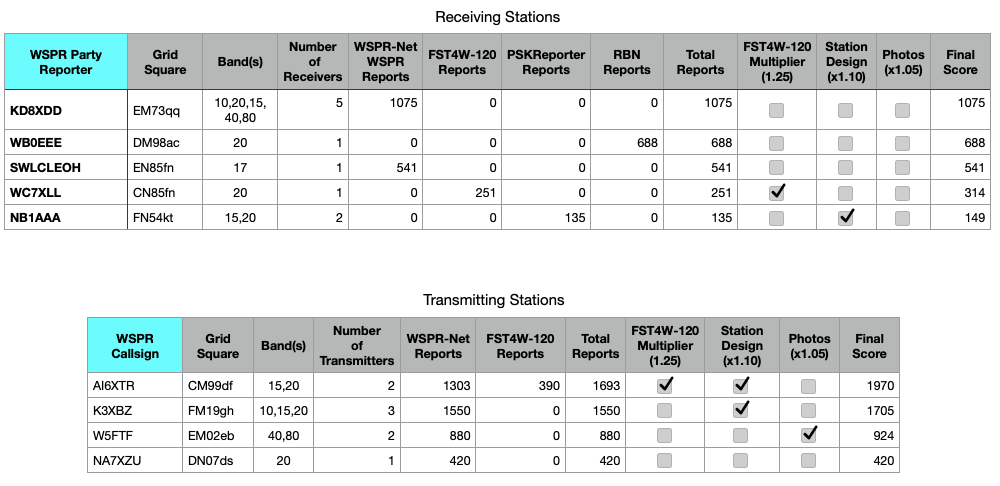
The contest results for the 2023 and 2024 GSSC events have been tabulated and published:     GSSC 2023 Results       GSSC 2024 Results


The following is an introduction to the GSSC.  Please visit the full GSSC Rules for detailed explanations of station requirements, and the post-event entry event and scoring process.  These FAQs are a brief, informal recap of the actual GSSC rules.  In case of conflicts or questions, the GSSC Rules should be considered the definitive resource.  The GSSC is but one event within the Festivals of Eclipse Ionospheric Science.

What is the Gladstone Signal Spotting Challenge?

The Gladstone Signal Spotting Challenge is planned to be a fun, friendly competition with a serious purpose.  Amateur radio operators (hams) and short wave listeners will be operating beacons and setting up receiving sites using WSPR, FST4W, PSK31 and Morse Code (CW).  (These activities are commonly referred to as 'spot generation', 'spot collection' and the resulting data, 'spots'.)  The spots generated and collected by GSSC participants will be used in scientific studies exploring the Earthly ionosphere’s reaction to the 2023 and 2024 solar eclipses passing over North America.  The studies should lead to a better understanding of the interactions between the Sun, the ionosphere, and radio wave propagation.  That research should benefit hams, professional broadcasters, satellite operators, and many other users of the radio spectrum.  

When will the GSSC occur? (Download and open the ICS file below to add the event to your electronic calendar)

  • April 8, 2024; 1400-2400 UTC; is the official 2024 GSSC event period.
  • The GSSC will start a few hours before the eclipse begins its transit across the US mainland, so baseline data can be gathered (it is important to know how well the ionosphere is refracting high frequency (HF) signals prior to the eclipse)
  • It will continue through the entire eclipse period, in order to study how high frequency (HF) propagation is affected by the eclipse (past experience suggests that ionospheric changes will be clearly visible in the data).
  • It will conclude a few hours after the eclipse transits beyond the US mainland, in order to observe and study the after effects of the eclipse, such as ionospheric recovery.

You do not have to operate the full GSSC period, though that would be most welcome.  If you only have an hour or two, try to schedule your operating when the eclipse path is nearest to your QTH.  That will raise the odds that your signals will be affected by the eclipse.   Eclipse paths can be seen at https://www.greatamericaneclipse.com/.

GSSC 2024.ics

Geographically speaking, who should participate?

HF radio signals are rarely restricted to small geographic areas, so we welcome hams and radio enthusiasts from all over the world to set up WSPR and FST4W equipment (both transmitting and receiving) and also PSK31 and CW receivers (often called 'skimmers').   

What equipment is required?

Transmitting stations have many options (only a few are listed here, HamSCI is not recommending any specific method or vendor):

Receiving setups have many options (All require appropriate software, depending on the mode being received, e.g. WSJT-X, WSPRdaemon, fldigiCW Skimmer)

  • Standard HF transceivers with audio/computer interfaces
  • Most off the shelf software defined radios (SDRs)
  • Build-it yourself kits  (https://qrp-labs.com/)

Simple antennas, being minimally directive, are often best for these modes.  Verticals, dipoles, loops, installed indoors or out, will work well.  But - if all you have is a set of stacked beams hundreds of feet in the air - that's fine.  Please be sure to note your antenna system details in your post-event GSSC entry.

For receiving stations, a reliable Internet connection is highly desirable.  All spot collection software should be configured to forward the spot data, in real time, to one of the on-line aggregation sites, such as wsprnet.org or PSKReporter.info.  This relieves individual receiving stations from needing hardware and procedures to store and deliver the to spots to HamSCI researchers after the GSSC.

Where can I learn more about modes such as WSPR and FST4W?

The WSPR protocol is more than a decade old, yet is still widely used for propagation monitoring.  There are many web resources explaining WSPR and how to set up a WSPR station, perhaps the best place to start is at the WSJT-X software home page.  There are many YouTube sites to explore, one suggestion is linked here <https://www.youtube.com/watch?v=KYlaLT5HLkM>

WSJT-X contains a much newer protocol with exciting capabilities, FST4W.  The WSPR Daemon site http://wsprdaemon.org/presentations.html has many details on that mode.

The HamSCI site has a list of publications  https://hamsci.org/publications on propagation research, including the use of WSPR data.

The GSSC looks like fun, but I also want to participate in the Solar Eclipse QSO Party.

Feel free to enter both events!  For example, you may wish to operate WSPR or FST4W transmitters on one or more one of the WARC bands while you operate in the SEQP.  FT4/8 operators:  The 2024 GSSC scoring will not include FT4 or FT8 receptions or transmissions.  Operators who enjoy those modes are encouraged to enter the Solar Eclipse QSO Party (SEQP).

Further suggestions?

Whether you are new or an expert in the areas of spot generation or spot collection, there's no need to wait for the GSSC to put your station to use.  Explore your options, assemble and operate your equipment as soon as you are ready.  You'll work the bugs out of your system well before the eclipse events.  Even better, you'll contribute valuable spot information to the on-line databases as Solar Cycle 25 ramps up.  You can follow our Sun's activity at https://spaceweather.com/ and https://www.solarham.net/ .

If you have questions regarding the Gladstone Signal Spotting Challenge, please send them to [email protected]


Participate in HAARP Experiment Studying Near Earth Asteroids

The High-frequency Active Auroral Research Program (HAARP) will be conducting a research campaign on December 27, 2022, with transmissions between 1100-2300 UTC (0200-1400 AKST) on 9.6 MHz. Actual transmit times are highly variable based on real-time ionospheric conditions. All information is subject to change. Amateur radio operators are encouraged to listen for and record the echo of HAARP off of the asteroid and submit demodulated recordings in .wav or .mp3 format. See official HAARP press release for more information.

This campaign will be in support of a NASA Jet Propulsion Laboratory project, in collaboration with Caltech’s Owens Valley Radio Observatory Long Wavelength Array (OVRO-LWA) and the University of New Mexico Long Wavelength Array (UNM-LWA), testing the potential use of HAARP/OVRO-LWA/UNM-LWA for interior sensing of near-Earth asteroids (NEAs). This experiment will reflect HAARP transmissions off of NEA 2010 XC15, and the echo will be received by OVRO-LWA and UNM-LWA. The target asteroid will be roughly two lunar distances away from Earth at the time of transmission.

Characterizing the interior structure and composition of NEAs is critical for advancing our understanding of solar system evolution and aiding in planetary defense. Multiple lines of evidence indicate that many, if not most, NEA interiors are rubble piles, with a subset that are monolithic solids, but definitive answers will influence the response to potentially hazardous objects. Approximately 80 known NEAs passed within one lunar distance in 2019. This will increase as new search observatories come online (e.g., the Large Synoptic Survey Telescope and NASA's NEO Surveillance Mission). In particular, the asteroid Apophis will pass Earth at 34,000 km (~5 Earth radii) in 2029 and presents one of the best opportunities for direct observations of an NEA. The proximity and frequency of NEA flybys creates opportunities to repeatedly probe and study the interiors of NEAs using ground-based radar systems and to fill a strategic knowledge gap in our understanding of these objects.

Amateur radio and radio astronomy enthusiasts are invited to listen to the transmissions/echoes and submit reception reports to the HAARP facility at [email protected], or by mailing a report to the address at the end of this document.

For real-time ionospheric conditions in Gakona, please consult ionograms from the HAARP Diagnostic Suite: https://haarp.gi.alaska.edu/diagnostic-suite

To request a HAARP QSL card, send reception reports to:
HAARP
P.O. Box 271
Gakona, Alaska 99586
USA

SEQP 2023 and 2024 FAQs

seqp_logo_small.jpg


The following is an informal introduction to the SEQP.  Please visit the full SEQP Rules for detailed explanations of all terms, links to useful sites, and just about everything needed to prepare for and operate in the SEQP.  The rules also contain details on after-contest scoring and log submission.  These FAQs are a brief, informal recap of the actual SEQP rules.  In case of any conflicts or questions, the SEQP rules should be considered the definitive resource.  The SEQP is but one event within the Festivals of Eclipse Ionospheric Science.

What is a Solar Eclipse QSO Party, and why is it being held?

The Solar Eclipse QSO Party is an opportunity for amateur radio operators (hams) to operate during the October, 2023 and April, 2024 eclipses, before, during and after they pass over North America.  Using various modes (CW, voice, and digital), two-way transmissions (QSOs) made during the SEQP will contribute to scientific studies focusing on the ionosphere’s reaction to the eclipse.  The studies should lead to a better understanding of the interactions between the Sun, the ionosphere, and radio wave propagation.  That research should benefit hams, professional broadcasters, satellite operators and many other users of radio spectrum.  

Results from the 2023 SEQP are available here 

Results from the 2024 SEQP are available here

When will the SEQP occur? (Download and open the ICS files below to add the events to your electronic calendar)

  • October 14, 2023; 1200-2200 UTC; is the official 2023 SEQP event period.
  • April 8, 2024; 1400-2400 UTC; is the official 2024 SEQP event period.
  • The SEQPs both starts a few hours before the eclipses begins their transit across the US mainland, so baseline data can be gathered (it is important to know how well the ionosphere is reflecting and refracting high frequency (HF) signals prior to the eclipses)
  • They continue through the entire eclipse period, in order to study how HF propagation is affected by the eclipse (past experience suggests that ionospheric changes will be visible in the data).
  • They conclude a few hours after the eclipses transit beyond the US mainland, in order to observe and study the after effects of the eclipse (such as ionospheric recovery, if any).

You do not have to operate the full SEQP hour period, though that would be most welcome.  If you only have an hour or two, try to schedule your operating when the eclipse path is nearest to your QTH.  That will raise the odds that your signals will be affected by the eclipse.  Eclipse paths can be seen at https://www.greatamericaneclipse.com/.

GSSC 2023.ics

2024 SEQP.ics

Who should participate?

The 2023 and 2024 eclipses will be passing over the continental United States, so researchers are most interested in having hams in North America participate.  Of course, HF radio signals don’t generally restrict themselves to small geographic areas, so hams from all over the world are welcome to operate and enter the SEQP.

What equipment is required?

Almost any ham station can participate.  An HF radio and antenna(s), usable on one or more of the 160, 80, 40, 20, 15 10 and 6 meter bands.  

It is extremely helpful to have contest logging software on a computer in your station.  The software guides you through the QSO making process, and it records all of the QSO data needed to submit your results after the SEQP.  It is those results which scientists will gather, from you and thousands of other participants, to aid in their research.

What can I expect if I get on the air during the SEQP?

The SEQP, while technically an 'operating event', closely mirrors fits the definition of a ‘contest’.  It is a friendly competition where participants endeavor to make many contacts in a short period of time, over the widest possible area.  QSOs will be short, with specific information (callsigns, signal reports, stations locations) exchanged between stations.  If it is your first contest, the first few minutes can be a bit overwhelming, but listen in, learn the operating rhythm, and jump in!

The SEQP encourages operation on CW, SSB and all digital modes.  The basic idea is to have as many hams as possible make as many QSOs as possible, then collect their QSO data, carefully studying it for trends indicating how far, how strong and where HF signals propagated vs. the path of the eclipses. 

Is there a 'fun factor' to the SEQP?

Yes, absolutely!  Operating events are supposed to be ‘fun’.  One way to increase the fun factor of any contest is to calculate a score for all participates, based on the number of contacts made, their geographic reach, and how many receiving stations heard their signals.  The HamSCI Data Processing Team will gather all of the entries submitted on the SEQP website, visit propagation databases such as WSPRNET.org and PSKReporter.info, and assemble millions of data points into a research database.  From that database the HamSCI Data Processing Team will be able to assign everyone a score, which will then be published some months after the SEQP.

What if I am not interested in two-way QSOs, but I am a WSPR or FST4W enthusiast?

There is a solar eclipse event for those who are interested in transmitting and receiving WSPR and FST4W signals: The Gladstone Signal Spotting Challenge

Ideally, many WSPR and FST4W transmitters will be on the air for the entire SEQP, their transmissions logged by receivers worldwide (or as far as propagation allows), enabling researchers to search out propagation effects of the solar eclipses as they move across our planet. 

If you have questions regarding the Solar Eclipse QSO Party, please send them to [email protected]


Gladstone Signal Spotting Challenge Rules for 2023 and 2024

Please bookmark this page and join the HamSCI eclipse mailing list for future announcements related to the GSSC.

Version 1.25 (added 2024 Google entry form)

8 Apr 2024


The Gladstone Signal Spotting Challenge is named for Philip Gladstone, N1DQ, the creator and maintainer of the PSKReporter.info website, also known as the Digimode Automatic Propagation Reporter.  Philip has made a tremendous contribution to Amateur Radio operating, citizen-science and ionospheric research through the data ('spots') which are collected and stored on PSKReporter.info.  This Wikipedia entry tells the story:  https://en.wikipedia.org/wiki/PSK_Reporter


The first contest results for the GSSC have been tabulated and published:  GSSC 2023 Results


FT4/8 operators:  The 2024 GSSC scoring will not include FT4 or FT8 receptions or transmissions.  Operators who enjoy those modes are encouraged to enter the Solar Eclipse QSO Party (SEQP).

The following are the complete, detailed rules for the GSSC.  For a quick introduction to the GSSC, please visit the GSSC FAQ page.  The GSSC is one event within the HamSCI Festivals of Eclipse Ionospheric Science.

I) Dates and Times

14 Oct 2023 1200 – 2200 UTC (Partial eclipse began ~1500 UTC in Oregon ended ~1840 UTC in Texas) Event complete - Results available

8 Apr 2024 1400-2400 UTC (Partial eclipse begins ~1710 UTC in Texas and ends ~2040 UTC in Maine)

Participants are encouraged to operate before, during and after the eclipse passes over the continental US.  Doing so will create baseline data (pre- and post-eclipse), and eclipse influenced data (during annullarity or totality) for the research team.

II) Objective

To generate observations of propagation by  WSPRNetPSKReporter and the Reverse Beacon Network, along with participants' event logs before, during, and after the eclipse on the amateur bands for the purpose of ionospheric sounding.  

    III) Station Requirements - Receiving WSPR, FST4W, PSK or CW 

    Reception reports for all of these modes will be useful to the scientific community in their propagation research efforts.

    1. Bands of interest are 160, 80, 40, 30, 20, 17, 15, 12, 10, and 6 meters, reception of CW and all digital modes included.
    2. A typical entrant will operate one CW Skimmer or PSK or WSPR or FST4W receiving node in a particular grid square.  
    3. Entrants may operate multiple nodes in a given grid square, each on different band/mode combinations (e.g., 40m WSPR & 20m WSPR & 15m WSPR all in grid EN91gm).​
    4. An entrant may choose to set up nodes in multiple grid squares.  If setting up multiple receiving nodes on a specific band/mode combination, those nodes must be separated by at least 100km in order to be useful to the science community (e.g., you may operate a 20m CW Skimmer site in grid EN91gn and another 20m CW skimmer site in grid EN90ha). 
    5. Be sure the receive node data is properly configured (especially Reporter, 6-character Reporter Grid) when sending reports to the RBN/PSK/WSPR/FST4W reception report aggregation sites and in your event log.
    6. WSPR nodes should monitor standard WSPR which uses 2 minute cycles (also known as 'WSPR-2' on wpsrnet.org).
    7. Please register your node(s) and configure them for automatic uploads to the appropriate network: Reverse Beacon Network (RBN – http://www.reversebeacon.net/), PSKReporter (https://pskreporter.info/), WSPRNet (http://www.wsprnet.org).  This is the most effective way to pass GSSC reception information on to the HamSCI Data Processing team, and also, the best way to earn points and recognition for your efforts.
    8. ​If you cannot register your receiving node(s) as suggested above, contact the GSSC Committee via the HamSCI mailing list prior to the event so we can discuss alternate arrangements for collecting your data.
    9. Ionospheric science is advancing at a rapid rate.  New modes, such as FST4W-120, are gaining popularity and recognition for their ability to provide additional opportunities for research.  If you have access to a Kiwi software defined radio (SDR) and you can run WsprDaemon software, please consider setting the configuration for receiving FST4W-120 signals on the HF bands.   A bonus multiplier will be awarded for reception of FST4W-120 signals - see Bonus Multipliers below.
    10. There are no provisions for mobile or rover operations.  Receivers should remain fixed in one location for the duration of the GSSC.

    IV) Station Requirements - Transmitting WSPR, FST4W

    WSPR transmissions are a well established method for generating propagation related data, useful to the science community.

    1. WSPR and FST4W transmissions are encouraged on 160, 80, 40, 30, 20, 17, 15, 12, 10, and 6 meters. Operation on multiple bands is encouraged - the more data generated, the better.  Transmissions of FST4W-120 are also encouraged on these bands. A bonus multiplier will be awarded for transmitting FST4W-120 signals - see Bonus Multipliers below.
    2. ​Use standard, legal WSPR and FST4W frequencies with a callsign which does not​ include a forward slash ( / ).
    3. Whenever possible, configure your WSPR transmitter as follows:  Transmit (Tx) frequency to be either above or below 1500Hz, Type 1 messages, transmit percentage (Tx %) to 100%, 2 minute WSPR cycles.​ (While usual WSPR etiquette is not to transmit at 100%,  the GSSC is a time-limited event, designed for observing transient phenomena of scientific interest, thus 'the more, the better'.). The GSSC will be most successful if participants choose random frequencies.  One method for picking a random frequency is to visit a random number generator site for frequency selection.
    4. Most users will want to transmit WSPR and/or FST4W using the latest stable release of WSJT-X, see K1JT's WSJT-X Page).  Stand-alone WSPR gear (such as hardware from Zach Tech, TAPR and others) will work as well.
    5. WSPR reception reports will be automatically logged on WSPRNet (wsprnet.org).  The HamSCI Data Processing Team will download relevant WSPRNet data after the contest, so it is not necessary to submit reception reports from WSPRNet.org or any other WSPR aggregator to prove that your WSPR transmitter was 'on the air'.

    V) Post-Event Entry Process

    At the conclusion of the GSSC event, use the Google form at the bottom of this web page  to enter callsign/identifier, contact information, bonus point requests and comments.  

    The HamSCI Research Team greatly appreciates all who contribute to the Gladstone Signal Spotting Challenge.  The Team would like to recognize all participants via postings on the HamSCI website and in other media.  ​Further, we may have questions for the participants as we work through the data analysis process.   Note: We will not share contact information with anyone outside the HamSCI Data Processing and Research teams.   We highly encourage allGSSC participants to complete the post-event entry process and receive a score and ranking once the results are tabulated.

    Note:  if you choose to upload files to Zenodo (see Bonus Point Multipliers, below) do that first, note your DOI (Digital Object Identifier) and include that in the Comments section of the post-event Google form.

    VI) Scoring and Post-Event Recognition

    Scoring each participant's contribution in a highly technical and widely diverse event such as the GSSC is a challenge for the party organizers.  The HamSCI team has decided to list the relevant details about each submission, in the format shown below, as a way to recognize and thank those who contributed to the GSSC, and, ultimately, to the Festivals of Eclipse Ionospheric Science.

    1. GSSC entries for transmit sites will be reported by three attributes:  Call, Reporter Grid, Frequency Band
      1. 'Call' must be be an amateur radio callsign (e.g. WR8ABC)
      2. 'Grid' must be the 6-character grid square where the transmitter is located
      3. 'Frequency Band' will be one of 160m, 80m, 40m, etc.
    1. GSSC entries for receive sites will be reported by three attributes:  Reporter, Reporter Grid, Frequency Band
      1. 'Reporter' may be be an amateur radio callsign (e.g. WR8ABC) or another textual identifier (e.g. OHSWLEN91)
      2. 'Reporter Grid' must be the 6-character grid square where the receiver is located
      3. 'Frequency Band' will be one of 160m, 80m, 40m, etc.
    Some months after the event, after the HamSCI Data Processing Team has concluded their work, a chart, similar to that shown here, will be published to the HamSCI website. 
     
    SEDMC Sample Results_0.png


      XI) Bonus Multipliers

      All bonus multipliers will be verified by the HamSCI Data Processing Team, after the Gladstone Signal Spotting Challenge, as part of the final score calculation process.

      1. Upload PDF file(s) of antenna and station design characteristics (1.10 multiplier). 
        1. Antennas: Type, location, orientation, E and H plane patterns, height above ground
        2. Station:  Block diagram, including equipment information (manufacturer/model, transmitter power), software names and version numbers
      2. Photograph(s) of station equipment and/or of the operating site (1.05 multiplier for the first photograph, more photos will not result in more multipliers)
      3. Receiving or transmitting FST4W-120 signals (1.25 multiplier specifically for FST4W-120 reports )
      4. Email the above files to [email protected]
      5. Upload any other files you believe would be useful to research for purposes to the public HamSCI zenodo.org community. You will be provided a DOI (digital object identifier) which you can then include on your post-event GSSC Google form to associate your GSSC entry with your bonus files.
      6. Bonus multipliers should be claimed on the GSSC post-event report form

      Zenodo files will be uploaded under Zenodo's 'open access' policy.  Data files and entry forms will likely be transferred to Zenodo in the future - under the same 'open access' policy.

      Station design characteristics and photographs may be used by the HamSCI Research Team to further their understanding of how and why signals propagated across the US before, during and after the eclipse.


      2024 GSSC Google Entry Form


      2023/2024 HamSCI Festivals of Eclipse Ionospheric Science (FoEIS)

      HamSCI Festivals of the Eclipse e-banner.jpg


      Data from the 2023 MW Recordings Event are available on Zenodo.  The complete story is here:  2023 MW Recordings

      Contest results from the 2023 and 2024 FoEIS events (GSSC, SEQP) have been tabulated and published: FoEIS Results


      The HamSCI Festivals of Eclipse Ionospheric Science will occur October 14, 2023 and April 8, 2024 during spectacular North American solar eclipses.

      The Festivals will consist of multiple events, each with a goal of increasing our understanding of sun-ionosphere-earth relationships.

      ​Participants will include volunteer amateur radio operators, short wave listeners and science researchers from multiple US universities.

      ♦ HamSCI FoEIS Contests (Non-WARC Bands, 6-160 meters)

      ♦ HamSCI FoEIS Research Events (40, 75 and 160 meters)
      ♦ Grape Personal Space Weather Station (Monitoring WWV, WWVH, CHU)
      • Using the Grape 1 and Grape 2 Low-IF receivers to measure Doppler Effects on the Reception of WWV and CHU (this is a long term experiment - monitoring and data gathering has research value on a 24/7/365 basis - beginning anytime before and continuing long after the eclipses)

      Additional Events Taking Place Across the Radio Spectrum

      • Medium Wave (MW) Recordings Event - Making IQ recordings (using software defined radios) of medium wave broadcast stations for future studies of eclipse-influenced ionospheric dynamics
      • ​VLF Reception Exercise (Definition in progress - please check back at a later date)


      2017 Eclipse Archive

      ​Participating Universities

      Media Hits

      See what others are saying about the Festivals of Eclipse Ionospheric Science:  FoEIS Media Hits Page
       

      Please bookmark this page and join the HamSCI eclipse mailing list for future announcements related to the HamSCI FoEIS.

      hamsci_collaboration.png

      Solar Eclipse QSO Party Rules

      Please bookmark this page and join the HamSCI eclipse mailing list for future announcements related to the SEQP.

      Version 1.07 (removed mention of PA, NV, AZ, SD QSO Parties from Section X)

      3 Dec 2022 / 25 Jul 2023 / 26 Sep 2023 / 6 Oct 2023 / 14 Oct 2023 / 27 Feb 2024 / 5 Apr 2024

      The following are the complete, detailed rules for the SEQP.  For a quick introduction to the SEQP, please visit the SEQP FAQ page.  The SEQP is one event within the Festivals of Eclipse Ionospheric Science.

      Log submission links are in Section X, below.

      Both N1MM+ and N3FJP logging programs officially support the SEQP.

      I) Dates and Times

      8 Apr 2024 1400-2400 UTC (Partial eclipse begins ~1710 UTC in Texas and ends ~2040 UTC in Maine)

      Participants are encouraged to operate before, during and after the eclipse passes over the continental US.  Doing so will create baseline data (pre- and post-eclipse), and eclipse influenced data (during annullarity or totality) for the research team.

      II) Objective

      To generate observations of propagation by the Reverse Beacon Network and PSKReporter event logs before, during, and after the eclipse on the amateur bands for the purpose of ionospheric sounding.

      The Solar Eclipse QSO Party (SEQP) is unique among ham radio competitions as it awards points for two-way QSOs (ham to ham contacts via radio) and bonus points for reception reports from skimmers, RBN nodes and the like.  

      Please be aware that the SEQP is one of many events to be held during the HamSCI Festivals of Eclipse Ionospheric Science.  You are welcome to participate in more than one event.  Each event has its own 'rules' page, accessible from the 'Festival' link above.

      III) Station Requirements

      1. All transmitting and receiving equipment used to make two-way QSOs must be located within a 500-meter diameter circle.
      2. Remote operation is permitted for two-way QSOs if the physical location of the remote stations meets the 500-meter diameter circle rule above, all station and operator licensing requirements are met for the remote location, and all category limitations in these rules are met.
      3. Portable operation, from a fixed location (such as POTA, SOTA, Field Day style setups, operated by individuals or groups) are welcome and encouraged (see bonus points below).
      4. There are no provisions for mobile or rover operations.  Transmitters and receivers should be fixed in one location for the duration of the SEQP.

      IV) Categories (to be listed separately in the results)

      1. Single-operator (only one transmitted signal, emitted for the purpose of making two-way QSOs, is permitted at any time)
      2. Multi-operator (one or more transmitters) (only one transmitted signal per band and mode, emitted for the purpose of making two-way QSOs, is permitted at any time)
      3. Checklog  Checklogs will not be scored, but submissions will be eligible for an SEQP Participation Certificate.  
      4. There are no restrictions on transmitter power (please be reasonable, don't run a kilowatt on FT8!), spotting assistance, or band changes.
      5. There are no band specific or mode specific categories.  All entries will default to 'Mixed Mode' and 'All Bands'.

      V) Bands, Frequencies and Modes for Two-Way QSOs

      160, 80, 40, 20, 15, 10, and 6 meter bands, using these modes: CW, SSB, digital (all varieties)

      Reminder:  By international agreements, the 60, 30, 17, and 12 meter bands may not be used for two-way contest QSOs.

      We anticipate plenty of activity. On CW and SSB, tune for stations calling 'CQ SEQP' near 'the 38s' (just a starting point - use any legal frequency) (CW +/-10kHz from 3538, 7038, 14038, etc.  SSB +/-25kHz 3838, 7238, 14328, 21338, 28338).  Activity on digital modes will be close to the usual activity centers but - please - spread out!  With many stations active, assist the receiving decoder stations to make quick and accurate measurements by leaving some space between signals.  You can find band planning information at 

      VI) Exchange for Two-Way QSOs

      Accurate Signal Report, 4-Character Grid Square.

      Example Exchange: 

      • W1AW:  CQ CQ SEQP de W1AW W1AW
      • N0AX:   N0AX
      • W1AW: N0AX 579 FN31
      • N0AX:  589 EM48
      • Optional:  Either station's callsign may be inserted at any time during an SEQP QSO.  Use your judgment to balance efficiency (short QSOs) against accuracy (knowing for sure who you worked).
      • If you miss any of the information, simply ask for a repeat (on SSB), or send AGN? (on CW).  Be sure to log what you receive.

      Notes

      1. On CW, call “CQ CQ TEST DE [your call] [your call] K” using a single code speed during the transmission.  Repetition of CQ and/or TEST as shown, as well as repetition of your callsign, maximizes the ability of the automated receivers to decode and spot your transmission. Please see Getting Spotted by the RBN for tips on getting spotted while calling CQ during the SEQP.
      2.  To determine your grid square, visit this Amateur Radio Grid Square Locator Tool.
      3. Signal Report
        • CW/Phone: The strength (S) value of RS(T) signal reports should represent the approximate peak S meter reading.  (Readings greater than S9 should be sent as S9.)
        • Digital: The preferred digital signal report is the SNR in dB as provided by the digital mode software. Alternatively, give the operator-determined RSQ (Readability - Strength - Quality) value. Note that N1MM+'s FT8 integration should automatically place SNR values into the Snt and Rcv signal report entry boxes, though you can do so manually if desired. (Researchers will assume any CW or digital signal report not in three-digit RST/RSQ format is an SNR [dB] value.)

      VII) Transmitting Digital Modes

      1. Many software authors publish guides to using their programs with FT8.  
        • Contesting software, such as  N1MM+ , interfaced with WSJT, is the best solution for operating FT8 in the SEQP, in part because it generates Cabrillo files.

        • Desktop logging packages, such as Ham Radio Deluxe, also work well with FT8 and other digital modes.  However, it will take a few extra steps to generate a log for uploading to the SEQP Scoring Robot.  (You will need to selectively export your SEQP QSOs as ADIF for the date and time you were operating in the SEQP.)
      2. PSK Reporter Spotting:  Many digital mode packages such as the open-source fldigi program and Ham Radio Deluxe/Digital Master 780 have options for automatically sending spots to PSKReporter.  Please enable this option to send additional data to PSKReporter.
      3. Operate normally, call CQ, answer CQs - same as you would when not involved in a contest or QSO party.
      4. Make sure your software is configured with your station location in the 4-character grid square format. This is especially important if you are operating portably.  See the Amateur Radio Grid Square Locator Tool.
      5. When using WSJT, it is important to do two things:
        1. ​Enable PSKReporter in the Reporting tab.  This will send received signal data to the PSKReporter website, where it will be saved for later retrieval by the HamSCI data analysts.
        2. Enter an antenna description on the Frequency tab.  This field must have some information, even something simple, like 'dipole' or 'mag loop', in order for PSKReporter to accept received signal data.
      6. Use an Internet connection for time sync and spotting if possible. Smart phone hotspots and public WIFI may provide Internet in portable locations.
      7. Use CAT radio control if possible, to accurately record QSO frequencies.
      8. In your Cabrillo soapbox, please note the type and version number of software used e.g. WSJT-X 2.5.4 or fldigi 4.1.23
      9. ​Optionally sign SEQP to attract other participating operators (e.g., "KV4PC SEQP 73").​

      VIII) Scoring

      Score = (QSO Points x Multipliers) + Bonus Points

      1. QSO Points: CW and Digital QSOs, 2 points each; SSB QSOs, 1 point each
      2. Multipliers: 4-character grid squares, counted once per band.
      3. The same station may be worked for QSO points on all SEQP bands and modes (e.g. N4BB contacts KD8GMH three times, on 40m CW, 20m SSB and 10m FT8).
      4. Duplicate contacts (second, third, fourth, etc. QSOs with a station previously worked on a given band and mode) are allowed after 10 minutes have elapsed since the previous QSO with that station (ie K8MAD may contact N4FCG for QSO points on 40m CW at 2130z, 2152z, and again at 2215z). Note: N1MM+ logging software will correctly accept and score duplicate QSOs as follows:
        1. If you work a station that is truly a duplicate (same callsign, band, mode) within 10 minutes, N1MM+ will warn you with a red DUPLICATE message and refuse to log the QSO.
        2. If you work a 'legal duplicate' per Rule #4, N1MM+ will warn you with a red DUPLICATE message but it WILL allow you to log the QSO.
      5. Bonus points earned (see Bonus Points section)

      The final score, including bonus points, will be calculated by the HamSCI Data Processing Team.  Claimed Scores are not required to be accurate.

       IX) Bonus Points

      All bonuses will be calculated after the SEQP and included with the final scores.  

      1. Operate during annularity or totality (the time of greatest coverage of the sun at your QTH): 100 points.  Visit eclipsewise.com to determine the eclipse start and end times at your QTH.  Note:  Not all participants will be able to claim this bonus, only those operating under the path of the eclipse will qualify.
      2. Operate outdoors (so you can see the eclipse): 100 points
      3. Operate at a public venue: 100 points
      4. Upload PDF or JPG file of antenna and station photos and/or design characteristics, information such as orientation, E and H plane patterns, height above ground, station block diagram: 100 points.
      5. Provide Effective Radiated Power relative to a Dipole (ERPD) on each band in a PDF or JPG file: 50 points per band.
      6. One bonus point will be awarded for each band and clock hour during which your signal was spotted in a grid square other than your own by the RBN, PSKReporter, or DX spotting network. Spots will be counted only during the contest period and only on the seven contest bands. A spot of your signal on any mode will qualify for the bonus point.  HamSCI data analysts will mine the data for these bonus points and apply them to your score.
      7. Soapbox comments (optional), PDF and JPG bonus points files should be submitted via e-mail to [email protected]

      X) Log and Score Submission

      A log upload 'robot' will be available for SEQP logs after the start of the contest.  Follow this link:  SEQP Log Robot

      Visit that page after the SEQP results are published in 2024 to download a Participation Certificate, and other certificates for the category winners.

      1. Submit logs using the Cabrillo format standard (see Logging Requirements, below). Cabrillo is the preferred log format.  However....
      2. Participants may also submit ADIF logs.  Typically, these will be FT4/8 QSOs, with the log coming from WSJT-X software.
      3. It is possible to upload both a Cabrillo log (e.g. for CW and SSB QSOs) and a second ADIF log (e.g. for FT8 QSOs).
      4. It is important to calculate and record the 6-character Maidenhead grid square of all transmitters used in the SEQP because the 6-digit grid square will be needed during the log submission process. Visit this Amateur Radio Grid Square Locator Tool for help in determining your 6-character grid square prior to uploading your log(s).  Note that although 4-character grid squares are used in the contest exchange, we ask for 6-character grids in the soapbox and log header.
      5. Any additional supporting files you believe would be useful to research may be posted to the public HamSCI zenodo.org community. You will be provided a DOI (digital object identifier) which you should include in your regular log's Cabrillo file header so we can associate the files with your log.
      6. Entrants agree that they have followed the SEQP rules to the best of their abilities.  Entrants agree to be bound by the decisions of the SEQP Scoring Committee.
      7. Log deadline:  30 days following the SEQP:  2359 UTC Sunday, May 7, 2024

      Zenodo files will be uploaded under Zenodo's 'open access' policy.  Logs and entry forms will likely be transferred to Zenodo in the future - under the same 'open access' policy.

        XI) Logging Requirements

        Logs should be in the Cabrillo format (http://www.arrl.net/cabrillo-format-tutorial).  All modern logging programs are capable of generating a Cabrillo format log.  Required fields:

        Frequency, Mode, Date, Time (UTC, not local), Sent Call, Sent Signal Report, Sent Grid, Received Call, Received Signal Report, Received Grid

        Example QSOs (or click here for full example log):

        QSO:  7030 CW 2017-07-20 2241 K2MFF             579  FN20 N3AO              599  EM97 
        QSO:  1816 PH 2017-07-20 2243 K2MFF             59   FN20 KC2LRC            59   FN13 
        QSO:  3590 RY 2017-07-20 2249 K2MFF             599  FN20 W1AW              599  FN31 
        QSO: 14070 PK 2017-07-20 2305 K2MFF             30   FN20 AD0AE             24   CM97 
        
        • Use the following mode codes should appear in the log.  N1MM+ should automatically generate logs with the correct codes.
         
              Mode     Cabrillo Code
        LSB/USB/AM PH
        CW CW
        RTTY RY
        PSK31 DG
        JT65 DG
        FT4/FT8 DG


        • Include station power level, 6-character grid square, antenna type, equipment list, and extra comments in the Cabrillo file soapbox. Please use the example below to allow easy and accurate post-event processing. Note that although 4-character grid squares are used in the contest exchange, we ask for 6-character grids in the soapbox and log header.

        Example soapbox:

        SOAPBOX: power=100 W, grid=FN20vt, antenna=dipole, equipment=IC7410
        SOAPBOX: comments=Totality was beautiful!
        
        • Use any software that supports the Solar Eclipse QSO Party. The N1MM+ contest logger natively supports the SEQP as log type "ECLIPSE". 
        • News Flash:  N3FJP Logger now supports the SEQP:  N3FJP VHF Contest Log 6.6.8 - updated to also support the Solar Eclipse QSO Party.  While the SEQP includes HF, the existing grid exchange in the VHF software was the best fit for SEQP's inclusion.  Just click Settings > Setup and select Solar Eclipse QSO Party. 
        • Any logging software that supports the ARRL VHF contest exchange format (signal report and grid square) can also be used, though you will have to edit your Cabrillo file, changing the contest name to ECLIPSE-QSO
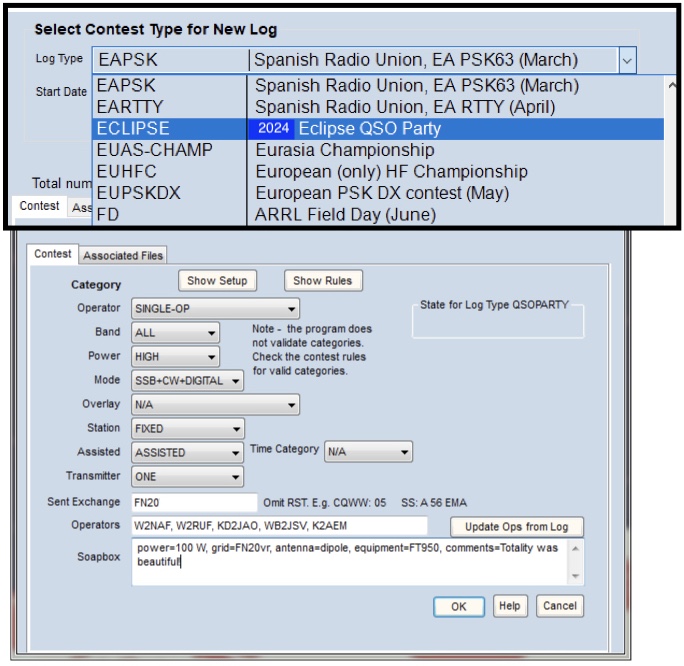
        N1MM for 2024 SEQP.001.jpeg

        Figure: "New Log in Database" dialog box from the N1MM+ contest logging program. Select log type "ECLIPSE", choose "SINGLE-OP" or "MULTI-OP", put your four-character grid square in the Sent Exchange box, and include station data in the soapbox.  Be sure the 'Mode' selection is set to SSB+CW+Digital if you plan to operate any digital modes.
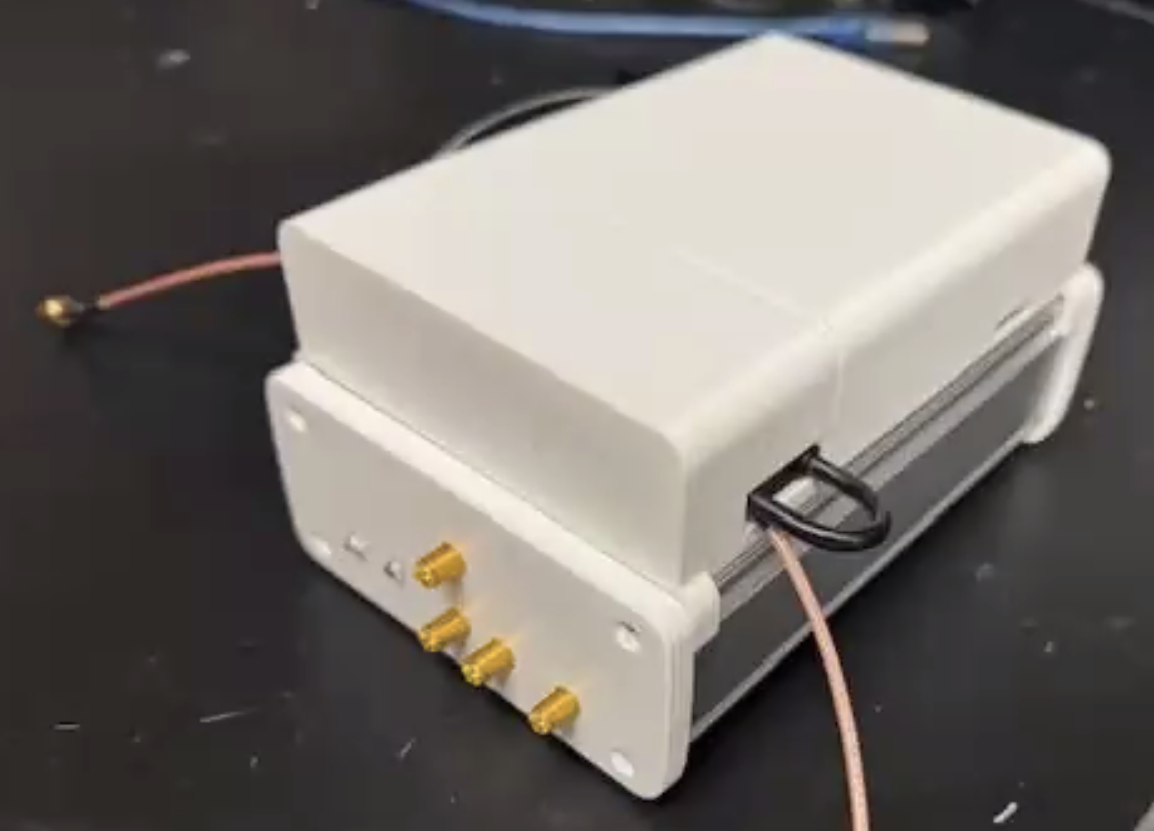
        HamSCI Workshop 2023 Participation Guidelines

        HamSCI was started by people who are both hams and professional scientists with the goal of bringing both communities together. We welcome participation from technically inclined and interested amateur radio operators in partnership with the professional scientific research community, for the advancement of science and understanding of the art of radio wave propagation and radio communications.
        • HamSCI workshop presentations and discussions are expected be consistent with the bullet points stated in the section below entitled “HamSCI and the Scientific Method.”
        • All HamSCI activity is expected to be conducted in a respectful and considerate manner. Discussions should never consist of personal attacks or crude language.
        • Members are expected to act in an ethical manner, which excludes the practices of plagiarizing, misusing, misrepresenting, or stealing data or ideas.
        • Presentations and discussions are expected to be of direct interest to the HamSCI community.
        • Commercial endorsements, unrelated / inappropriate event advertisements, or other similar material should not be presented.

        HamSCI Use of the Scientific Method

        • The scientific method is a core strategy for HamSCI activities.  This implies that research findings, especially those containing potentially unusual or novel results, should first undergo the rigors of this technique before widespread community acceptance.  Discussions may therefore potentially include direct questions and suggestions from the professional research community, along with reference comparisons to previously published material in the open refereed scientific literature.  
        • HamSCI workshop participants should always be willing to engage in scientific discussions in a spirit of open curiosity and knowledge advancement.  We emphasize that such interactions may include questions on findings, and these are not a sign of disrespect but, rather, of community interest in particular observations or implications.  The scientific method’s practices are a time-tested and vital method for producing a robust finding and avoiding incorrect conclusions based on misleading or potentially biased/flawed results.
        • Questions may also be posed about specific methodologies and equipment characteristics, and these are equally important to the HamSCI method and should be treated with an equally open spirit.  Investigations in this area may require follow-up data collection or coordinated measurement activities in partnership with the collective.
        • Members who violate the guidelines above may have their HamSCI participation privileges revoked at the discretion of the HamSCI Workshop Science/Program Committee.

        Non-Discrimination, Anti-Harassment, Sexual Harassment, and Sexual Misconduct Policies

        All participants of the 2023 HamSCI Workshop, which is hosted by The University of Scranton, are expected to treat each other with respect and follow The University of Scranton's current Non-Discrimination and Anti-Harassment Policy and Sexual Harassment and Sexual Misconduct Policy that are available from the University’s Office of Equity and Diversity website (https://www.scranton.edu/equity-diversity/). Participants who wish to report a violation of these policies may contact the HamSCI Workshop Science/Program Committee Chair, Dr. Nathaniel Frissell at [email protected]. Dr. Frissell is a full-time employee of The University of Scranton who will report the complaint to the University’s Title IX Coordinator and Office of Equity and Diversity. Alternatively, the University’s Title IX/Equity and Diversity Coordinator, Elizabeth Garcia, Esq., may be contacted directly at [email protected] or (570) 941-6645.


        HamSCI Workshop 2023: Forging Amateur-Professional Bonds

        HamSCI 2023 Banner

        March 17-18, 2023
        A Hybrid In-Person and Virtual Workshop

        Come join HamSCI at its sixth annual workshop March 17-18, 2023 at The University of Scranton. The primary objective of the HamSCI workshop is to bring together the amateur radio community and professional scientists. The theme of the 2023 HamSCI Workshop is Forging Amateur-Professional Bonds.

        This workshop will also serve as a team meeting for the HamSCI Personal Space Weather Station project, a NSF-funded project to develop a citizen science instrument for studying space weather from your backyard. The PSWS is led by the University of Scranton, and includes participation from TAPRCase Western Reserve University/W8EDU, the University of Alabama, the New Jersey Institute of Technology CSTRMIT Haystack ObservatoryDartmouth College, and the amateur radio community at large.

        The 2023 HamSCI workshop is organized by The University of Scranton with generous financial support provided by the United States National Science Foundation and ARDC. HamSCI is an officially recognized NASA Citizen Science project.

        Invited Speakers

        Invited Scientist Tutorial: Dr. Joseph Huba, “Modeling the Ionosphere with SAMI3”

        Photo of Dr. Joseph Huba
        Abstract: SAMI3 (Sami3 is Also a Model of the Ionosphere) is a global, comprehensive model of the ionosphere/plasmasphere system. It is based on the SAMI2 model developed at the Naval Research Laboratory (Huba et al., 2000). SAMI3 models the plasma and chemical evolution of seven ion species (H, He, N, O, N, NO and O). The ion temperature equation is solved for three ion species (H, He and O) as well as the electron temperature equation. Ion inertia is included in the ion momentum equation for motion along the geomagnetic field. The neutral composition and temperature can be specified by empirical models (e.g, NRLMSISE00, HWM14) or by first-principle atmosphere models (e.g., TIEGCM, WACCM-X, HIAMCM). SAMI3 uses a nonorthogonal, nonuniform, fixed grid. The grid is designed to optimize the numerical mesh so that the spatial resolution decreases with increasing altitude. SAMI3 can use an untilted or tilted dipole model of earth’s magnetic field, or an IGRF field model based on the Richmond apex model. A general overview of ionospheric physics and the SAMI3 model will be presented, as well as several applications of the code.
        Bio: Dr. Joseph Huba completed his PhD in theoretical plasma physics at the University of Maryland in 1975. Following his graduation, he joined the Naval Research Laboratory as an NRC post-doc and eventually became a staff member. Between 1995 and 2018, he headed the Space Plasma Physics Section, part of the Beam Physics Branch at the Naval Research Laboratory. He is now a Vice President of Syntek Technologies whose clients include the US Federal government. Dr. Huba’s main research interests include boundaries and wave phenomena in plasmas, physical processes governing the Earth’s upper atmosphere, and approaches to modeling these systems. Over the last two decades he has been dedicated to writing advanced computer codes to simulate these systems, which incorporate algorithms capable of simulating their sheer complexity. Dr. Huba is a Fellow of the American Physical Society and the American Geophysical Union.

        Invited Amateur Radio Tutorial: Mr. Jesse Alexander WB2IFS, “The Ham Radio Project: Exploring the Electromagnetic Spectrum”

        Photo of Jim Bacon G3YLA
        Abstract: The National Radio Astronomy Observatory (NRAO) recently received funding from ARDC for a new 2-year project designed to teach young adults about the electromagnetic spectrum while sharing the excitement of amateur (ham) radio among BIPOC and LGBTQIA+ students. The project goals are to: Introduce students to the Electromagnetic Spectrum and radio technologies; develop a scalable, shareable curriculum via SuperKnova; provide hands-on activities to deepen subject knowledge, and support student attainment of Technician and General Class Amateur Radio Licenses.
        Bio: Jesse Alexander WB2IFS/3 is an amateur radio operator leading the project's efforts to introduce young people to the wonder of the Electromagnetic Spectrum through hands-on ham radio based experiences. Jesse has been a licensed amateur radio operator since 1975, when he got hooked on amateur radio as a teenager reading ARRL's QST magazines at the Montclair Public Library in NJ. The stories about hams communicating with each other from Antarctic science stations and small Caribbean islands, chatting in Morse code through satellites, bouncing signals off the moon (Earth-Moon-Earth), and providing life-saving support during natural disasters filled him with wonder and curiosity! Jesse has more than 30 years of experience in technical writing, designing for people and companies involved in IT, wireless communications, and telecommunications, and is an award-winning poet, trainer, and entrepreneur. Jesse holds a B.S. and M.Eng. in Electrical Engineering from Howard University. He is a senior member of IEEE, ARES/RACES, ARRL/OTC, OMIK/ARC, and FISTS, and a life member of Alpha Phi Alpha Fraternity, Inc.

        Keynote Speaker: Dr. Patricia Reiff W5TAR, “Forging Amateur-Professional Bonds”

        Photo of Dr. Patricia Reiff W5TAR
        Abstract: Amateurs have played an important role in scientific research for many centuries. Up until the time of automated computerized telescope searches, virtually all comets were discovered by amateurs. As David Levy (of comet Shoemaker-Levy fame) said, "Amateurs have time to observe and enjoy the sky. Professionals have to submit proposals, take data, and write papers." Amateurs have long held associations with professional scientists in the realms of botany, ornithology, and even fossil and meteorite hunting. Ham Radio operators have worked closely with meteorologists as stormspotters and to provide communication in times of severe weather or other emergencies. It is a very natural outgrowth that Ham Radio amateurs team up with space physicists and aeronomers who study the ionosphere and its dependences on solar disturbances, in the general term of "space weather". Stanford first created VHF SID ionospheric monitors for amateurs and schools, and the "Radio Jove" program from Goddard has enlisted amateurs in monitoring solar and Jovian radio emissions. Ham beacons using Joe Taylor's compression algorithms now are used to track amateur balloons that have sailed four more times around the Earth. Amateurs team up with college students to provide communication with Cubesats. We are entering a new era of amateur radio providing important information on the structure and variability of the ionosphere, especially during eclipses. Several HamSCI talks and posters were shown at the recent Chicago AGU meeting, and we look to this group to lead the way for future uses of ham radio in "real" scientific research. talks and posters were shown at the recent Chicago AGU meeting, and we look to this group to lead the way for future uses of ham radio in "real" scientific research.
        Bio: Dr. Patricia Reiff W5TAR is a Professor in the Department of Physics and Astronomy at Rice University and was the founding Director of the Rice Space Institute. Dr. Reiff is highly regarded in both professional space science and amateur radio fields. She is a Fellow of the American Geophysical Union and has been involved in space plasma physics research for more than 50 years, with interests in magnetospheric reconnection, convection, plasma particle acceleration mechanisms, and solar wind control of the magnetosphere and ionosphere. She was a Co-I on the Dynamics Explorer, Polar, IMAGE, and Cluster Missions. She is a Co-I and Education/Public Outreach (EPO) lead for the MMS (Magnetospheric Multiscale Mission), and has served as Director for public education projects for over 30 years.  Her “Space Update” software has been used by over a million visitors at over 15 museums and distributed to 400,000 educators and learners. Dr. Reiff is also the developer and instructor of Rice University course PHYS 501: Physics of Ham Radio and trustee of the W5YG Rice University Amateur Radio Club. She has taught ham radio to new licensees as young as 8.
         

        W3USR Special Event Station

        The HamSCI Workshop will feature a real, working special event amateur radio station using the callsign W3USR! In-person participants are encouraged to stop by the station and guest operate or learn about how an amateur radio station works. We are grateful to the Murgas Amateur Radio Club K3YTL for organizing and running the W3USR Special Event Station. QSL information will be available here and on QRZ.com at a later date.

        Amateur Radio Licensing and Exams

        Although an amateur radio license is not a prerequisite to participate in HamSCI, we encourage participants to pursue a license. Getting a Technician Class license requires passage of a 35 question multiple choice test with a public question pool. Hamstudy.org provides free practice tests and materials and access to real online exam sessions. The ARRL also has an excellent selection of license study materials. You can also earn your amateur radio license at the HamSCI Workshop! An in-person Volunteer Examiner (VE) session will be held during the Saturday afternoon session. Please review the ARRL's "What to bring to an exam session" prior to the session. We are grateful to the Scranton Pocono Amateur Radio Club K3CSG (SPARK) for running this session.

        Amateur Radio Through the Ages Exhibit

        Amateur Radio Through the Ages Exhibit is an exhibit of historical amateur radios, QSL cards, QST magazines, and radio accessories on display at the University of Scranton Loyola Science Center / Hope Horn Gallery during the Spring 2023 semester. This exhibit is presented by the Murgas Amateur Radio Club K3YTL, The University of Scranton Amateur Radio Club W3USR, and The University of Scranton Department of Physics and Engineering, especially Tom Mayka W3TRM, Bill Gallagher WA3RA, Herb Krumich K2LNS, Ian Kellman K3IK, Phil Galasso K2PG, Elaine Kollar K3VQR, Dave Kirby N3SRO, Dr. Darlene Miller-Lanning, and Dr. Nathaniel Frissell W2NAF.

        Friday Night Banquet and Door Prizes

        The HamSCI Workshop Banquet will be help Friday, March 17, 2023 at the Historic Radisson Lackawanna Station Hotel and will feature keynote speaker Dr. Patricia Reiff, W5TAR. Thanks to a very generous donation from DXEngineering, this year we will have door prizes at the banquet! Door prizes include an Icom IC-7300 and ten $100 gift certificates to DXEngineering. Thank you, DXEngineering!

        dxe.jpg

        Logistics

        Registration

        In-Person Participation

        In-person registration is now closed. However, you can still join us virtually! Please see below.

        Virtual Participation

        For those who cannot attend in-person, we offer a virtual participation option. Virtual participation will be via the Zoom platform. All oral presentations, tutorials, and the banquet keynote will be available via this platform. These presentations will be available for viewing after the workshop as well. Virtual participation is free of charge.

        Location

        The 2023 HamSCI Workshop will be held in the Loyola Science Center on The University of Scranton Campus.

        Parking

        Parking is provided free of charge during this event on the 4th floor and roof of the University of Scranton Parking Pavilion. Participants without University of Scranton parking permits must park on the 4th floor or the roof of the parking pavilion.

        Lodging

        Lodging will be available at the Radisson Lackawanna Station Hotel Scranton and the Hilton Scranton & Conference Center. Both hotels are in walking distance to the workshop.

        • For reservations at the Radisson Lackawanna Station Hotel Scranton, please call 570-342-8300 or 866-715-7836 and say that you are reserving for the HamSCI Workshop. The rate of US$109/night + 13% tax is valid the nights of March 16 - 19, 2023.

        Transportation

        The University of Scranton and the HamSCI Workshop 2023 is located only 15 minutes from the Wilkes-Barre/Scranton (AVP) International Airport.

        Participation Guidelines

        All participants in the HamSCI Workshop 2023 are expected to treat each other with respect and follow the HamSCI Workshop 2023 Participation Guidelines, which include The University of Scranton's Non-Discrimination, Anti-Harassment, Sexual Harassment, and Sexual Misconduct Policies. In-person participants and presenters will be required to sign and abide by the The University of Scranton HamSCI Workshop 2023 Waiver.

        Science/Program Committee

        • Dr. Nathaniel Frissell, W2NAF, The University of Scranton, Chair
        • Mr. Jesse Alexander, WB2IFS, National Radio Astronomy Observatory
        • Dr. Kristina Collins, KD8OXT, Case Western Reserve University
        • Dr. Philip Erickson, W1PJE, MIT Haystack Observatory
        • Mr. Bill Liles, NQ6Z, HamSCI Community
        • Ms. Veronica Romanek, KD2UHN, The University of Scranton

        Local Organizing Committee

        • Dr. Nathaniel Frissell, W2NAF, The University of Scranton, Chair
        • Ms. Salisa Brown, The University of Scranton
        • Prof. Rachel Frissell, W2RUF, The University of Scranton
        • Ms. Frani Mancuso, The University of Scranton
        • Ms. Veronica Romanek, KD2UHN, The University of Scranton
        • Dr. Christine Zakzewski, The University of Scranton

        Questions?

        Please e-mail [email protected].


        University of Scranton, NSF, NASA Partner, and ARDC Logos

        The 2023 HamSCI workshop is organized by The University of Scranton with generous financial support provided by the United States National Science Foundation (NSF) and Amateur Radio Digital Communications (ARDC). HamSCI is an officially recognized NASA Citizen Science project.

        Congratulations to Dr. Kristina Collins, Ph.D., KD8OXT!

        Congratulations to Dr. Kristina Collins, Ph.D., KD8OXT, who successfully passed her thesis defense on Friday, November 18, 2022, to earn her Ph.D. in Electrical Engineering from Case Western Reserve University! Dr. Collins’ thesis is entitled Development Of A Low-Cost Meta-Instrument For Distributed Observations Of Ionospheric Variability and focuses on the development of the HamSCI Grape Personal Space Weather Station Network. For the past three years, Dr. Collins has been the funded Ph.D. student on the National Science Foundation Distributed Array of Small Instruments Personal Space Weather Station Project and been an important and influential leader in the HamSCI community. She currently serves on the HamSCI advisory board, leads the HamSCI Eclipse and Frequency Measurement Festivals project and WWV/H Scientific Modulation team, and served as chair of the local organizing committee for the 2019 HamSCI Workshop held at Case Western Reserve University. Dr. Collins has been interviewed on the ARRL's Eclectic Tech Podcast, has peer-reviewed papers published in the American Geophysical Union's EOS magazine and IEEE Geoscience and Remote Sensing Letters, and has papers under review at Atmospheric Measurement Techniques and EGUSphere. Dr. Collins is excited to be joining the Space Science Institute in Spring 2023 as a postdoctoral research fellow through the NSF Office of Polar Programs. In her upcoming project at SSI, she will be developing sonification and mixed reality tools to explore magnetometer data. In addition to her radio and space science, she enjoys sailing, scuba diving, and film projection. She is also a member of the Luxuriant Flowing Hair Club for Scientists.