Publications

RSGB Trophies Awarded to HamSCI Members

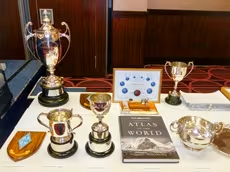
The Radio Society of Great Britain*, at its April, 2025 Annual General Meeting, continued its tradition of announcing the previous years' winners of the RSGB Trophies.

Two well known members of HamSCI were awarded trophies for 2024:

Dr Nathaniel Frissell, W2NAF:  Les Barclay Memorial Award - To recognize those who have made excellent contributions to propagation research and understanding, ranging from conducting original research, through to spreading knowledge about propagation and inspiring interest among amateurs, particularly citizen scientists.

Gwyn Griffiths, G3ZIL:  Wortley-Talbot Trophy - Awarded for the most outstanding experimental work in amateur radio such as the series of articles Gwyn authored that were published in the RSGB’s RadCom magazine during 2024.  In particular, he was recognized for “Height of Reflections at HF”, published in August 2024 issue.

Congratulations to Nathaniel and Gwyn for earning this much deserved recognition by their peers!


Past Winners

HamSCI members have long been recognized by the RSGB for their contributions to radio science.  Research on the RSGB website revealed the following past winners:

2023
Chris Deacon, G4IFX:  Harold Rose Plat- Awarded for outstanding contribution to 50 MHz

Gwyn Griffiths, G3ZIL: Les Barclay Memorial Award

2022
Gwyn Griffiths, G3ZIL and Glenn Elmore, N6GN:  Bennett Prize - For any significant contribution or innovation which furthers the art of radio communication

2021
Chris Deacon, G4IFX:  Les Barclay Memorial Award

2020
Jim Bacon, G3YLA:  
Les Barclay Memorial Award

2017
Jim Bacon, G3YLA: Harold Rose Plate

Chris Deacon, G4IFX: 1962 Committee Cup - Awarded for outstanding amateur development at VHF/UHF


***Corrections or omissions from this list should be brought to the attention of Gary Mikitin, AF8A, at the HamSCI mailbox.  Every effort will be made to update this article!


*About the RSGB

The Radio Society of Great Britain (RSGB) is the national membership organisation for amateur radio enthusiasts. The society was first founded in 1913 and incorporated in 1926.  The Society is dedicated to the development of the science and practice of amateur radio. It works to increase awareness and understanding of amateur radio and to make the hobby accessible to everyone.

Save the Dates: HamSCI Meteor Scatter QSO Party

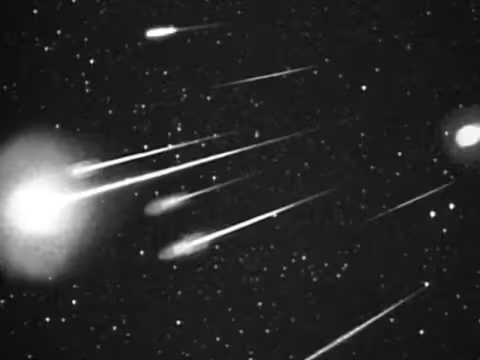
Meteor shower

HamSCI is preparing for a series of meteor scatter (MS) experiments later this year. The target storms are in August 11-12 (Perseids) and December 12-13 (Geminids). Preparation and testing are underway now. This is a combination 'special event' and a contest to generate contact data during meteor scatter events using 10 meters and 6 meters.  A 'How To' guide and event rules are under development.

Ten meters has not been used much for meteor scatter study due to past symbol rate limits.  But with recent changes in FCC rules, WSJT-X's MSK144 mode can now be used on HF bands. The HamSCI meteor scatter event will collect contact data from both 10 meters and 6 meters as part of the scheduled events in August and December. Data will be analyzed offline, comparing data from both bands, using both PSKReporter raw data and operator contact logs from WSJT-X. User data including both logged contact and received reports are necessary for valid experimental analysis. The latter can be provided by any receive system reporting on MSK144 through automated uploads to PSKReporter.

Currently, we need operators to be active (i.e., CQ-ing) on MSK144; or passive, if possible, reporting via PSK Reporter as 'monitors'. The best times are early morning hours prior to 10M opening to F2 propagation. Meteor scatter propagation occurs well below F2 and is supported in or near the E layer where the meteor ionization tracks occur. Saturday mornings are being used regularly to announce and coordinate 10M contacts using Ping Jockey Central. Announcements are also made on the Front Range Six Meter Groups.io listserv due to the substantial number of meteor scatter operators in that group.

To be successful, this effort needs operators, both active and passive. The upcoming April-Lyrids shower is an excellent time to set up your equipment and join with other operators preparing for the events later this year. If you do not have the time to be active, at least set up passive reporting. PSK Reporter currently has scarce 10M MSK144 monitors; so we need to increase those numbers during the early morning hours.

The best Lyrid times are around local midnight and early morning hours, peaking April 21-22, but also for several days before and after the peak dates. We expect large numbers of 10M and 6M MSK144 operators to be both active and passive during the extended Lyrid events.

Specific information for the August and December special events will be published as it becomes available, and as the planning matures.  The MSQP Operating Guidelines are under development.

Please join us in becoming both active and/or passive operator/participants in event planning during April. Eventually, the HamSci team will be collecting operator contact information, but for now, all that is required is for participants to report through PSKReporter.

Thanks to Bruce KN4GDX for the above.  Anyone wishing to help define these events, generate 'how-to' documents, or assist with data analysis afterwards, please join the HamSCIENCE Zoom telecons on Thursday afternoons (4PM US Eastern Time Zone).

(Meteor image courtesy NASA / Ames Research Center / ISAS / Shinsuke Abe and Hajime Yano)

Meteor Scatter QSO Party Operating Guidelines

I) Dates and Times

See the chart on the HamSCI MSQP Home Page for the six major showers that HamSCI will be investigating.  The next will be the Geminids, 13-15 December, 2026.  For operating purposes, the next event runs from 0000 UTC on 13 Dec to 2359 UTC on 15 December.

II) Operating Bands and Mode

HamSCI is interested in both 6 and 10 meter MS propagation. While 6 meters is the most popular MS band, 10 meters, a band having both HF and VHF characteristics, lends itself to novel research opportunities.

  1. This event is open to both Two-Way (transmit/receive) and Monitor (receive only) stations, fixed in position (no mobiles or rovers).
  2. The event will use both the 6 and 10 meter bands.  (50.260 and 28.145 MHz are popular MS operating frequencies.)
  3. If your station can operate both 6 and 10 meters - please operate on both, alternating bands at 20 minute intervals (xx:00, xx:20, xx:40)
  4. MSK144 is the only mode for this event.
  5. Be sure the receive node software (most likely, the WSJT-X suite) is properly configured, especially your 6-character Maidenhead Grid Square, for sending reports to the PSKReporter.  The data sent to, and collected by, PSKReporter will be critical to the research efforts underlying this event.
     

III) Valid Exchange

A valid 2-way MS QSO is defined as follows:

  1. Each station transmits and receives callsigns, grid squares and/or signal reports and acknowledges the other station’s information (typically by sending ‘R’ or ‘RRR’ or ‘RR 73’)
  2. There is no time limit when making a QSO.  Whether 15 seconds, 5 minutes or 15 minutes - multiple retries are common with the MSK144 mode.
  3. There is no penalty for 'dupes' (duplicate QSOs), meaning it is possible for one station to work another station 2, 3 or even 5 times during the operating period, on the same or a different band.


IV) Collection of WAV Files - Very important to the science objectives!

After the event concludes - all entrants - transmitters and monitors - please consider uploading your WAV file decodes to HamSCI's data repository at zenodo.org.  Complete instructions are available at the MSQP GitHub Site. In brief...  

  • Zenodo.org is a permanent, publicly accessible scientific data repository funded by the European Union via CERN
  • HamSCI's plan for the WAV files:  Develop an 'ping algorithm' - a method of identifying MSK144 decodes via meteor scatter vs. other propagation modes, such as sporadic E, tropo or simple F layer refraction.  If we are successful, we will run all of the WAV files through the algorithm, classifying the MSK144 decodes according to propagation method.  Then, we can examine the decodes according to our science objectives.
  • Uploading to Zenodo requires a user account/login ID/password.  There is no cost, no obligation, and perhaps best of all, no spam once your account is active! 
  • Be sure to locate the WAV file directory on your computer, and ZIP all of your MSQP WAV files (those covering the shower time period during which you are operating) into one file - that simplifies the upload process
  • Note that the instructions mention the HamSCI Community on Zenodo.  Please follow that step - so we have everyone's data consolidated under the HamSCI name
  • Save your login credentials in a safe place - you can use them again after future MSQPs, and for other research campaigns sponsored by HamSCI
  • If you have questions on any aspect of the MSQP, including the entry and WAV file upload process, please email us:  [email protected]

Thank you, in advance, for taking this important step in the name of citizen science and radio wave propagation research!
 

V) MSQP Leader Board

HamSCI has published a chart of data contributors (WAV files) for this year's showers:  MSQP Data Contributors (see bottom of page)

The HamSCI Research Team greatly appreciates all who contribute to the Meteor Scatter QSO Party.   The Team would like to recognize all participants via postings on the HamSCI website and in other media.   


VI) Science Objectives

Generate research-worthy data resulting from 6 and 10 meter meteor scatter operation. The data will be used by the research community in an attempt to answer science questions, such as:

  1. What factors influence meteor scatter propagation?
    • What are the similarities and differences between HF and VHF meteor scatter propagation?
    • How does propagation change between the various sporadic sources and minor showers with their different speeds and radiant geometries?
    • How does propagation change with radiant geometries, trail direction, meteoroid size, and speed?
  2. What is the typical duration of useful meteor scatter propagation?
    • How does this duration vary with operating frequency, transmitter–receiver distance, and meteor velocity?
  3. What is the minimum size of an amateur radio station needed to work meteor scatter operations?
    • What defines a 'successful' MS station?  Power levels?  Antenna type (directionality, gain, elevation, height, polarization)?  System ERP (effective radiated power)?
    • Does the definition of a 'successful' station (judged by both the number of contacts and the contact distances) vary between HF and VHF bands?  If so, what are the differences?
  4. How can meteor scatter communication be distinguished from other propagation modes?
    • What percentage of reported meteor scatter QSOs are actually meteor scatter?
    • What percentage are due to other modes (e.g., tropospheric, F-layer, E-layer, auroral)?
  5. How do optical and radar meteor observations compare with amateur radio observations?

The target communities include: Seasoned meteor scatter operators, meteor scatter 'rookies' (those who are new to the mode), researchers with an interest in radio wave propagation.  Data sources will include participant's log files (ADIF format), 'spotting' databases, such as PSKReporter.info and operators' WAV files from MSK144 decodes.


This is Version 4.1 of the MSQP Operating Rules and Guidelines, dated 24 May 2026 (updated next event name & dates)


Hamvention 2026

Hamvention 2025 Cropped.jpg

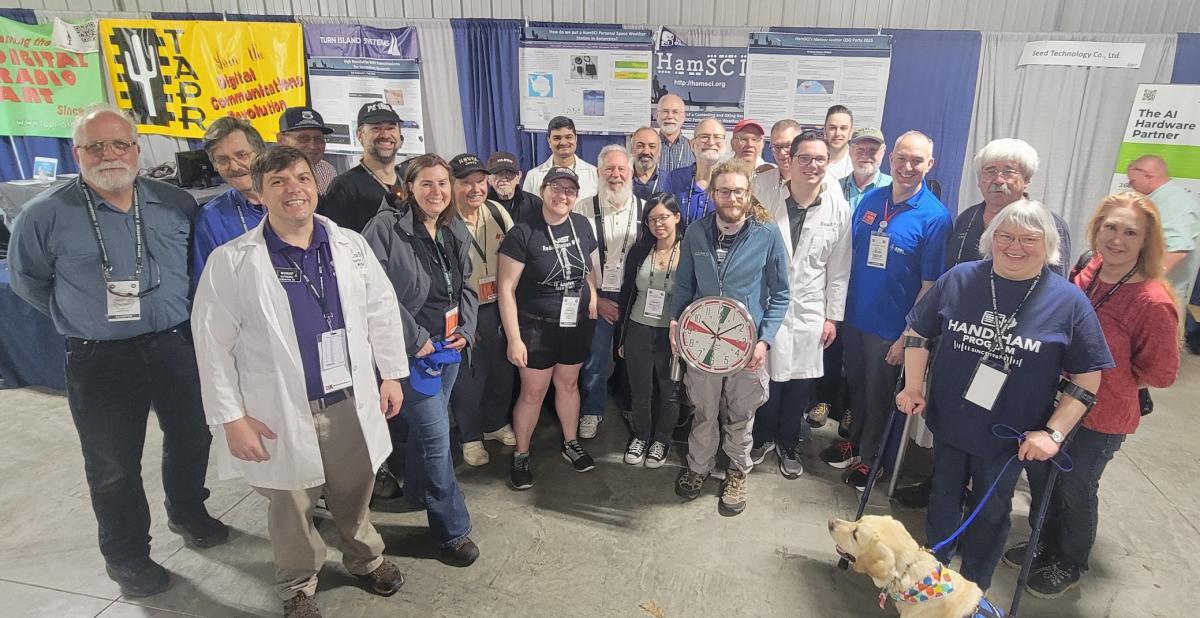
HamSCI at Hamvention 2025

Overview

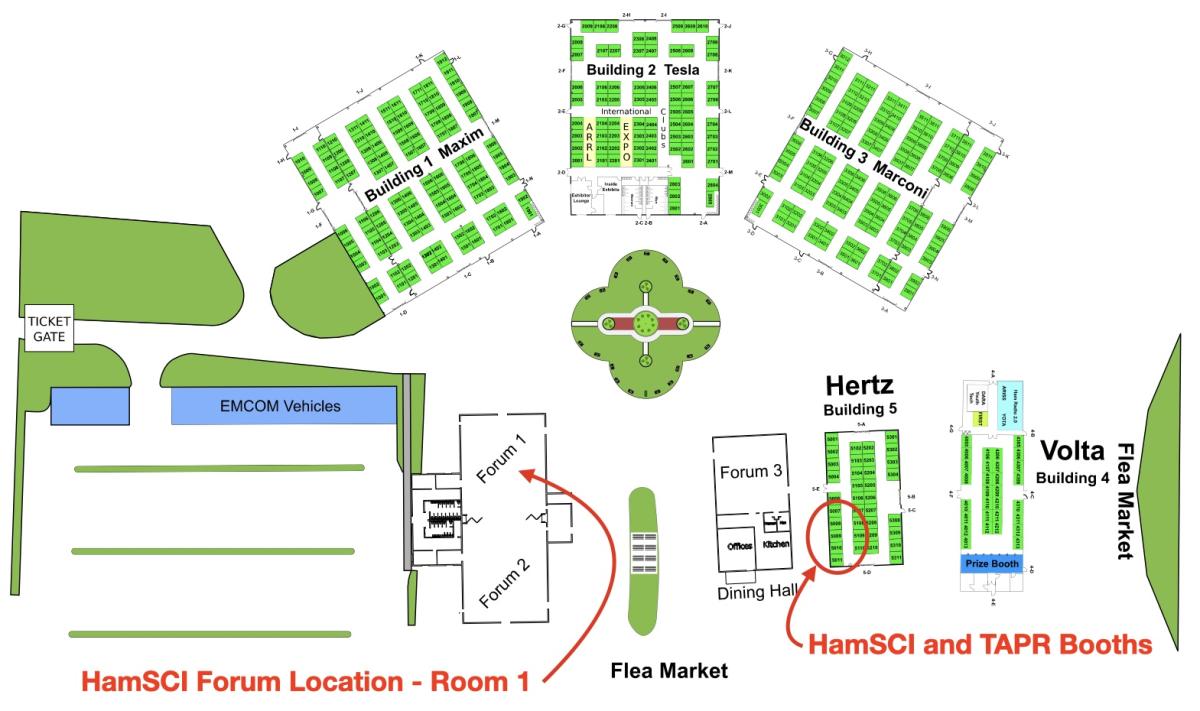
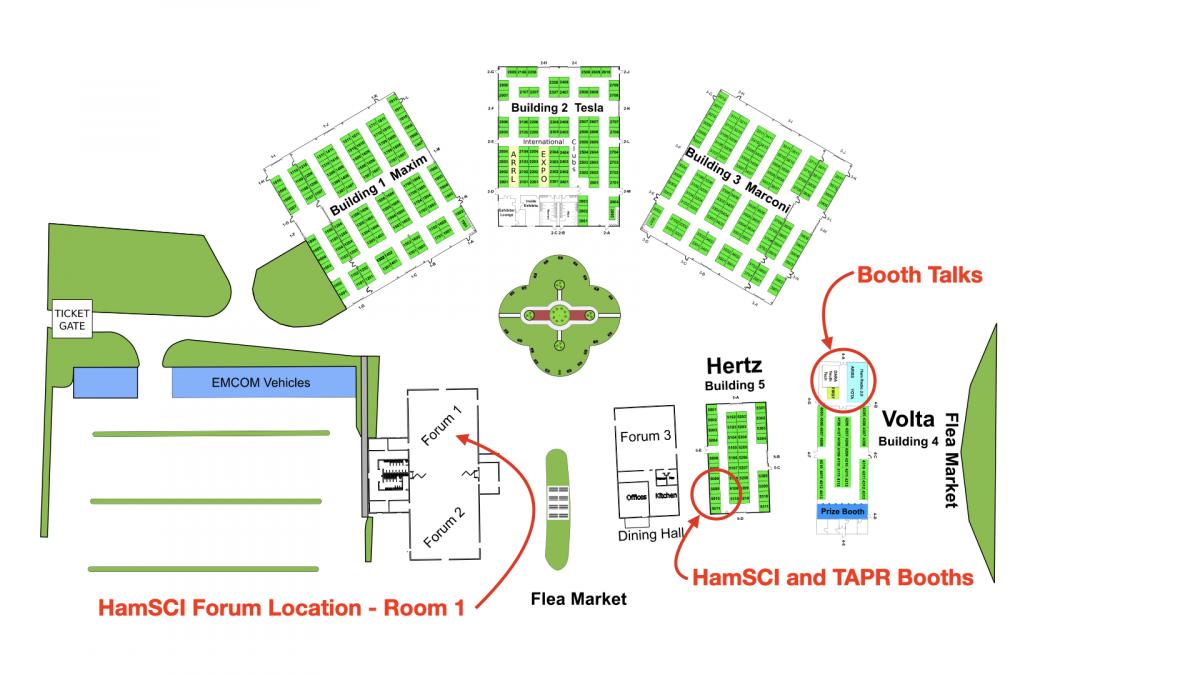
HamSCI will be present at the 2026 Dayton/Xenia Hamvention in order to further its goal of connecting the ham radio and scientific communities. Support for the 2026 HamSCI Hamvention activities comes from The University of Scranton, The Yasme FoundationTAPRThe National Science Foundation, NASA, and volunteers like you. Per long standing tradition, HamSCI will be hosting booths 5007 and 5008 (next to TAPR in Building 5, the Hertz Building, map below), hosting the HamSCI Forum on Friday morning . To help out, please sign up to volunteer at the booth.

Booth Volunteering

The 2026 HamSCI booth location will be in Building 5, the Hertz Building, same as in years past. Please stop by the booth anytime to sign up as a booth volunteer.   As a volunteer, we ask that you be present in the HamSCI booth during your agreed upon time slot, welcoming visitors, talking with them about HamSCI in general, HamSCI projects and your specific research interests. Feel free to bring demonstration items and materials and to talk about what you know best. The goal of HamSCI is to connect ham radio with scientific research. So, any topic that supports this goal is a good topic to talk about. The booth uniforms, are, by tradition, HamSCI labcoats.  Purchase details below.

Lab Coats

HamSCI labcoats may be ordered from https://www.allheart.com/lab-coats. Please use custom logo code C_5163_Q5D and place the logo on the left chest. Put your whole name on Line 1, and your call sign on Line 2. Use block style lettering.

Recommended Styles for 2026

Note that allheart.com changes their available styles on a regular basis. The important thing is to pick a white lab coat that fits you and put the custom logo code C_5163_Q5D and place the logo on the left chest.   Good news!  As of early April, the vendor is again offering embroidery, so please have the custom HamSCI logo, your name and callsign added to your lab coat.

Sample Order - Information confirmed April, 2026

AllHeart
Unisex 41" Ipad Pocket Lab Coat
Item #: ah-8004---whtlge
Color: WhiteWHT White
Size: LGE

Personalized: RIGHT CHEST
Font Style: Block Style
Thread Color: black
Text Line 1: Gary Mikitin
Text Line 2: AF8A
Logo: C_5163_Q5D


Group Photo 

A HamSCI group photo will be taken during the Hamvention on Saturday at 9:30 AM (1330 UTC) at the HamSCI booth. Wear your labcoats!

Questions?

If you have questions about HamSCI's 2026 Hamvention plans, please contact the HamSCI Team at [email protected].

Booth Location

HamSCI will be at Booths 5007 and 5008, next to TAPR, in Building 5, the Hertz Building.

2026 Hamvention Map.001.jpeg

HamSCI at Hamvention - Schedule and Map

Hamvention Logo


HamSCI will have a major presence at the 2025 Dayton Hamvention, to be held in Xenia, Ohio May 16-17-18, 2025 at the Greene County Fairgrounds. Hamvention is the world's largest ham radio gathering, recently scoring over 30,000 attendees per year. The Hamvention, sponsored by the Dayton Amateur Radio Association (DARA), is an extremely important event for engaging with the amateur radio community, sharing ideas, developing collaborations, and sharing scientific results.

The Hamvention 2025 theme is Radio Independence, expressing amateur radio's freedom to explore, communicate, and innovate without limits. HamSCI will be hosting booth 5008 (next to TAPR in Building 5, the Hertz Building), giving presentations in the ARISS/YOTA area and hosting the HamSCI Forum on Saturday afternoon. Support for the 2025 HamSCI Hamvention activities comes from The University of Scranton, the Yasme FoundationTAPR, the National Science FoundationNASA, and volunteers like you. 

As always, we welcome HamSCI booth volunteers.  As a volunteer, we ask that you be present in the HamSCI booth as your schedule permits, welcoming visitors, talking with them about HamSCI in general, HamSCI projects and your specific research interests. Feel free to bring demonstration items and materials and to talk about what you know best. The goal of HamSCI is to connect ham radio with scientific research. So, any topic that supports this goal is a good topic to discuss.  The booth uniforms, are, by tradition, HamSCI labcoats.  The 2025 HamSCI Booth Volunteer Page is up!

HamSCI Forum  

Date & Time Sponsor/Venue Title Presenter(s) Organization Home QTH(s)
Saturday, May 17th
4:00 PM
HamSCI-50x11.png
Forum Room 1
Opening Remarks from HamSCI's Founder Dr. Nathaniel A. Frissell, W2NAF HamSCI-50x11.png Scranton, PA

Saturday, May 17th
4:05 PM

HamSCI-50x11.png
Forum Room 1
HamSCI's Personal Space Weather Station:  Hosts Wanted! Gary Mikitin, AF8A HamSCI-50x11.png
 
Cleveland, OH

Saturday, May 17th
4:20 PM

HamSCI-50x11.png
Forum Room 1

Science Results from the 2023 and 2024 Solar Eclipse QSO Parties Dr. Kuldeep Pandey   NJIT Newark, NJ
Saturday, May 17th
4:35 PM
HamSCI-50x11.png
Forum Room 1
HamSCI's Meteor Scatter QSO Party

Ed Efchak, WX2R

HamSCI-50x11.png

Fairlawn, NJ

Saturday, May 17th
4:50 PM
HamSCI-50x11.png
Forum Room 1
Visualizing Personal Space Weather Observations with OpenSpace

Dr. Kristina Collins, KD8OXT

   Space Science Institute Cleveland, OH


Booth Talks:  ARISS, HamSCI and YOTA

Booth talks, social hours and demonstrations will be given by ARISS (Amateur Radio on the International Space Station), HamSCI and YOTA (Youth on the Air).  They will take place at Booth 4303 in the Building 4, the Volta Building (map below). 

Date & Time Sponsor Title Presenter(s) Organization Home QTH(s)
Saturday, May 17th
10:00 AM
ARISS     ARISS-USA  
Saturday, May 17th
11:00 AM
HamSCI-50x11.png Space Weather Effects on Quantum Communication Networks

Maj Michael Seery, USAF

Air Force Institute of Technology Dayton, OH
Saturday, May 17th
12:00 PM
YOTA Youth Social Hour YOTA  team YOTA Americas
Saturday, May 17th
1:00 PM
HamSCI-50x11.png 2024 Solar Eclipse Bill Mader, K8TE HamSCI-50x11.png Albuquerque, NM
Saturday, May 17th
2:00 PM
ARISS     ARISS-USA  

*YOTA = Youth On The Air (youthontheair.org), ARISS = Amateur Radio on the International Space Station (ariss.org)


2025 HamSCI Hamvention Map.001.jpeg

FoEIS Event Data Made Available

The raw data from a number of the 2023 and 2024 Festivals of Eclipse Ionospheric Science events can now be found for viewing and downloading on Zenodo.org.  No account or login information is required.  

The following data sets have been made publicly available:

2023/2024 Gladstone Signal Spotting Challenge

2023/2024 Solar Eclipse QSO Party

2023 Medium Wave Recordings Event

Each event title is a link to a an explanatory page here on hamsci.org, stating what has been archived, and how to locate it on Zenodo.org.

Image courtesy of Gerd Altman, under CCO 1.0 license.

MW Recordings - 2023 Eclipse - FoEIS

10 TerraBytes of MW Spectrum Recordings - Made During the October, 2023 Annular Eclipse

 By Nick Hall-Patch, VE7DXR

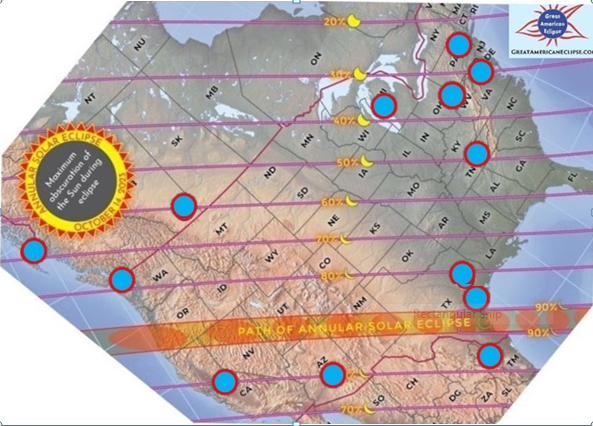
During the October 14, 2023 annular solar eclipse across the Americas, 13 HamSCI volunteers recorded the entire medium wave AM broadcast band (525-1705 kHz ) at 14 sites in Canada, the USA, Mexico and Portugal, using software defined radios (SDRs).  In addition, many participants made reference recordings of local sunrise and sunset periods on the day of the eclipse, as well as of the eclipse period on another day.   

A variety of SDRs were used, with most using network time protocol to establish accurate Universal Time on the computers recording the SDR data.  Some SDRs were locked to a frequency standard, while others recorded SDR files that included a frequency standard’s carrier.

The data sets have been uploaded to, and thoroughly indexed on, the free and open data repository, Zenodo.org:  2023 Eclipse MW Recordings. It is available for anyone who cares to examine the recordings, whether for research purposes or satisfaction of an individual's curiosity.  Note:  If the data is used for research, cited in an article, paper, poster or presentation, the participants would expect and appreciate the courtesy of receiving credit for their work.  Questions regarding attribution should be directed to HamSCI, via e-mail.

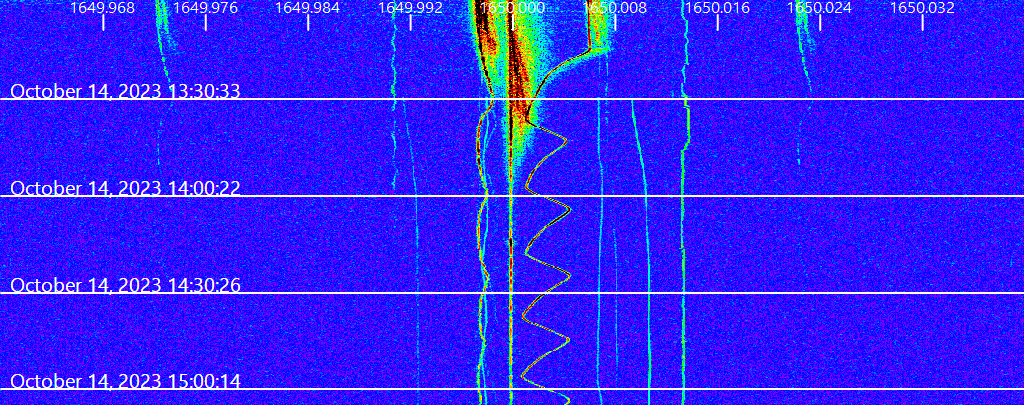
Well over 10TB of SDR data was recorded by these participants, so some form of “first look” visualization of the data was required, as, for each participant, there were 117 domestic broadcast channels to be examined, spaced at 10kHz intervals across the medium wave band.   This capability was provided by Carrier Sleuth software, which was used to process all the raw data, providing the ability to pinpoint AM broadcasters’ carrier frequencies in 80Hz wide waterfall displays of each channel in the medium wave band.    An example for the broadcast channel on 1650kHz, is shown in Figure 1.

MW Recordings 2023 Fig 1.png

Figure 1

These visualization files, with an extension of FFT, require Carrier Sleuth software to open them.  The latest version of the software can be obtained from Black Cat Systems, but a copy of it “CarrierSleuthWindowsMay2024.zip” is also provided in the Zenodo data set, courtesy of its developer, Chris Smolinski, W3HFU.

If desired, the user can obtain the raw data and re-examine it with Carrier Sleuth.   For example, with further processing, evidence of 9kHz spaced carriers from East Asian transmitters can be seen in a couple of the west coast data sets.  The software is also able to deliver CSV files of signal strength vs. time for a 0.1Hz slice of spectrum, which can allow the user to start processing specific parts of the data in earnest.  Details about the use of Carrier Sleuth can be found in the “CarrierSleuthOverview.pdf” file included at this site.

From the initial processing, at least 400 distinct enhancements in broadcaster signal strengths of 10dB or greater were observed in the raw data sets during the eclipse period.  Those data sets are identified on the Zenodo site referenced above, along with instructions for obtaining the raw data.  In the best examples of enhancements, audio from the broadcaster can be heard along with the carrier.  Some of these audio signals have already been identified by participants, but there are likely others still to be found, either by listening for station identification, or by comparing that audio with what was heard in recordings from other participants.

Eclipse participants and their data sets

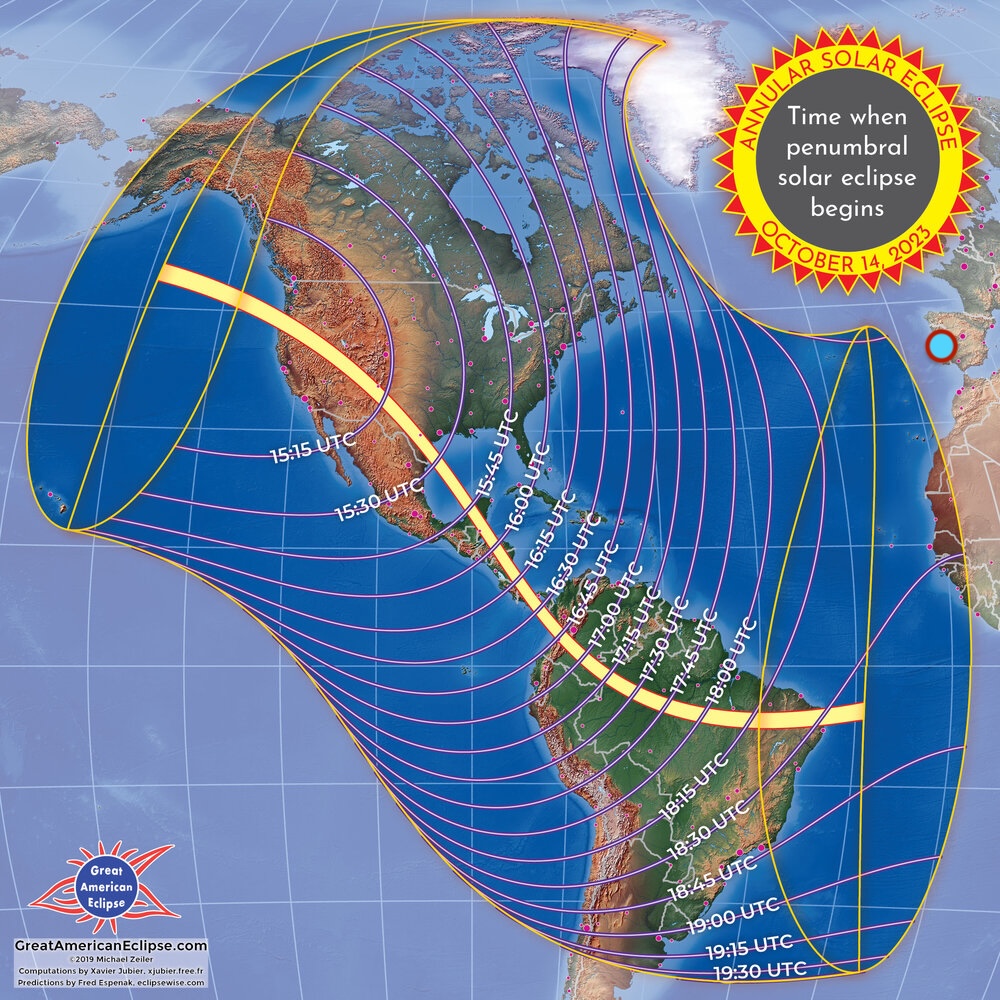
The 14 October 2023 annular solar eclipse took place across North and South America (Figure 2).   Almost all participants were in North America, but one, Carlos, CT7AUS, was just beyond the eclipse path, in Portugal, and searched for evidence of signals from the Americas fading in early at his location due to the eclipse-caused early darkness path across the Atlantic Ocean on 14 October.   

MW Recordings 2023 Fig 2.jpg

Figure 2

Carlos did note early signal enhancements on the 14th compared with the 13th and 15th of October, but the effect was subtle. His location is indicated in Figure 2 by a pale blue circle.

Figure 3 shows the participants in North America, again indicated by the pale blue circles.  Not all participants noted obvious effects from the eclipse in their data; that is noted in the Zenodo data sets, along with their Carrier Sleuth files and raw data available for their entire recording periods.

MW Recordings 2023 Fig 3.PNG

Figure 3

2023 MW Recordings were made by the following individuals.  Details on their equipment (receiver, antennas, software). locations, positions relative to the October 14, 2023 annular solar eclipse, can all be found on the Zenodo site referenced above.

Name Call Sign Maidenhead Grid Square

Carlos Nascimento 

CT7AUS IM58ht

Burke Baumann

KF7NP DM33wp

Nick Hall-Patch 

VE7DXR CO44aa and CN88ik

Richard Cook 

K6EEE CM98jp

Nigel Pimblett 

VE6TNF DN49rx

Mark Whittington

AG5RT EL19et

Manuel F. Caballero

XE2NNS

DL59vp

James Niven 

(none) EM10fc

Mike Boice

KW1ND EM75wx

Tim Tromp

KE8JFM EN63we

Bill Whitacre 

(none) FM18kt

John Glover 

W2QL FM18iu

John Ciccoletta 

N3BE FN12oh


Asteroid! What will HamSCI monitor on 22 December 2032?

The near-Earth asteroid 2024 YR4, as seen by the European Southern Observatory’s Very Large Telescope in January 2025, shortly after the object was discovered in December 2024. As of January 29, 2025, the asteroid has an almost 99 percent chance of safely passing Earth on December 22, 2032, but a possible impact cannot yet be entirely ruled out.ESO/O. Hainaut et al. (CC BY 4.0)

https://www.scientificamerican.com/article/will-asteroid-2024-yr24-strike-earth-in-2032/


The space news for 27 December 2024 is asteroid 2024 YR4.  It's heading this way, or at least roughly this way, with a current low estimated probability of Earth impact on December 22, 2032.  That estimate will almost certainly be reduced by there won't be much data with which to do that until 2028.


Editorial view from AD8Y, then, is that perhaps there will be some interesting radio phenomena to measure when the asteroid misses.  From this time of writing (Groundhog's Day 2025), the near-pass is about as temporally distant as the 2024 eclipse was from the 2017 one.  The event is unique.  What might we prepare?  What data should we be seeking to collect?


Let's talk about it...


73,


David AD8Y


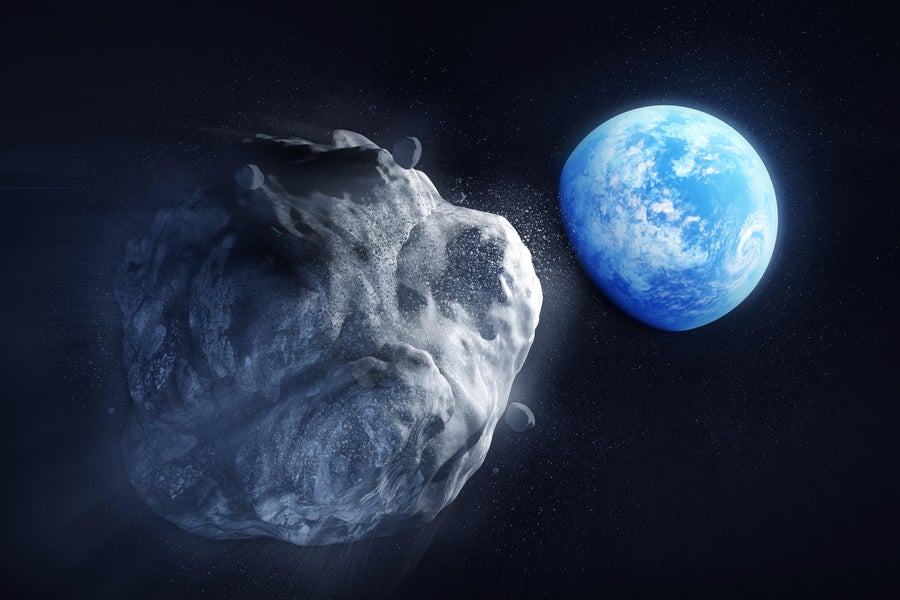
An illustration of an asteroid approaching Earth. James Thew/Alamy Stock Photo

HamSCI 2025 Program

Posters and presentations at the HamSCI workshop are made for community discussion and for exploration of new possibilities. Please note that these materials are not peer-reviewed.

All Workshop events to be held at the NJIT Campus Center, 150 Bleeker Street, Newark NJ 07103

Note:  Agenda is subject to change

Main workshop page: hamsci.org/hamsci2025

HamSCI Glossary

Friday, March 14, 2025

Eastern Daylight Time UTC NR Title Presenter Modality Location
7:15 AM EDT 1115z   Registration & Breakfast     Ballroom 
8:15 AM EDT 1215z   Day 1 Welcome & Opening Remarks

Dr. Teik C. Lim
President
New Jersey Institute of Technology

​Lt. Col. James Carter
Detachment Commander, AFROTC
Professor of Aerospace Studies

In-person Ballroom

ORAL SESSION I - Personal Space Weather Station
Chair: Gareth Perry

8:30 AM EDT 1230z O1

HamSCI Welcoming Address / DASI2 Project


Expanding the HamSCI PSWS Network

Dr. Nathaniel Frissell W2NAF
The University of Scranton

Gary Mikitin AF8A
HamSCI Community

In-Person Ballroom
8:50 AM EDT 1250z O2 Software Development for the Grape Personal Space Weather Station, V2 Cuong Nguyen KC3UAX
University of Scranton
In-Person Ballroom
9:10 AM EDT 1310z O3 Interim Findings of the HamSCI DASI2 HF Antenna Project Michael Hauan AC0G
WSPRDaemon / HamSCI Community
In-Person Ballroom
9:30 AM EDT 1330z O4 The Whistler Catcher Thin: An Advanced VLF Reception System Based on the Whistler Catcher Pi

Jonathan Rizzo KC3EEY
HamSCI Community

In-Person Ballroom
9:50 AM EDT 1350z O5 EZIE-Mag:  A low cost, science quality, magnetometer suite enabling global coverage Dr. Jesper Gjerloev
John Hopkins - Applied Physics Laboratory
Virtual  
10:10 AM EDT 1410z O6 HamSCI in OpenSpace: Toward Unified Visualizations of Geospace Data Dr. Kristina Collins
Space Science Institute
In-Person Ballroom
10:30 AM EDT 1430z   COFFEE BREAK     Ballroom

ORAL SESSION II - Solar Eclipses
Chair: Ryan Tolboom

10:50 AM EDT 1450z O7 HamSCI Solar Eclipse QSO Party (SEQP): Observations and Modeling on Ionospheric Effects Dr. Kuldeep Pandey
New Jersey Institute of Technology
In-Person Ballroom
11:10 AM EDT 1510z O8 The Solar Eclipse Inverse Problem Rachel Boedicker AC8XY
Case Western Reserve University
In-Person Ballroom
11:30 AM EDT 1530z O9 Analysis by Citizen Scientists of Doppler Radio Observations of the April, 2024 Solar Eclipse Dr. Mary Lou West KC2NMC
Montclair State University
In-Person Ballroom
11:50 AM EDT 1550z O10 Analysis of the HamSCI Solar Eclipse High Frequency Time Difference of Arrival Experiment Observations Using Automated Techniques

Alexandros Papadopoulos KC3WUD
University of Scranton

In-Person Ballroom
12:10 PM EDT 1610z O11 Approaches to Identifying Medium Wave Signal Enhancements in HamSCI's Solar Eclipse Data Nick Hall-Patch VE7DXR
HamSCI Community
In-Person Ballroom
12:30 PM EDT 1630z   LUNCH     Ballroom

ORAL SESSION III
Chair: Nathaniel Frissell

1:30 PM EDT 1730z O12 The HamSCI Book Club
Note:  There is optional reading material associated with this presentation.  Click on the abstract to find a copy of Romeo and Juliet andCode Poems.  Only "RJ", from Code Poems,  will be discussed.
Dr. David Kazdan AD8Y
Case Western Reserve University
In-Person Ballroom
1:50 PM EDT 1750z O13 High-Frequency Signal Strength Simulation at GRAPE Personal Space Weather Stations Using PHaRLAP Ray Tracing Gamal Zayed
American University in Cairo 
In-Person Ballroom
2:10 PM EDT 1810z O14 Ionospheric Variability's Impact on HF Propagation: Insights from Grape V1 Doppler Residuals and PHaRLAP Ray Tracing Sabastian Fernandes
New Jersey Institute of Technology
In-Person Ballroom
2:30 PM EDT 1830z O15 Radio Wave and GPS Scintillation Impacts of the 10 May 2024 G5 Geomagnetic Storm Observed at the United States Military Academy Jason Derr KI5YMW
United States Military Academy
Virtual Ballroom
2:50 PM EDT 1850z O16 Post-sunset sporadic F propagation: A sign of electron density isopleth convergence?

Gwyn Griffiths G3ZIL
WSPRDaemon / HamSCI Community

In-Person Ballroom
3:10 PM EDT 1910z O17

Distributional Characteristics of Short-Term 2022 20-Meter Sequential Matched WSPRDaemon Noise Observations

Bob Gerzoff, WK2Y
HamSCI Community
In-Person Ballroom
3:30 PM EDT 1930z   COFFEE BREAK WITH SNACKS     Ballroom

ORAL SESSION IV
Chair: Gary Mikitin

3:50 PM EDT 1950z O18

Climatology of Large-Scale Traveling Ionospheric Disturbances Observed with 14 MHz Amateur Radio Using a Novel Automated Detection Technique

Diego Sanchez KD2RLM
University of Scranton
In-Person Ballroom
4:10 PM EDT 2010z O19 Effect of the equatorial plasma bubbles on amateur radio communication: Full-wave simulation Study

Eun-Hwa Kim
Princeton Plasma Physics Laboratory 

In-Person Ballroom
4:30 PM EDT 2030z O20 Generating and Receiving GPS-Timed Acoustic and Radiofrequency Costas Array Sounding Signals Solomon El-Gannam KZ5FZH
Case Western Reserve University 
In-Person Ballroom
4:50 PM EDT 2050z O21 GPS-Disciplined Shortwave Beacon for High Rate Of Measurement Ionospheric Propagation Analysis Ruslan Gindullin W2HAT 
Case Western Reserve University
In-Person Ballroom
5:10 PM EDT 2110z O22 The Physical Nature of Sporadic-E  Dr. Chris Deacon G4IFX
The University of Bath
In-Person Ballroom
5:30 PM EDT 2150z   Day 1 Closing Remarks Dr. Gareth Perry KD2SAK
New Jersey Institute of Technology
In-Person Ballroom

Friday Night Banquet
NJIT Campus Center

Chairs: Nathaniel Frissell and Gareth Perry

6:30 PM EDT 2230z   Banquet Begins     Campus Center Atrium
7:30 PM EDT 2330z   Keynote: Discovering Amateur Radio Bob Inderbitzen NQ1R
Director of Marketing and Innovation, ARRL
In-Person Campus Center Atrium

Saturday, March 15, 2025

Eastern Daylight Time UTC NR Title Presenter Modality Location
7:15 AM EDT 1115z   Registration & Continental Breakfast     Campus Center Ballroom
8:30 AM EDT 1230z   Welcome & Opening Remarks   In-Person Campus Center Ballroom

ORAL SESSION V
Chair: Kuldeep Pandey

8:50 AM EDT 1250z O23 Predictive Implications of Space Weather on Quantum Network Functionality Brett Martin
U.S. Air Force Institute of Technology
In-Person Campus Center Ballroom
9:10 AM EDT 1310z O24 PAC e-Lab's Space Education Initiatives in Africa through Amateur Radio on the International Space Station Miracle Chibuzor Marcel
Pan-African Citizen Science e-Lab (PACS e-Lab)
Virtual Campus Center Ballroom
9:30 AM EDT 1330z O25 The NRAO Exploring the EMS/Ham Radio Project: The Way Ahead Jesse Alexander WB2IFS
National Radio Astronomy Observatory
In-Person Campus Center Ballroom
9:50 AM EDT 1450z O26 Integrating Amateur Radio into the Introductory Electricity and Magnetism Curriculum at Kettering University Dr. Ronald E. Kumon K8DTJ
Kettering University
Virtual Campus Center Ballroom
10:10 AM EDT 1410z   COFFEE BREAK     Campus Center Ballroom

INVITED TUTORIALS I
Chair: 

10:30 AM EDT 1430z T1 INVITED TUTORIAL: The Role of the Polar Vortex in Atmosphere-Ionosphere Coupling

Lynn Harvey

In-person Campus Center Ballroom
11:00 AM EDT 1500z T2 INVITED TUTORIAL: Radio Wave Propagation and Antenna Fundamentals Steve Cerwin WA5FRF
HamSCI Community
In-person Campus Center Ballroom
11:30 AM EDT 1530z   LUNCH     Campus Center Ballroom

INVITED TUTORIALS II
Chair: Hyomin Kim

1:30 PM EDT 1730z T3 INVITED TUTORIAL: GNU Radio Dr. Derek Kozel
GNU Radio Community
In-Person Campus Center Ballroom
2:00 PM EDT 1800z T5 INVITED TUTORIAL: A History of Space Weather Research

Dr. Louis Lanzerotti
Distinguished Research Professor, Center for Solar-Terrestrial Research,
New Jersey Institute of Technology 

In-Person Campus Center Ballroom

POSTER / DEMO / BREAKOUT SESSION

2:30 PM EDT  1830z  

POSTER / DEMO SESSION BEGINS

    Campus Center Ballroom
3:00 PM EDT 1900z   COFFEE BREAK WITH SNACKS      
      BREAKOUT SESSIONS      

2:30 PM EDT


3:00 PM EDT

1830z

1900z

B1

B2

NJIT Makerspace Tour

NJIT Campus / K2MFF Tour


Meet in Campus Center

Meet in Campus Center

4:00 PM EDT

4:30 PM EDT

2000z

2030z

B3


B4

NJIT Makerspace Tour


NJIT Campus / K2MFF Tour


Meet in Campus Center

Meet in Campus Center

4:30 PM EDT 2030z B5 Collegiate Amateur Radio Program (CARP) Panel   In-Person Campus Center Ballroom
5:30 PM EDT 2130z    DINNER     Campus Center Ballroom
             
      POSTERS AND DEMOS      
    P01 Monitoring tropospheric propagation at 24 GHz: A pilot study

Gwyn Griffiths G3ZIL
HamSCI Community

In-Person Campus Center Ballroom
    P02 Why you should attend the Youth on the Air camp
Katherine Campbell KE8LQR & Jack Roberts W9RFT
Youth on the Air (YOTA)
In-Person Campus Center Ballroom
    P03 Integration & Validation of a Standardized Library & File Format for PyDARNMUSIC & DARNtids: Migrating From Legacy Pickle Files to HDF5 & Implementing a Comprehensive Testing Suite

Nicholas Guerra AC3LB
The University of Scranton

In-Person Campus Center Ballroom
    P04 Investigation of Electromagnetic Wave Propagation in CB Radio with Elementary Students:  A 'Super Bowl' Mystery Alexandre Takio Kitigawa
Department of Education of Insaial, Brazil
Virtual Campus Center Ballroom
    P05 Sunrise: A natural perturbation enables identification of propagation modes from distinct Doppler shifts Gwyn Griffiths G3ZIL
HamSCI Community
In-Person Campus Center Ballroom
    P06 Understanding HamSCI Magnetometers Measurements and Observations Rachel Frissell W2RUF
The University of Scranton
In-Person Campus Center Ballroom
    P07 How Do We Put a HamSCI Personal Space Weather Station in Antarctica? Rebecca Potter KE2EBI
The University of Scranton
In-Person Campus Center Ballroom
    P08 HamSCI as a Tool for Equatorial Plasma Bubbles Study Kornyanat Hozumi
The University of Scranton
In-Person Campus Center Ballroom
    P09 A Statistical Study of Ion Temperature Anisotropy Using AMISR Data

Aidan Thayer
New Jersey Institute of Technology

In-Person Campus Center Ballroom
    P10 Are Weak Type II Radio Bursts Associated with Shocks Driven by Coronal Mass Ejections? KesUranNu Baylor
New Jersey Institute of Technology
In-Person Campus Center Ballroom
    P11 A Low-Cost Low-Power Chirp Ionosonde for Studying Eclipse Ionospheric Impacts Gerard Piccini KD2ZHK
The University of Scranton
In-Person Campus Center Ballroom
    P12 WSPRsonde Installation at WWV/WWVB Dave Swartz W0DAS
HamSCI Community
Virtual Campus Center Ballroom
    P13

Bridging Indoor RFID Localization and Long-Range Sensing: Exploring Energy-Efficient Backscatter Positioning

Gamal Zayed
American University in Cairo 
In-Person Campus Center Ballroom
    P14

Enhancing Lidar-GPS Fusion for Localization: Integrating Ionospheric Modeling with NeQuick G and V2V Implementation

Gamal Zayed
American University in Cairo 
In-Person Campus Center Ballroom
    P15


Turkish Morse Code (TMK)

Hanife Kılıç
Karabuk Science and Art Center School  YM2VKA

Virtual Campus Center Ballroom
    P16

Machine learning applied to the ray tracing model of the OTH radar

Zenon Saavedra
Universidad Nacional de Tucuman - Argentina

In-Person Campus Center Ballroom
    P17 HamSCI's Meteor Scatter QSO Party McKenzie Denton KO4GLN
HamSCI Community
Virtual Campus Center Ballroom
    P18

Effect of near total solar eclipse on radio propagation of HF, Weak-Signal Propagation Reporter (WSPR) transmissions

Mindy Hull, MD KM1NDY
HamSCI Community
In-Person Campus Center Ballroom
    P19

Southern Hemisphere MSTID response to a Sudden Stratospheric Warming Observed by the Falkland Islands SuperDARN Radar

James Fox KE2ANL
The University of Scranton
In-Person Campus Center Ballroom
    P20

Development of a Contesting and DXing Dashboard for the HamSCI Personal Space Weather Station

Owen Ruzanski KD3ALD
The University of Scranton
In-Person Campus Center Ballroom
    P21 Investigating January 2016 Traveling Ionospheric Disturbance Causes with SuperDARN Michael Molzen KE2ENS
The University of Scranton
In-Person Campus Center Ballroom
    P22 University of Scranton W3USR Teaching Amateur Radio at the Lackawanna Blind Association Tom Pisano KE2BAC
The University of Scranton
In-Person Campus Center Ballroom
    P23 Electron thermionic emission and tunneling  transport in spherically symmetric charged grains in dusty plasmas Rebecca Potter KE2EBI
The University of Scranton
In-Person Campus Center Ballroom
    P24 The IP400 Networking Project Steve Stroh N8GNJ
Zero Tries Newsletter
In-Person Campus Center Ballroom
    P25 Incorporating HamSCI Project into a College Physics Course: A Progress Report Hyomin Kim KD2MCR
New Jersey Institute of Technology
In-Person Campus Center Ballroom
             
    D01 WSPRDaemon GRAPE Software Defined Receiver + PSWS Antenna Elmer Musser N3AGE In-Person Campus Center Ballroom
    D02 NOAA Weather Satellite Reception Bill Liles NQ6Z In-Person Campus Center
             

HamSCI Workshop 2025 Abstract Submission Open

The abstract submission window for the 2025 HamSCI Workshop, to be held at the New Jersey Institute of Technology, March 14-15, 2025, is now open.  The abstract submission deadline, for both oral presentations and posters, is February 10, 2025.  Abstracts can submitted via this link:  2025 Workshop Abstract Submission

The Workshop theme for 2025 is HamSCI's Big Year, recognizing the efforts, observations and findings resulting from the October, 2023 and April 2024, solar eclipses over North America.  Of course, we expect that presentations, posters and conversations will cover much more than just eclipse-related material.  HamSCI and its members are interested in a broad range of space physics topics, including the Earth's ionosphere, magnetosphere, heliophysics, and the use of amateur radio to further those investigations. Topics might include:

  • Observations and findings from HamSCI's Festivals of Eclipse Ionospheric Science
  • Personal Space Weather Station project updates
  • Data management and visualization techniques
  • Radio wave propagation modeling
  • The applicability of HamSCI's research to amateur radio operations
  • General interest topics, e.g. from the arts, literature, history, with an amateur radio, science or technology theme

Submissions are welcome from all sectors of the HamSCI Community:

  • Professional researchers
  • Academics / Educators
  • Students, at all academic career levels 
  • Citizen scientist volunteers, including the ham radio community

Further Details

Further details on the Workshop - hotels, transportation, registration - will be announced shortly.  Note that the Workshop will be held in Newark, New Jersey, a major metropolitan area, accessible to the Newark Liberty International Airport (EWR) and only a short distance from one of the most visited cities in the world: New York, New York.

Questions can be directed to the Local Organizing Committee via this link:  HamSCI Email

HamSCI Workshop 2025 Participation Guidelines

HamSCI was started by people who are both hams and professional scientists with the goal of bringing both communities together. We welcome participation from technically inclined and interested amateur radio operators in partnership with the professional scientific research community, for the advancement of science and understanding of the art of radio wave propagation and radio communications.
  • HamSCI workshop presentations and discussions are expected be consistent with the bullet points stated in the section below entitled “HamSCI and the Scientific Method.”
  • All HamSCI activity is expected to be conducted in a respectful and considerate manner. Discussions should never consist of personal attacks or crude language.
  • Members are expected to act in an ethical manner, which excludes the practices of plagiarizing, misusing, misrepresenting, or stealing data or ideas.
  • Presentations and discussions are expected to be of direct interest to the HamSCI community.
  • Commercial endorsements, unrelated / inappropriate event advertisements, or other similar material should not be presented.

HamSCI Use of the Scientific Method

  • The scientific method is a core strategy for HamSCI activities.  This implies that research findings, especially those containing potentially unusual or novel results, should first undergo the rigors of this technique before widespread community acceptance.  Discussions may therefore potentially include direct questions and suggestions from the professional research community, along with reference comparisons to previously published material in the open refereed scientific literature.  
  • HamSCI workshop participants should always be willing to engage in scientific discussions in a spirit of open curiosity and knowledge advancement.  We emphasize that such interactions may include questions on findings, and these are not a sign of disrespect but, rather, of community interest in particular observations or implications.  The scientific method’s practices are a time-tested and vital method for producing a robust finding and avoiding incorrect conclusions based on misleading or potentially biased/flawed results.
  • Questions may also be posed about specific methodologies and equipment characteristics, and these are equally important to the HamSCI method and should be treated with an equally open spirit.  Investigations in this area may require follow-up data collection or coordinated measurement activities in partnership with the collective.
  • Members who violate the guidelines above may have their HamSCI participation privileges revoked at the discretion of the HamSCI Workshop Science/Program Committee.

Anti-Discrimination, Anti-Harassment, Sexual Harassment, and Sexual Misconduct Policies

All participants of the 2025 HamSCI Workshop, which is hosted by the New Jersey Institute of Technology (NJIT), are expected to treat each other with respect.  NJIT has ZERO TOLERANCE regarding sexual misconduct and sexual harassment. All participants are expected to follow the New Jersey Institute of Technology's current Anti-Discrimination and Anti-Discriminatory Harassment Policy and Title IX Sexual Harassment policy, available from the NJIT Title IX website: https://www.njit.edu/titleix/policies-and-annual-report. Participants who wish to report a violation of these policies may contact NJIT’s Title IX Coordinator directly at 973-596-3466, or visit the Office of the Dean of Students located in L-71 in the Central King Building.


HamSCI @ AGU 2024

The week of December 9, 2024 many HamSCI members are presenting their research at the American Geophysical Union (AGU) Annual Meeting in Washington, DC. The AGU Annual meeting is one of the largest professional geoscience meetings in the world, and consists of over 25,000 attendees from over 100 countries. The scientific program includes sessions pertaining to all areas of geophysics, including space weather, the solar wind, auroral activity, the ionosphere, and the neutral atmosphere. Below is a list of selected presentations and sessions being given by HamSCI members (and friends), or of general interest to ham radio operators. The complete scientific program is available here.


HamSCI Presentations and Events - AGU 2024


Monday     December 9, 2024 First Author
8:52 - 9:02 EST Oral Liberty L (Marriott Marquis) SA11A-03 A Low-Cost Low-Power Chirp Ionosonde for Studying Eclipse Ionospheric Impacts Gerard Piccini KD2ZHK (UScranton)
9:02 - 9:14 EST Oral Liberty L (Marriott Marquis) SA11A-04 HamSCI HF Multipath Propagation Mode Analysis Using Amateur Radios and Audio Waveforms Sensitive to Time Difference of Arrival (TDOA) (Invited) Steve Cerwin WA5FRF (HamSCI Community)
8:30 - 12:20 EST Poster Hall B-C (Convention Center) SA11E-2721 Making Amateur Radio Data Available for Ionospheric Research Bill Engelke AB4EJ (UAlabama)
8:30 - 12:20 EST Poster Hall B-C (Convention Center) SH11G-2893 On the Effects of the 10 May 2024 G5 Geomagnetic Storm Observed in the Hudson Valley Jason Derr (US Military Academy)
17:20 - 17:30 EST Oral Ballroom A (Convention Center) U14A-08 HamSCI Festivals of Eclipse Ionospheric Science: Creating an International Community of Volunteers to Study the Ionospheric Impacts of the 2023/2024 North American Solar Eclipses and Beyond (Invited) Nathaniel Frissell W2NAF (UScranton)
13:40 - 17:30 EST Poster Hall B-C (Convention Center) SA13A-2726 HamSCI as a Novel Dataset to Validate Ionospheric Models Kornyanat Hozumi (UScranton)
13:40 - 17:30 EST Poster Hall B-C (Convention Center) SA13A-2727 HF Propagation Experiment Utilizing CHU Beacon During the April 2024 Solar Eclipse: A Collaborative Approach to Ionospheric Research Maris Usis KE8TXG (Case Western)
13:40 - 17:30 EST Poster Hall B-C (Convention Center) SA13A-2730 High Frequency Radio Receivers for Ionospheric Observations in the HamSCI Personal Space Weather Station Network Cuong Nguyen KC3UAX (UScranton)
Tuesday     December 10, 2024 First Author
8:45 - 10:15 EST Press Conference AGU Press Area NASA Solar Eclipse Science Press Conference Nathaniel Frissell W2NAF (UScranton)
8:30 - 12:20 EST Poster Hall B-C (Convention Center) SA21B-2592 A Multi-Year Climatology of 14 MHz Amateur Radio Large-Scale Traveling Ionosphere Disturbances Made Using a Novel Automated Detection Technique Diego Sanchez KD2RLM (UScranton)
8:30 - 12:20 EST Poster Hall B-C (Convention Center) SA21B-2594 Characterizing Ionospheric Variability through HF Doppler Measurements: A Combined Statistical and Ray-Tracing Analysis Sabastian Fernandes (NJIT)
8:30 - 12:20 EST Poster Hall B-C (Convention Center) SA21B-2602 Full-wave simulations of high-frequency (HF) wave in the small scale ionospheric density irregularities Eun-Hwa Kim (Princeton University)
13:40 - 17:30 EST Poster Hall B-C (Convention Center) SA23B-2673 Using Amateur (Ham) Radio Weak Signal Propagation Reporting (WSPR) to Monitor Real-Time 3D Global Mapping of Space Weather Disturbances, Particularly at High Latitudes Philip McGillivary (USCG Icebreaker Operations)
Wednesday     December 11, 2024 First Author
8:30 - 12:20 EST Poster Hall B-C (Convention Center) SA31E-2471 A Solar Cycle of Medium Scale Traveling Ionospheric Disturbances Observed Using SuperDARN Radars in the Northern and Southern Hemispheres James P. Fox KE2ANL (UScranton)
8:30 - 12:20 EST Poster Hall B-C (Convention Center) SA31E-2472 Amateur Radio Communications Showed the Tonga Blast, a Driver from Below Mary Lou West KC2NMC (Montclair State University)
8:30 - 12:20 EST Poster Hall B-C (Convention Center) SA31E-2476 First Observations Linking Large-Scale Traveling Ionospheric Disturbances to Polar Vortex Strength Nathaniel Frissell W2NAF (UScranton)
8:30 - 12:20 EST Poster Hall B-C (Convention Center) SA31E-2477 Forward Modeling of SuperDARN Medium Scale Traveling Ionospheric Disturbance Measurements Using High Frequency Raytracing and the PyDARN-MUSIC Toolkit Thomas Pisano KE2BAC (UScranton)
8:30 - 12:20 EST Poster Hall B-C (Convention Center) SA31E-2480 Investigating North American SuperDARN Observations of Medium-Scale Traveling Ionospheric Disturbances During January 2016 Michael Molzen (UScranton)
10:20 - 11:50 EST eLightning eLightning Theater 3 (Convention Center) SM32B-06 Mapping Solutions for Geomagnetic Conjugate Observations in the Arctic and Antarctic Kristina Collins KD8OXT (SSI/Case Western)
13:40 - 17:30 EST Poster Hall B-C (Convention Center) SM33B-2601 Direction Finding of Multiple Simultaneous Auroral Radio Emissions Tedi Godfrey (Dartmouth College)
13:40 - 17:30 EST Poster Hall B-C (Convention Center) P33B-2871 New modeling of Schottky Diode current-degradation due to proton irradiation on the lunar surface (Part I) Argyrios Varonides (UScranton)
14:10 - 15:40 EST eLightning eLightning Theater 6 (Convention Center) P33J-09 New Modeling Of Irradiation-induced Current Degradation Of A Schottky Barrier (SB) Indium Phosphide Solar Cell Under AM0 Conditions (lunar-surface) (PART II) Argyrios Varonides (UScranton)
Thursday     December 12, 2024 First Author
8:30 - 12:20 EST Poster Hall B-C (Convention Center) IN41C-2231 Integration & Validation of a Standardized Library & File Format for PyDARNMUSIC & DARNtids: Migrating From Legacy Pickle Files to HDF5 & Implementing a Comprehensive Testing Suite Nicholas Guerra AC3LB (UScranton)
Friday     December 13, 2024 First Author
8:30 - 12:20 EST Poster Hall B-C (Convention Center) SA51D-2730 Solar Eclipse QSO Party (SEQP) Ionospheric Results Kuldeep Pandey (NJIT)
8:30 - 12:20 EST Poster Hall B-C (Convention Center) SA51D-2731 Analysis of the HamSCI Solar Eclipse High Frequency Time Difference of Arrival Experiment Observations Using Automated Techniques Alexandros Papadopoulos KC3WUD (UScranton)
8:30 - 12:20 EST Poster Hall B-C (Convention Center) SH51E-2937 Observations of the Solar Eclipse Impact on Ionospheric Density Kuldeep Pandey (NJIT)
14:20 - 14:30 EST Oral Liberty I-K (Marriott Marquis) SH53F-02 Results from the 2023/2024 HamSCI Festivals of Eclipse Ionospheric Science and What Comes Next Nathaniel Frissell W2NAF (UScranton)
17:02 - 17:10 EST Oral Independence E (Marriott Marquis) SA54A-08 Interhemispheric Comparison of Geomagnetic Disturbance/ULF Waves During Magnetosheath Jet Events Kristina Collins KD8OXT (SSI/Case Western)


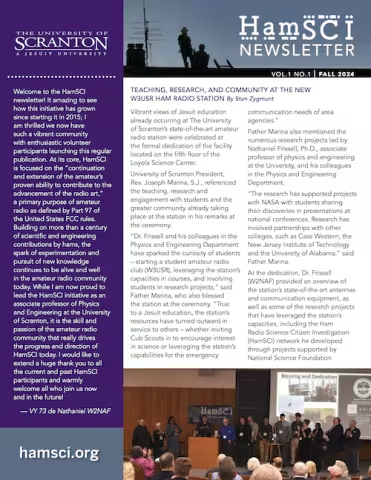
HamSCI Newsletter Volume 1, Number 1

The first issue of the new HamSCI newsletter is now available! Issues contain news about past and future HamSCI happenings, such as research projects, in-person meetings and on-air events. Many issues include HamSCI member profiles, stories on tools and techniques used in HamSCI's research work, plus general interest pieces. Reading the HamSCI Newsletter is a great way to learn about what, who, how and why HamSCI is making the connection between space physics and amateur radio! Special thanks to Ed Efchak WX2R for being the driving force behind this, Dr. Mary Lou West KC2NMC for editing and writing, and Vikki Lawhon for graphics design and layout. The HamSCI newsletter archive can be found at hamsci.org/newsletter.

HamSCI Newsletter

HamSCI Newsletter Banner


The HamSCI Newsletter is published on a quarterly basis. Each issue can be read by following the 'Volume, Number' links below.

Issues contain news about past and future HamSCI happenings, such as research projects, in-person meetings and on-air events. Many issues include HamSCI member profiles, stories on tools and techniques used in HamSCI's research work, plus general interest pieces. Reading the HamSCI Newsletter is a great way to learn about what, who, how and why HamSCI is making the connection between space physics and amateur radio!

Each HamSCI newsletter is posted to Zenodo, and has its own Digital Object Identifier (DOI). The DOI for all HamSCI newsletters is 10.5281/zenodo.15257908.

Volume 2, Number 2 - Fall, 2026

DOI

Thoughts on HamSCI from Nathaniel Frissell W2NAF
HamSCI in the News
Amateur Profile:  Jesse Alexander WB2IFS
2026 Meteor Scatter QSO Parties by Gary Mikitin AF8A
Contributor Column:  The Maunder Minimum by Ron Wilcox KF7ZN
Students Learn About HamSCI by Ron Kumon K8DTJ and Ruth Willet KM4LAO
2027 HamSCI Workshop Announcement (Save the date:  April 17-18, 2027, coinciding with both Citizen Science Month and World Amateur Radio Day)

Volume 2, Number 1 - Spring, 2026

DOI

The 2026 HamSCI Workshop
Scientist Profile:  Kuldeep Pandey
Amateur Profile:  Normand Juneau VE2DVG
Contributor Column:  Cream in Your Coffee?
Staff Profile:  Emma Moran KD3CKD
HamSCI Literature Review
News on the Meteor Scatter QSO Parties, Collaboration with the Indian Lightning Detection Network, Accolades given at the Orlando Hamcation...and more!

Volume 1, Number 4 - Winter, 2025

DOI

HamSCI at HamX, Rocky Mountain Convention, RCA Technical Symposium, Delaware Valley RA, Orlando HamCation
Amateur Profile:  Bill Mader K8TE
HamSCI Presentations at the AGU 2025 Conference
Contributor Column:  The 1921 New York Railroad Storm
HamSCI Literature Review
DX'ing Dashboard for the HamSCI Personal Space Weather Station
HamSCI Gets a Boost from NASA, Open HF Propagation Research...and more, including...a crossword!

Volume 1, Number 3 - Fall, 2025

DOI  

HamSCI Featured in QST Magazine
Scientist Profile:  Gareth Perry, KD2SAK
HamSCI Installs PSWS at K3LR
Amateur Profile:  Andrew Rodland KC2G
Contributor Column:  How the Ionosphere Was Discovered
Expanding the Network of PSWS Stations...and more


Volume 1, Number 2 - Spring, 2025

DOI

HamSCI's and NASA's Big Year
Amateur Radio Profile:  Dave Swartz, W0DAS
HamSCI In the News
Post Doctoral Scientist Profile: Kukkai Hozumi
Contributor Column:  Dr. Vera Rubin, Namesake of the Vera C. Rubin Telescope
Scientist Profile:  Steve Cerwin, WA5FRF
Grapes in Antarctica, PSWS Telecon, Meteor Scatter QSO Party...and more


Volume 1, Number 1 - Fall, 2024

DOI

Teaching, Research and Community at the New W3USR Ham Radio Station
HamSCI at the Big AGU Conference in Washington, DC
HamSCI Profile: Gwyn Griffiths, G3ZIL
HamSCI In the News
HamSCI Profile:  Rob Robinett, AI6VN
A Slice of Science History

2024 SEQP Contest Results Announced

The complete results for the April 8, 2024 running of the SEQP have been published.  They contain participants' scores and a sampling of photos, soapbox comments and station diagrams.  Finally, credits appear for those who helped make the SEQP possible.

Download the Complete April 8, 2024 SEQP Results

Download certificates for winners and participants

Visit the SEQP home page

A hearty 'Thank You' to all who participated and made it a successful event!

2024 SEQP Winners

 
  Single Op Score   Multi Op   Score
 1   W1UE
 Dennis Egan
 Marlborough, MA
 302,076 1 K0AJW
Souris Valley ARC
Minot, ND
  85,840
 2   K9OM
 Dick Van Zandt
 Marinette, WI
 272,117 2

WO1N
Operated by WO1N, N1KLK
Billerica, MA

  49,425
 3   W1SJ
 Mitch Stern
 Essex, VT
 229,235 3 W3USR
University of Scranton ARC
Scranton, PA
  29,362


Link to all FoEIS Results


CWRU Student Monitors WWVH from South America During Recent Eclipse

Case Western Reserve University Electrical Engineering master's degree student Maris Usis worked with Falkland Island hams and traveled to a remote area of Patagonian Chile, to monitor WWVH (Kauai, Hawaii) during the recent Pacific Ocean / South American solar eclipse.

The October 2, 2024 eclipse path was mostly over the south Pacific Ocean, with landfall only in Easter Island, southern South America, and the Falkland Islands.  Maris supplied amateur station VP8ADR/VP8BDR in Falkland Islands with equipment, which Bobby and Lyn Short set up for eclipse data collection and internet upload to Maris' server in Cleveland.  The Shorts then returned to their spring task of shearing the 20,000 sheep on their 200,000 acre ranch.  (Radio engineers and ionospheric physicists find help where it is to be found.)  The Walker Creek Farm station is shown here:


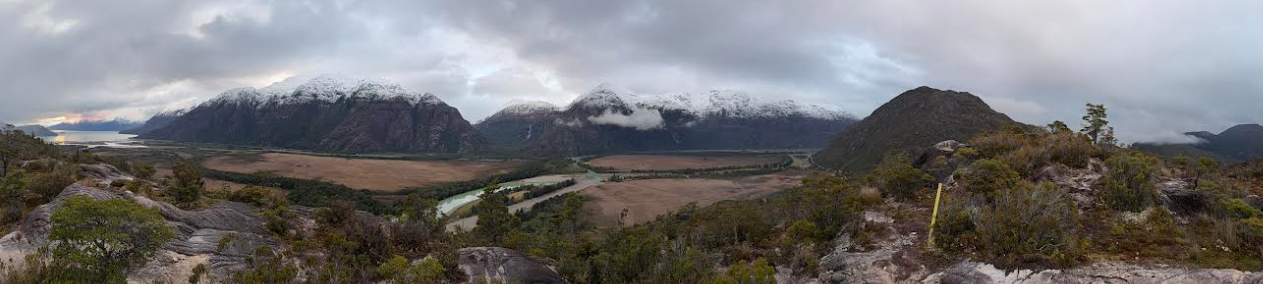
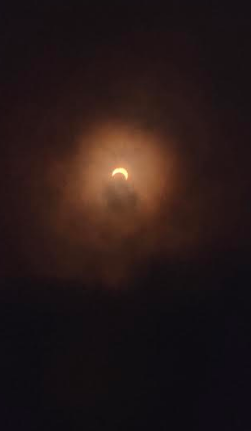
Maris recorded WWVH with Case Amateur Radio Club equipment he personally carried to Tortel, the only town in Patagonian Chile, after an eleven-hour gravel road drive from the nearest airport.  The antennas, receivers, and microcomputers were set up on the hilltops near Tortel, shown in a photo he took the morning of the eclipse.  He sent along one eclipse photo (below), taken during a spare moment while he was managing the radios and computers.

The data will be examined for propagation changes on three of WWVH's frequencies, 5, 10, and 15 MHz, as the moon's shadow distorted the ionosphere in mid-Pacific. Maris will be presenting the work at the annual scientific meeting of the American Geophysical Union in December, in Washington, DC.   The monitoring experiment was very similar to that performed by CWRU students on April 8, 2024, when they, and other school/college stations, were monitoring CHU along the path of the North American eclipse. 

(Thanks to the CWRU Electrical, Computer and System Engineering Department for this news item.)


Dr. James Breakall, WA3FET, Receives Major Award from the RCA

Congratulations to long-time HamSCI member Jim Breakall, WA3FET, on receiving the Dr. Ulrich Rohde Award for Innovation in Applied Radio Science and Engineering from the Radio Club of America (RCA).

Established in 2023, this award recognizes significant contributions to innovation in applied radio science and engineering in the wireless industry to inspire future generations of wireless professionals.

'Dr. Jim' received B.S. and M.S. degrees in Electrical Engineering from Penn State University and a Ph.D. in Electrical Engineering and Applied Physics from Case Western Reserve University, Cleveland, Ohio. He has over 50 years of experience in numerical electromagnetics and antennas. He was a Project Engineer at the Lawrence Livermore National Laboratory (LLNL-Livermore, CA), and an Associate Professor at the Naval Postgraduate School (NPGS-Monterey, CA). He is currently a Professor Emeritus of Electrical Engineering at Penn State.

He began his career as a graduate student at the Arecibo Observatory in Puerto Rico, working on antenna analysis and radar probing of the ionosphere. At LLNL, he and his group worked on the development of the Numerical Electromagnetics Code (NEC), the first sophisticated antenna modeling program. Other significant projects that he has worked on were the designs of the HAARP facility in Alaska, both HF facilities at Arecibo, and the Kinstar low profile AM broadcast antenna. Dr. Breakall (electrical) and HamSCI member/supporter Tim Duffy, K3LR, (mechanical) designed the very popular Ham Radio Skyhawk Yagi antenna, and Dr. Breakall is the inventor of the Optimized Wideband Antenna (OWA).

Dr. Breakall is a member of several IEEE societies, Eta Kappa Nu, International Union of Radio Science Commission B, and the IEEE Wave Propagation and Standards Committee. He has been an editor for several journals. He is a frequent speaker at the Dayton Hamvention Antenna Forum.

He received the RCA Sarnoff Citation and is a Life Fellow of IEEE and a RCA Fellow. He serves as an RCA director and as the Co-Chairman and later Chairman of the RCA Technical Symposiums. He also serves on the RCA Scholarship Committee, Education Committee and Awards Committee, and Innovation Council.

- Thanks to the RCA website for the above details

Hardware X Paper on HamSCI Ground Magnetometer

Hardware X Magazine Logo

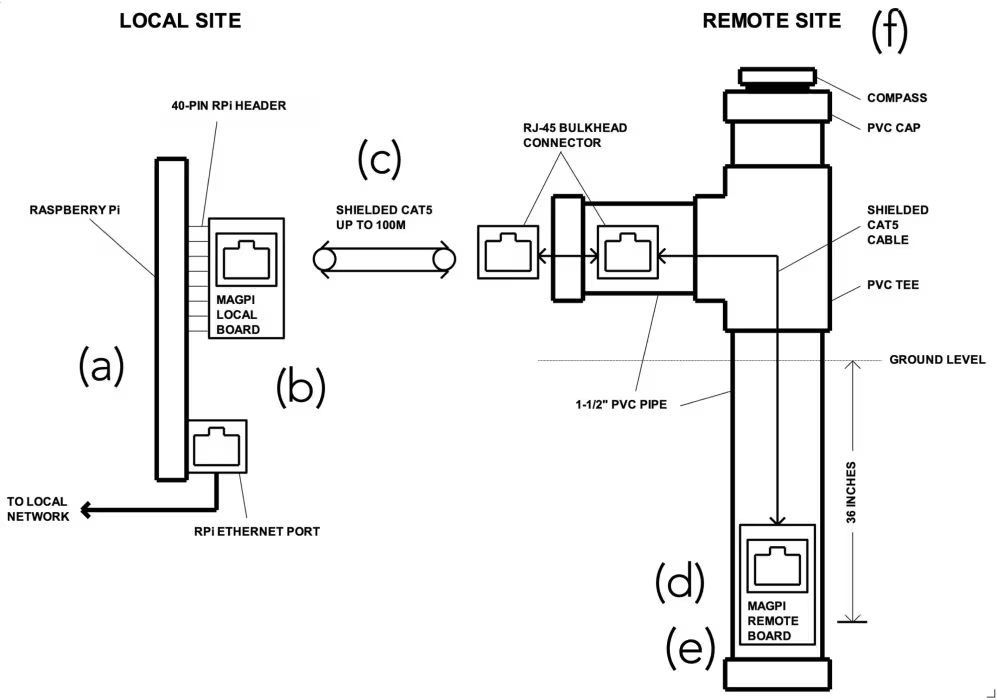
Congratulations to HamSCI member Hyomin Kim, Assistant Professor of Physics at New Jersey Institute of Technology, and his co-authors* on the publication of a paper in HardwareX entitled Citizen science: Development of a low-cost magnetometer system for coordinated space weather monitoring. 

From the Abstract:  As part of Ham Radio Science Citizen Investigation (HamSCI) Personal Space Weather Station (PSWS) project, a low-cost, commercial off-the-shelf magnetometer has been developed to provide quantitative and qualitative measurements of the geospace environment from the ground for both scientific and operational purposes at a cost that will allow for crowd-sourced data contributions. The PSWS magnetometers employ a magneto-inductive sensor technology to record three-axis magnetic field variations with a field resolution of 3 nT at a 1 Hz sample rate...

The full paper can be viewed here, on the HardwareX website.

HardwareX is a multidisciplinary, open access, peer-reviewed journal which publishes articles that describe the design, construction and customization of scientific devices and equipment.


*David Witten, Julius Madey, Nathaniel Frissell, John Gibbons, William Engelke, Anderson Liddle, Nicholas Muscoliono, Joseph Visone, Zhaoshu Cao


HamSCI 2025

HamSCI_2025_v3.png


Workshop Agenda
 

YouTube Recordings of 2025 Workshop


Program

The 8th annual HamSCI Workshop is upon us! Join us at the New Jersey Institute of Technology (NJIT) in Newark, NJ, on March 14-15, 2025. We're excited to welcome you to this fast-growing meeting. Organizers have worked hard to put together a memorable two-day event.

This year's theme, "HamSCI's Big Year," celebrates the community's achievements, including the Festivals of Eclipse Ionospheric Science (FOEIS) during the 2023 annular and 2024 total solar eclipses. The workshop features over 50 poster and oral presentations, five HamSCI tutorials, and a keynote address by ARRL's Bob Inderbitzen (NQ1R) at the HamSCI Banquet on Friday March 14th. 

The program will focus on the latest findings, strategy, and best practices, and is designed to bring together the amateur radio community and professional scientists. Anyone interested in these subject matter topics is welcome to join.  Most speakers and attendees will participate in-person.  A virtual option will be available (use Zoom registration button above).

Connect and share ideas with scientific industry leaders, peers, experts, and partners. Learn about the latest insights and best practices across different segments of ionospheric science. Get an in-depth look at what is coming next.   Click on the 'Workshop Agenda' button for details.


Friday Keynote:  Bob Inderbitzen (NQ1R), Director of Marketing and Innovation, American Radio Relay League

Abstract: Bob will share his vision for a more active and engaged Amateur Radio Service, exploring how the ham radio community can inspire others to develop a deeper understanding for wireless communications. Through personal stories, ARRL initiatives, and a spotlight on some of the brightest areas of amateur radio activity, Bob will illustrates how the service acts as a "sandbox" for introducing the public to the world of radio, while nurturing the next generation of innovators in radio science and technology.

Biography: Bob is the Director of Marketing and Communications for ARRL The National Association for Amateur Radio®. A ham since 1981, Bob has spent his life promoting amateur radio and supporting the community. He joined the ARRL staff in 1991 and has played pivotal roles in enhancing ARRL’s visibility and outreach, supporting members, volunteers, and a growing amateur radio community. Bob is passionate about engaging new hams and youth, creating opportunities for them to become more active. He enjoys HF operating, digital modes, portable and remote operating, and radiosport (PJ4/NQ1R). He lives in Glastonbury, Connecticut, with his family.


Invited Tutorial:  Dr. Lynn Harvey, Research Scientist, Laboratory for Atmospheric and Space Physics, University of Colorado, Boulder

Abstract: In the polar regions, the wintertime polar vortices play a critical role in "bottom-up" atmosphere-ionosphere coupling via the generation and modulation of atmospheric gravity waves (GWs) and via interactions with planetary waves (PWs). This talk will first present a tutorial on the polar vortex: why it forms, where and when it exists, and variability in vortex strength sub-seasonally (within each winter), inter-annually (from winter-to-winter), and inter-hemispherically (in the Arctic and Antarctic). I will then present the current state of understanding regarding the role of the polar vortex in coupling different atmospheric layers via “bottom-up” processes. In the last decade it has become widely accepted that PW-driven sudden stratospheric warmings (SSWs) cause variability in the thermosphere-ionosphere system. Recent results demonstrate that strong polar vortex events result in variability of the opposite sign than is observed during SSWs. In addition, the geographic distribution of smaller-scale GWs depends on the strength and shape of the polar vortex. The polar vortices act to vertically couple the atmosphere from the troposphere to geospace by changing the background wind field through which GWs propagate. Recent work demonstrates that localized jet cores around the polar vortex also act as a middle atmosphere source for GWs. Vortex modulation and generation of atmospheric GWs then impact the abundance of traveling ionospheric disturbances that may impact Ham radio communications.

Biography: Dr. Harvey received her doctorate in atmospheric and oceanic sciences from the University of Wisconsin in Madison in 2001. Her PhD focused on the numerical identification of stratospheric vortices, thus her scientific expertise is rooted in the neutral atmosphere. She did a postdoc at NASA Langley and has been a Research Scientist at the Laboratory for Atmospheric and Space Physics at the University of Colorado in Boulder for over 20 years where she is a world expert in studies of the polar vortices. She has published 120 peer-reviewed manuscripts on topics covering the general circulation, wave dynamics and transport of trace gases in the stratosphere, mesosphere, and lower-thermosphere. Her recent work focuses on how the polar vortex acts to couple the Sun-Earth system from the top down via the descent of nitrogen oxides produced by energetic particle precipitation and from the bottom up via the upward propagation of waves that drive variability in the thermosphere and ionosphere. 


Invited Tutorial:  Steve Cerwin (WA5FRF), Retired Institute Scientist, Southwest Research Institute

Abstract: Steve's tutorial will give a basic overview of radio propagation and the fundamentals of antennas. Topics include The Nature of Radio Waves, Dipole Antenna Characteristics, Line of Sight Propagation, Diffraction and Multipath Interference, What a BALUN does, The Isotropic Antenna and Concept of Gain, Examples of Gain Producing Antennas and How They Work, Transmission Line Basics, and Selected Antenna Stories.

Biography: Steve Cerwin, WA5FRF, is an experimental physicist with over 45 years’ experience in designing and building custom instrumentation systems spanning a wide range of disciplines. He spent 38 years at Southwest Research Institute, retiring as an Institute Scientist in 2008. While at the Institute he also taught Advanced Electronic Design and the associated lab at St. Mary's University as an evening course for 15 years. He is still a Technical Advisor for the Institute, operates his own consulting business, and teaches week-long, hands-on antenna courses. He attributes his career in science to an early start in ham radio. Hobbies include ham radio, scuba diving, and flying both full scale and RC model aircraft.


Invited Tutorial:  Derek Kozel (K0ZEL / MW0LNA), GNU Radio Leadership Team

Abstract: Introduction to GNU Radio

Biography:  Derek is an electrical engineer with a particular passion for embedded sytems, RF communications, and aerospace applications. His PhD research involves High Efficiency RF Power Amplifier design using Load Modulation techniques. He is an Amateur Radio operator currently focusing on the design and construction of systems for microwave bands. Prior work included work on Software Defined cellular basestation radios and developing low power sensor nodes. His masters work and courses involved evolutionary algorithms and low power computer architecture and software design.  When not playing with something with bits or volts he enjoys cycling, diving, and gardening.

.

Invited Tutorial:  Dr. Louis Lanzerotti, Distinguished Research Professor, CSTR, New Jersey Institute of Technology

Abstract: Dr. Lanzerotti's distiguished career will provide numerous opportunities to enlighten banquet attendees on the history of space weather research.

Biography:  Louis Lanzerotti has degrees in engineering physics and in physics from the University of Illinois (BS) and Harvard University (MA & PhD). He was a distinguished member of technical staff at Bell Laboratories in Murray Hill, NJ, for 37 years and is now a distinguished research professor in physics at NJIT. He has been elected a Fellow of five scientific societies and elected to the International Academy of Astronautics and the National Academy of Engineering. He has co- edited and co-authored eight books and has eight patents issued. He is an Eagle Scout.


K2MFF AMATEUR RADIO REPEATER

Licensed hams are welcome to use the NJIT Amateur Radio Club's 2 meter repeater on 147.225 MHz (+0.600 offset, PL 141.3).  K2MFF serves a large portion of northern New Jersey, the Hudson Valley, Manhattan, Staten Island and Long Island.


    ABSTRACT SUBMISSION
     

    The abstract submission window for the 2025 HamSCI Workshop closed on February 10, 2025.  Questions regarding submissions, formats and deadlines should be addressed to the HamSCI mailbox.

    Presentation and posters have been received from all sectors of the HamSCI community:

    • Professional researchers
    • Academics / Educators
    • Students, at all academic career levels
    • Citizen scientist volunteers, including, of course, the ham radio community

    Topics include:

    • Observations and findings from HamSCI's Festivals of Eclipse Ionospheric Science
    • Personal Space Weather Station project updates
    • Data management and visualization techniques
    • Radio wave propagation modeling
    • The applicability of HamSCI's research to amateur radio operations
    • General interest topics, e.g. from the arts, literature, history, with an amateur radio, science or technology theme.


    HamSCI PSWS HF Receiver - Overview, Specifications, Sourcing

    Grape:WSPR RX888.png

    2024-05-12 N3AGE RX888 .png

    Overview

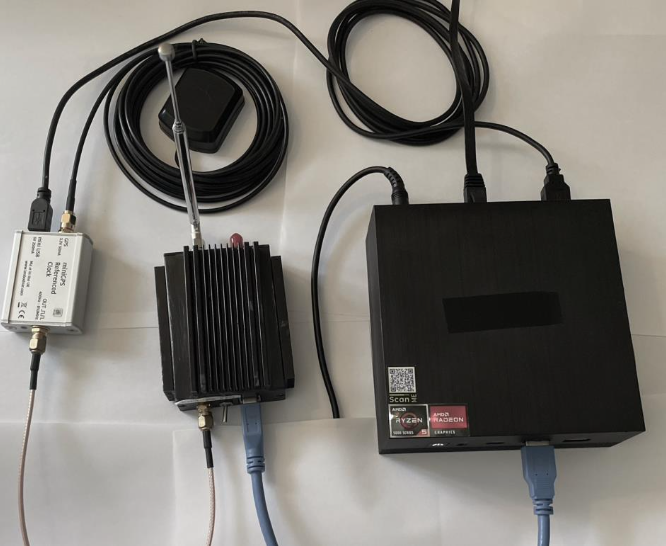
    The HamSCI Personal Space Weather Station HF Receiver (HFRx) is the most sophisticated component of the HamSCI Personal Space Weather Station (PSWS).  It is a wide bandwidth SDR (software defined radio) system capable of receiving the entire MF and HF bands, converting radio signals into high speed digital data streams.   It is able to measure Doppler shift while receiving multiple standard frequency stations (eg WWV/H on five frequencies, simultaneously).  Further, it can decode digital mode signals, such as  WSPR/FST4w. All data is uploaded to HamSCI data servers for later research and analysis.

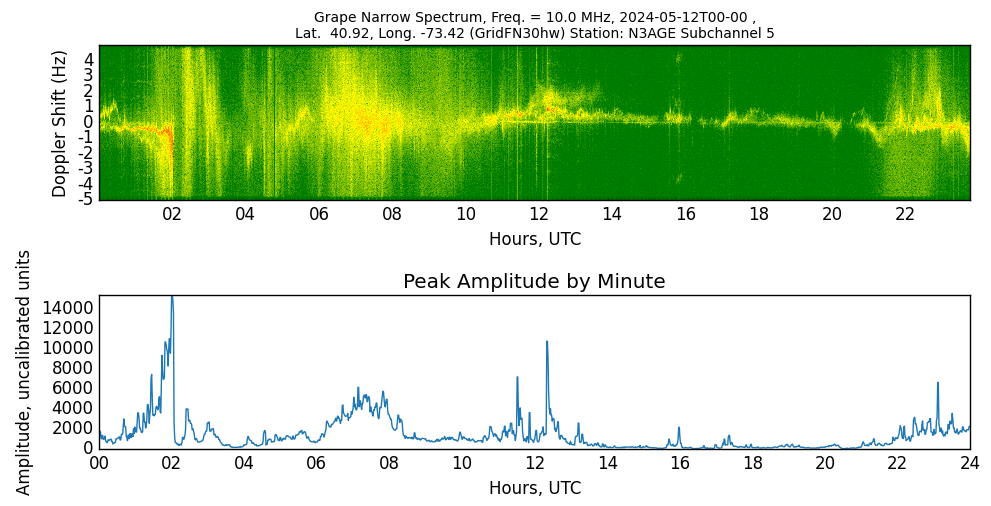
    The PSWS project involves monitoring changes in the Earth's ionosphere via receiving, decoding, digitizing and archiving precision radio signals on a 24/7/365 basis.   A sample plot from May 12, 2024 (a few days after a major solar storm, note the unsettled, Doppler shifted frequency measurement of station WWV) appears above.  

    Specifications

    Purpose Wide spectrum receiving system, reports data in multiple formats:  WSPR/FST4w and Doppler shift monitoring in the DRF format.  Data is useful for studying behavior of the ionosphere.
    Receiver RX-888 Software Defined Radio, as modified per instructions below
    Bandwidth 0.5 through 60 MHz (varies according to software configuration)
    Frequency Stability As stable as the Leo Bodnar GPS disciplined oscillator, approaching 1x10-12 
    Recommended Computer Beelink Mini PC, AMD Ryzen 7 processor (2 GHz/8 cores), 16 GB memory, 500 GB SSD
    Operating System Ubuntu 
    Required software KA9Q Radio, Ubuntu Server (version TLS 24.04) (subject to future revisions)
    See the WSPRDaemon documentation on readthedocs.io
    Data Repository Data from the network of HFRx is freely accessible, available for viewing, plotting and downloading from the Personal Space Weather Station Central Control System (self-created user account required).

    Sourcing

    DIY Option:  At present, the HamSCI High Frequency Receiver, an RX-888 based, GPS disciplined receiving system is a DIY (do it yourself) project, requiring the following steps:  1) Obtain hardware  2) Modify the RX-888 per the clock kit 3) Load operating system and install KA9Q radio from GitHub (requires working knowledge of compiling the 'C' language, Linux administration) 4) Deploy antennas (GPS and MF/HF), connect filter, preamp, etc.

    • RX888 SDR (amazon.com) (There are sometimes other on-line vendors at lower prices, be sure the vendor you choose is reputable before ordering)
    • Beelink Mini PC, (amazon.com)
    • Bodnar GPS Disciplined Oscillator, model LBE-1420 (leobodnar.com)
    • Low pass filter and preamplifier (turnislandsystems.com)
    • RX-888 Clock and Thermal Pad Kit (TAPR.org)​
    • Time Sync Precision Time Injector (turnislandsystems.com)
    • Software...Ubuntu Server 24.04 TLS
    • Software...WSPRDaemon (see readthedocs.io for the user documentation)
    • Software....KA9Q radio (also see Tom McDermott's YouTube series, Getting Started with KA9Q radio (the link is to Part 1, look for Parts 2 through 5 on YouTube)
    • Antenna recommendation  - Recent deployments have been successful using the DXEngineering DXE-RSEAV-1 (requires two coax cables, one for signal, one for 12-15VDC) or the DXE-RSEAV-1FV1 (one coax cable carries both signal and +12VDC).  Some users have reported better (lower noise) results using the two cable version of this antenna system.  Either way, a clean source of 12-15VDC is required.  Most 'wall wart' type power supplies are too noisy - their switching artifacts spread across the RF spectrum we are trying to receive.  Others have reported success with amplified receiving loops, fan dipoles, etc.  There is probably no 'one best' solution for all situations (considering geography, local noise floor, the host station's desire to transmit on the HF bands {antenna separation}, etc.)
    • System Programming Instructions...Under development at this URL:  https://github.com/HamSCI/PSWS_Documentation/wiki/HF-wsprdaemon-Receiver
    • Community-driven documentation:  Read about David K3DFD's PSWS HFRx build on his GitHub site:  https://github.com/K3DFD-Radio/K3DFD-PSWS

    HamSCI Provided:  HamSCI has been awarded a grant from the National Science Foundation to fund up to thirty (30) complete PSWS (High Frequency Receiver + Ground Magnetometer + VLF Whistler Catcher). In 2026, HamSCI  will be selecting locations based on an application review process, with a goal of siting thirty systems at scientifically advantageous locations across North America.  If you are interested in being considered as a PSWS host, please navigate to the Searching for Instrumentation Sites page, review the site selection criteria, and if you feel you qualify, complete the Interested Participant Form at the bottom of the page.  There's also a button to submit questions to the project team.  The actual ship date for the first complete PSWS is yet to be determined...if all goes well, Q3 and Q4, 2026.

    Further Information

    Credits

    The original concept for the HamSCI High Frequency Receiver is credited to Rob Robinett, AI6VN, who is also the developer of the WSPRDaemon software package and website.   HamSCI recognizes Phil Karn, KA9Q, for his efforts in writing the KA9Q Radio software package, enabling the RX-888 (and other SDRs) to perform accurate and reliable data collection.  HamSCI owes a debt of thanks to TAPR, an organization of amateur (ham) radio operators dedicated to advancing the state of the radio art, for helping bring the HamSCI High Frequency Receiver from concept to reality.  Dr. Nathaniel Frissell, W2NAF, was the Principal Investigator on National Science Foundation grant 2002278 ('Collaborative Research DASI Track 1 - Personal Space Weather Station').   Their efforts were supported by additional NSF grants (1922972, 1932997) and these institutions:

    hamsci_collaboration.png

    4 July 2026:  Updated for new PSWS landing page, HFRx name change

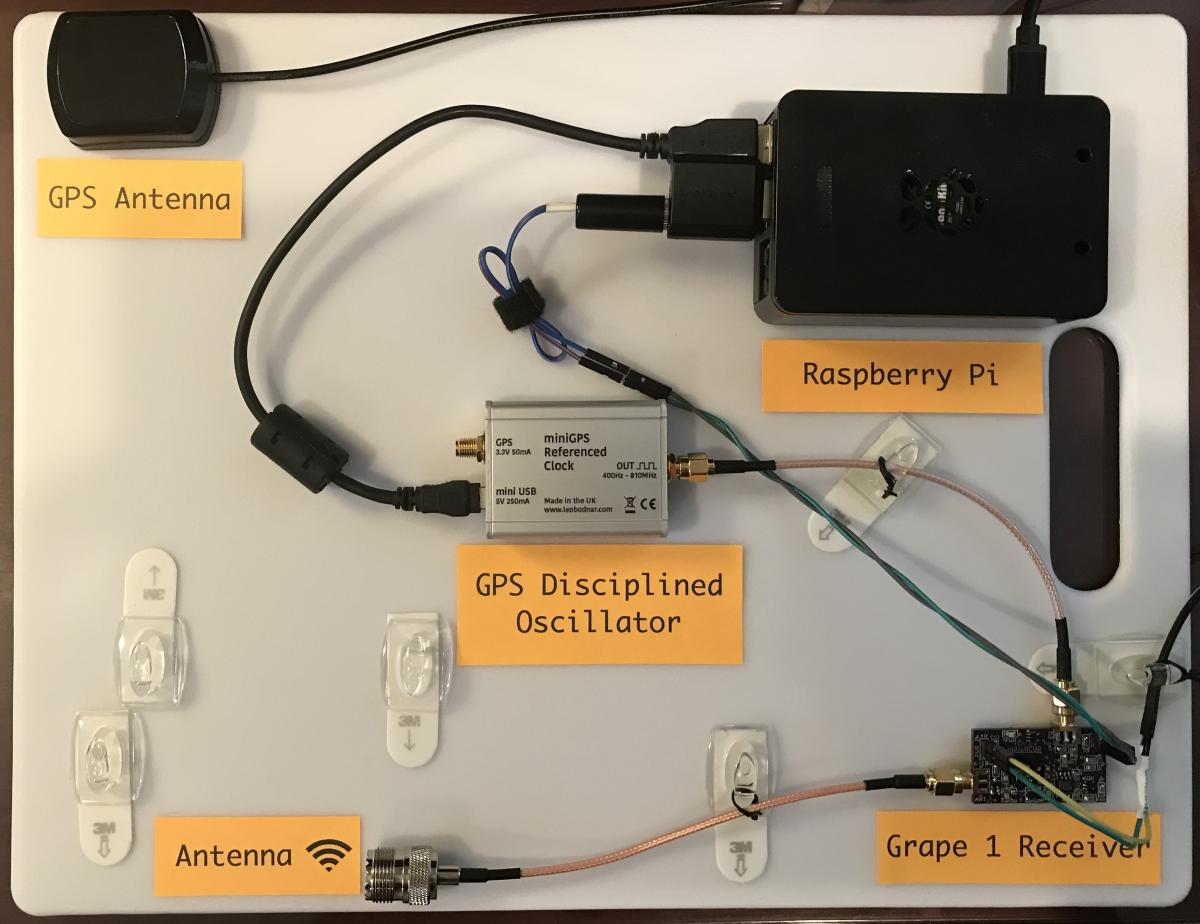
    GRAPE 1 DRF - Overview, Specifications, Sourcing

    NEGG Grape 1-DRF  Photo.jpeg S000045_2023-10-14T00-00_EM57ta.png

    Overview

    The GRAPE 1 Doppler Monitor is a key component of the HamSCI Personal Space Weather Station (PSWS). It functions well as a stand alone module. GRAPE 1 DRFs have been providing scientifically useful Doppler shift data since September, 2023. The GRAPE 1 was designed with a specific purpose in mind: Receiving, analyzing and recording of signals from frequency standard stations such as WWV/H and CHU.The PSWS project involves monitoring changes in the Earth's ionosphere through measurements of Doppler frequency shifts on a 24/7 basis. One well built example of a GRAPE 1 DRF Doppler Monitor appears above, along with a plot of Doppler shift and signal amplitude vs. UTC hour from April 8, 2024 (the date of the recent North American total solar eclipse)appears above. (The solar eclipse's effect on the ionosphere is clearly visible in the green Doppler shift plot, between about 1600 and 1800 UTC.)

    This particular vision of the GRAPE(GRAPE = Great Radio Amateur Propagation Experiment) is relatively easy to assemble, and then it takes some care to prepare the software. Hosting involves building a GRAPE low-IF receiver board, obtaining a GPS Disciplined oscillator, Raspberry Pi, disk drive, providing reliable power, space for an antenna and an Internet connection. Other factors come into play, such as the need for visibility to the constellation of GPS satellites. Complete documentation (schematics, bill of materials) and instructions for building the GRAPE 1 low-IF receiver board, as well as configuring the GRAPE 1 DRF-specific Raspberry Pi image, are available on this website.   Note: The GRAPE is a receive-only device. An amateur (ham) radio license is not required to operate a GRAPE 1 Doppler Monitor!

    Specifications

    Purpose Single frequency, low-IF receiver, used for measuring Doppler shift while receiving frequency standard stations such as WWV/H or CHU.  Data is useful for studying bottom side motion of the ionosphere.
    Frequency Selections 2.5, 5.0, 10.0 or 15.0 MHz (reduced though very acceptable performance on 3.33, 7.58 or 14.36 MHz)
    Frequency Stability As stable as the Leo Bodnar GPS disciplined oscillator, approaching 1x10-12 
    Sensitivity Under review
    Dynamic Range Under review
    Received Bandwidth Under review
    Current Hardware Version See Builders Information in the Sourcing section, below
    Required Computer Raspberry Pi 4B, 8 GB memory
    Operating System Ubuntu
    Required software GNU Radio, plus various GRAPE 1 DRF-specific Python routines (all are included with the GRAPE-1 DRF image - see Builders Information, in Sourcing section, below)
    Data Repository The GRAPE 1 DRF data is freely accessible, available for viewing, plotting and downloading from the Personal Space Weather Station Central Control System (self-created user account required).

    Sourcing

    Note:  A number of GRAPE 1 DRF systems were funded by a grant from the National Science Foundation, and then assembled and deployed by volunteers (The New England GRAPE Group) in mid-2023.  Occasionally, units are returned to HamSCI for redeployment.  If you are interested in hosting a grand-funded GRAPE 1 DRF, please send your contact info, including location (grid square and city/state/province) to [email protected].  Note that grantees are expected to have basic Linux experience, an HF (shortwave) antenna, common computing peripherals (USB keyboard/mouse, monitor) and an Internet connection (wired Ethernet preferred) for daily data uploads.  Of course, we can't guarantee availability but we are very interested in having as many systems running as possible.

    Builders's Information:  The GRAPE 1 is suitable for the DIY enthusiast.  

    • The single-frequency receiver portion is built by the user on a PC board using surface mount components.  Engineering and construction information for the GRAPE low-IF receiver board is available here
    • Additional purchased components (GPS disciplined oscillator, Raspberry Pi, USB sound card, disk drive, power supply) are programmed and/or interconnected to form a GRAPE 1 DRF system.  A component list is available here.
    • Commercially built or DIY antenna suitable for your location, distance from time standard station, appropriate for frequency being monitored
    • Documentation for the GRAPE1-DRF is available here.

    This video (courtesy of the American Radio Relay League) provides an excellent overview of the GRAPE 1.12 low-IF receiver

    Further Information


    Credits

    The GRAPE Version 1 was designed by John Gibbons, N8OBJ, Lab Director of the Sears Undergraduate Electrical Design Lab, Case Western Reserve University, Department of Electrical Engineering.  Additional software applications were written by Bill Engelke, AB4EJ, of the University of Alabama.  Bill was also the architect of the PSWS Central Control System.   Dr. Nathaniel Frissell, W2NAF, was the Principal Investigator on National Science Foundation grant 2002278 ('Collaborative Research DASI Track 1 - Personal Space Weather Station').   Their efforts were supported by additional NSF grants (1922972, 1932997) and these institutions:

    hamsci_collaboration.png

    17 October 2025:  Updated PSWS CCS URL - af8a

    GRAPE 1 fldigi - Overview, Specifications, Sourcing

    Grape 1 AF8A System with placards cropped.jpg 2024-04-08 AF8A Grape 1 Total Eclipse Grape1 fldigi plot.jpg

    Overview

    The GRAPE 1 Doppler Monitor (fldigi version) is a key component of the HamSCI Personal Space Weather Station (PSWS).  It functions well as a stand alone module; various versions have been providing scientifically useful Doppler shift data since 2019.    The GRAPE 1 was designed with a specific purpose in mind:  Receiving, analyzing and recording of signals from frequency standard stations such as WWV/H and CHU. The PSWS project involves monitoring changes in the Earth's ionosphere through measurements of Doppler frequency shifts on a 24/7 basis.  One user's GRAPE 1 Doppler Monitor and that monitor's plot of Doppler shift vs. UTC hour from April 8, 2024 (the date of the recent North American total solar eclipse) appears above.  (The solar eclipse's effect on the ionosphere is clearly visible between about 1800 and 2100 UTC.)

    This particular vision of the GRAPE (GRAPE = Great Radio Amateur Propagation Experiment) is the lowest cost, easiest to assemble version of the GRAPE family. Hosting involves building a GRAPE low-IF receiver board, obtaining a GPS Disciplined oscillator, Raspberry Pi, providing reliable power, space for an antenna and an Internet connection.  Other factors come into play, such as the need for visibility to the constellation of GPS satellites.  Complete documentation (schematics, bill of materials) and instructions for building the GRAPE 1 low-IF receiver board, as well as configuring the GRAPE-specific Raspberry Pi image, are available on this website.   Note:  The GRAPE is a receive-only device.  An amateur (ham) radio license is not required to operate a GRAPE 1 Doppler Monitor!

    Specifications

    Purpose Single frequency, low-IF receiver, used for measuring Doppler shift while receiving frequency standard stations such as WWV/H or CHU.  Data is useful for studying bottom side motion of the ionosphere.
    Frequency Selections 2.5, 5.0, 10.0 or 15.0 MHz (reduced though very acceptable performance on 3.33, 7.58 or 14.36 MHz)
    Frequency Stability As stable as the Leo Bodnar GPS disciplined oscillator, approaching 1x10-12 
    Sensitivity Under review
    Dynamic Range Under review
    Received Bandwidth Under review
    Current Hardware Version See Builders Information in Sourcing section, below
    Required Computer Raspberry Pi 3B or 4B
    Operating System Raspbian OS
    Required software fldigi, a ham radio modem application, numerous GRAPE-specific shell scripts (all are included with the GRAPE-1 fldigi image - see Builders Information, in Sourcing section, below)
    Data Repository The GRAPE-1 fldigi data is freely accessible, available in the HamSCI Community on Zenodo.org

    Sourcing

    Builders's Information:  The GRAPE 1 is designed for the DIY enthusiast.  

    • The single-frequency receiver portion is built by the user on a PC board using surface mount components.  Engineering and construction information for the GRAPE low-IF receiver board is available here
    • Additional purchased components (GPS disciplined oscillator, Raspberry Pi, USB sound card, power supply) are programmed and/or interconnected to form a GRAPE 1 fldigi system
    • Commercially built or DIY antenna suitable for your location, distance from time standard station, appropriate for frequency being monitored

    This video (courtesy of the American Radio Relay League) provides an excellent overview of the GRAPE 1.12 low-IF receiver

    Further Information

    Credits

    The GRAPE Version 1 was designed by John Gibbons, N8OBJ, Lab Director of the Sears Undergraduate Electrical Design Lab, Case Western Reserve University, Department of Electrical Engineering.  Additional software applications were written by David Kazdan, AD8Y, also of CWRU, and Bob Benedict, KD8CGH.   Dr. Nathaniel Frissell, W2NAF, was the Principal Investigator on National Science Foundation grant 2002278 ('Collaborative Research DASI Track 1 - Personal Space Weather Station').   Their efforts were supported by additional NSF grants (1922972, 1932997) and these institutions:

    hamsci_collaboration.png


    HamSCI Glossary

    This is HamSCI's "Work in Progress" glossary of terms found in articles, presentations and posters on this website.  Credits are at the bottom of this page.

    Corrections, additions and suggestions are welcome and encouraged, via email, to the HamSCI mailbox. (Latest revision:  3 Aug 2024)

    Term

    Definition

    Adaptive remote sensing

    Steering your station’s receiving capabilities based on other data from other sources. Hams have been pioneers in this area with the DX spotting networks reaching back to the early days of packet radio networks!

    AE index

    Auroral Electrojet Index.  Measure of strength of currents flowing in the E region of the ionosphere near the auroral zone, driven by closure currents along magnetic field lines when aurora is active.  Much more about aurora in tomorrow’s tutorials.

    AGU

    American Geophysical Union

    AGW

    Atmospheric Gravity Wave.  Not to be confused with gravitational waves.

    AMISR

    Advanced Modular Incoherent Scatter Radar. Phased-array ISR designed by SRI International and deployed at Poker Flat (PFISR), Resolute Bay (RISR-C, RISR-N), and a smaller version at Jicamarca, Perú.

    AU

    Astronomical Unit : 149.6 million kilometers, the mean distance from the center of the earth to the center of the sun

    CW

    Continuous Wave.  Typically called Morse code, a communications mode using dots and dashes to represent letters, numbers and punctuation.

    Decimation

    Keep only 1 out of N samples.  Effectively reduces the time rate of the signal (but is subject to aliasing of higher frequencies if you haven’t filtered the signal first).  Standard signal processing technique.

    Digital modes

    FT8, PSK31, WSPRNet, Olivia, RTTY - all examples of coded transmissions for digital communications used by amateurs. (FCC Part 97, which licenses amateurs, requires though that all digital comms be easily unencrypted by all on the ham bands - no public/private key pairs, for instance)

    DOA

    Direction of Arrival (within the context of radio direction finding)

    DOI

    Digital Object Identifier.  A “one-stop shop” to find a particular scientific dataset or article.  See http://dx.doi.org for a lookup tool. DOI is a way to get cited for your data & contributions as well. Looks good on a CV (especially for the early career folks).

    Doppler Effect

    Doppler Effect is the change in the frequency of a wave in relation to an observer who is moving relative to the source of the wave.

    Dst

    Measure of magnetic field depression at several stations around the earth’s equator.  This is due to a current out in space called the ring current, which gets enhanced during geomagnetic storm activity.  Think of it as a fine grained index that tells us more and different things about activity levels.

    DX

    Long distance contacts or long distance reception (usually, between countries, but often between continents)

    Epoch

    A reference time that data is aligned to, defined by the study under question.  It’s a way to make different data taken at different times line up to e.g. test a hypothesis on a particular phenomenon.

    FAC

    Ffield Aligned Currents. Phenomena resulting from electron precipitation that directly drive the large voltage drops and particle impacts that cause the visible (and radio) aurora. (defined by Kristian Birkeland) 

    FD

    Field Day. It is an annual amateur radio exercise that serves emergency preparedness, competitive, social, educational and public relations goals. It happens on the fourth weekend in June and participants are from the US and Canada. Contacts take place at a very rapid rate. Hams use Morse code, voice and digital modes to make contacts. An estimated 30,000 hams participate in this activity every year.  It is sponsored by the American Radio Relay League (ARRL), the National Association for Amateur Radio.

    FPGA

    Field Programmanble gate array.  A highly complex, highly flexible type of integrated circuit

    Geospace

    Processes and features in near-Earth space, including the magnetosphere (place where the Earth’s magnetic field is a dominant force)

    GNSS

    Global Navigation Satellite Systems (GPS is one. Others are GLONASS, GALILEO, COMPASS/BEIDOU)

    GPSDO

    GPS-Disciplined Oscillator. An oscillator (used to provide a reference frequency for making measurements) that is adjusted based on timing signals from the GPS constellation. Once adjusted, can provide very accurate reference frequencies.

    Ham radio

    Not an acronym for anything. No one really knows why amateur radio operators became known as "hams" - there are competing theories - but it's just a slang reference. Should be styled "ham radio," never "HAM radio." Or you can always say "amateur radio" to err on the side of formality.

    Heliophysics

    The science of the Sun and the physical connections between the Sun and the rest of the solar system.

    IS radar

    Incoherent scatter radar.  Also called Thomson scatter radar, from JJ Thomson (discoverer of the electron).  Uses very weak backscatter from thermal electrons in the ionosphere, electrostatically modified by the presence of ions.  Technique remotely senses plasma state properties: electron density, electron and ion temperature, ion velocity, ion composition.  Makes full altitude profiles due to the weak nature of the scatter (Born approximation), but requires a megawatt pulsed radar combined with large antennas (30 meter diameter or bigger, or phased arrays), typically at UHF frequencies.  Perhaps 12+ IS radar systems worldwide are operated for ionospheric diagnostics - US equals NSF Geospace Facilities program (Geosciences Directorate), Europe eq EISCAT (European Incoherent Scatter Scientific Association). EISCAT operates the only truly tri-static ISR capable of measuring ionospheric plasma flow in 3D within a “common volume” of overlapping beams. In 2023, the phased-array EISCAT_3D is expected to be operational, which will be able to measure vector velocities at all relevant altitudes along the transmitter beam simultaneously.

    JGR

    Journal of Geophysical Research (major journal for upper atmospheric physics among other things)

    Kp

    planetary K index<> average of magnetometers at ~12 stations around the world<> quasi-logarithmic indication of currents flowing in the upper atmosphere caused by geomagnetic disturbances. See https://aurorasaurusbl.wpengine.com/?p=187. The Kp index is calculated using measurements from ground magnetometers.

    L1

    About 1.5 million kilometers from Earth, or 0.01 au, 1/100th the distance to the Sun (according to Wikipedia)

    Laminar

    A smooth flow, as opposed to highly structured (or turbulent) flow

    Leo Bodnar GPSDO

    Low cost yet high performance GPS disciplined oscillator from Leo Bodnar Electronics - programmable, usually used to provide 10 MHz and 1 PPS outputs.  See  leobodnar.com

    Meridional

    North-South

    MLT

    Magnetic Local Time.  Midnight is when your location is opposite the sun

    NCJ

    National Contest Journal (www.ncjweb.com). Magazine covering competitive aspects of ham radio.

    NSPIRES

    NASA system for people who write proposals, manage grants, and write reviews.

    NVIS

    Near-Vertical Incidence Skywave

    Ovation Prime

    Operational model for where auroral boundaries are in a rough sense based on historical data - but it’s only a model.

    PCA

    Polar Cap Absorption

    Phase noise

    Phase noise is the term used to describe short term variations in phase or frequency stability, with "short term" referring to time intervals on the order of seconds or less. Another way of defining or describing phase noise is as random or unintentional phase modulation. Short term stability or "good phase noise performance" is very important in a wide variety of RF applications, but this short term stability can be difficult to obtain, with a substantial cost and complexity often associated with even modest increases in phase noise performance.

    Plasma

    4th state of matter - in which both negative and positive charged particles which are to zeroth order balanced (no net charge) but at the 1st order and above, lots of dynamics and therefore electrodynamics going on.  Coined by Irving Langmuir (physical chemist <> Nobel laureate <> GE R+D leader) in the early 20th century.  99% of the universe (probably more) is in the plasma state.

    PMSE

    Polar Mesospheric Summer Echoes <> very bright scatter from probably charged ice particles in the mesosphere <> VHF and up.

    QAM

    Quadrature Amplitude Modulation, a digital transmission method that was shown off here.

    QEX

     An ARRL publication for experimenters and those intrested in new radio technology. http://www.arrl.org/qex

    QRZ

    https://qrz.com”, a go-to site to look up ham information by call sign, along with forums, etc. etc.). “The facebook of amateur radio.”

    QSO

    Two-way contact made over amateur radio

    RF

    Radio Frequency

    RIOMETER

    Relative Ionospheric Opacity Meter for Extra-Terrestrial Emissions of Radio noise.   Developed in the 1950s at U Alaska, it measures radio noise power using simple yagi antennas. Typically, the measured noise power is compared to the “Quiet Day Curve”, i.e. the received noise power on a day without ionospheric disturbances. It thereby measures the opacity of the ionosphere for radio waves. Riometers have been operated between 20 MHz and 50 MHz, most commonly around 30 MHz. Nowadays, spectral riometers are used, which can measure many frequencies simultaneously and use, e.g., inverted-V or log-periodic antennas. Spectral riometers have been developed in Finland and Norway. The shape of the profile of differential absorption, i.e. the part of the radio noise absorbed at a specific altitude, does depend on frequency. The effect is slight, but allows for getting D-region electron density profiles from this otherwise integrated measurement.

    RTTY

    Radio Teletype. Long standing amateur radio digital mode, back to the days of physical teletypes (pre-WWII)

    Scintillation

    Rapid variation of signal strength and phase caused by small-scale irregularities in the ionospheric plasma density along the propagation path.  The size of the irregularities causing scintillation on a particular signal are a function of the radio frequency, but are typically on the order of meters to kilometers, with smaller scales having smaller density variations than the larger scales (a “red” spectrum).  Scintillation will affect frequencies from HF to tens of GHz.

    SDR

    Software Defined Radio, in which a good portion of the RF processing (sometimes all) takes place in software.

    Simplex

    Direct stations to station communication (as opposed to going thru a repeater or any sort of intermediary rebroadcasting device)

    Sonification

    Process of creating audio from (in our case) radio frequency signals. In any given measurement, the range of frequencies and the length in time of recorded may not be the frequencies or durations humans are capable of (or willing to put up with) listening to, so there are a number of choices to make when converting a measurement to audio.

    Spectral Spreading Spectral spreading, also referred to as frequency spreading or Doppler spreading, is a broadening of the frequency spectrum of a transmitted signal that may arise from a number of causes. Phase noise, also known as frequency jitter, within the oscillators of the transmitter and receiver can give rise to spectral spreading. When a signal is propagated via the ionosphere small-scale turbulent motions cause variations in phase path, hence in Doppler shift, which contributes to spectral spreading. Turbulent motions may be much stronger during geomagnetic storms and at auroral latitude, hence spectral spread may be higher under those conditions. Multipath and multihop propagation, spread-F propagation, and two-hop sidescatter propagation can lead to substantially greater spectral spread than on simple one-hop paths. The spectral spread of a simple crystal oscillator and synthesiser, for example in a WSPR transmitter, can be greater than from one-hop propagation. If spectral spread approaches the tone spacing of a digital mode the probability of decode will be reduced, despite adequate signal to noise ratio. Care is needed when comparing values as different width criteria are used, for example the frequency span that contains 50% or 90% of the total power.

    STEVE

    Strong Thermal Emission Velocity Enhancement. Newly discovered sub-auroral sky glow in the upper atmosphere, which looks like a purple-white narrow auroral arc. While aurora is created by particle precipitation, STEVE is mostly due to very fast plasma streams in a very narrow and very long area in the F region, i.e. above the typical auroral altitudes. However, involvement of some particle precipitation hasn’t been completely ruled out. STEVE was discovered by citizen scientist photographers!

    Substorms

    An increase in magnetic field reconfiguration and activity in the magnetosphere that can end up injecting lots of energy and particles into the upper atmosphere.

    SuperDARN

    Super Dual Auroral Radar Network. A network of paired HF radars from ~2 - 16 MHz approximately, with beams steered electronically.  It typically sweeps at 2 minute cadence across a wide field of view, measuring ionospheric velocity by tracking 10s of meter scale irregularities embedded in the ionospheric flow. SuperDARN is an international collaboration and was started in the mid 1980s by pioneers including Dr. Ray Greenwald at Johns Hopkins Applied Physics Laboratory

    SWPC

    Space Weather Prediction Center at NOAA.

    SYM-H

    A higher time resolution version of Dst (defined above as being caused by the ring current). Yet another measure of geomagnetic activity. SYM-H , Dst, and other indices are calculated by the World Data Center in Kyoto Japan and provided free on the web to the community.

    TAPR

    Tucson Amateur Packet Radio Association.  Group of technically minded amateur radio entrepreneurs, currently leading the technical implementation of the Personal Space Weather Station.

    TEC

    Total Electron Content. Defined as the total number of electrons along a specified path (units electrons/m**2).  There are two forms of TEC:  slant TEC (sTEC), the TEC along a ray path between a ground location (typically a receiver) and a satellite (typically a transmitter)<> and equivalent-vertical TEC (evTEC), the TEC along a vertical path from a ground location to overhead (also vertical TEC (vTEC), or simply “TEC”).  Except when from a model, vTEC is almost always a converted sTEC, with a variety of methods used for the conversion process. A couple of things to think about regarding TEC: 1) It is a beautiful way to get a large-scale measurement of the ionosphere 2) Even so, it does not tell the whole story. TEC is an integrated measurement.

    TIDs

    Traveling Ionospheric Disturbances. On HF/shortwave, it can cause fades that last 15 to 60 minutes. Just like waves on a beach, TIDs come in different spatial wavelengths too (hundreds of km to 1000s of km long) and wave periods (as said above, 10-15 minute to 60 minutes).  Anything longer than 1 hour or so gets studied separately as tidal motions (i.e. 6 hour tide, 12 hour tide, 24 hour tide, multi-day tides).  (Also, MSTIDs (medium-scale TIDs and LSTIDs, large scale TIDs)

    ULF

    Ultra-Low Frequency.  Oscillations in the few milliHertz corresponding to periods of a few minutes.  ULF oscillations are often a result of magnetic field line oscillations out in the magnetosphere or traveling Alfven waves (think plucking a bass string)

    USRP

    Universal Software Radio Peripheral. Essentially an Ethernet connected SDR with high bandwidth and the ability to generate as well as receive signals. USRP generates 10 mW or so maximum - then must have a power amplifier afterwards (with low pass filters, etc.) Manufactured by Ettus Research, now a part of National Instruments. 

    Zonal

    East-West

    Credits:

    This glossary was developed during the 2020 HamSCI Workshop.  Thanks to the Workshop participants for their suggestions, and especially  to Phil Erickson, W1PJE for his many contributions and to Aidan Montare, KB3UMD for authoring the original version.

    --> Back to top of page

    GRAPE Science

    The Science Behind the GRAPE HF Receiver/Doppler Monitor

    The following is an abbreviated summary of the science behind the GRAPE receiver network and how the GRAPE creates valuable data for scientific study.   It is recommended that the reader follow the links at the end of this page to gain a full understanding of the concepts described here.   Before diving in, it would be helpful to understand Doppler effect, and also to be aware of the HamSCI Glossary.

    GRAPE is now an acronym: Great Radio Amateur Propagation Experiment.  

    Scientific Interests

    The GRAPE, one module in the HamSCI Personal Space Weather Station (PSWS) network, has proven to be useful in the study of short-term (lasting hours to days) geophysical and solar events, such as traveling ionospheric disturbances, solar flares, solar eclipses and geomagnetic storms.  It does so by observing the bottom side of the ionosphere.  Data from PSWS member stations, often combined with observations from other scientific instruments, yields clues as to how and why those events impact HF (high-frequency, 3–30 MHz) radio wave propagation.  The data can also be used to improve mathematical models of the ionosphere, which should result in more accurate predictions of HF propagation (such as maps of the MUF and critical frequencies). 

    Role of the GRAPE in the HamSCI PSWS Project

    HF Doppler sounding is an established means of observing the bottom side of the ionosphere. Its principle of operation is straightforward: A shift in signal path length causes a corresponding Doppler shift (Figure 1). The Grape receiver performs Doppler measurements by measuring the carrier freqency of frequency standard stations such as WWV/H (or CHU). Their transmit frequency accuracy and stability is less than one part in 10^13 - an incredibly small value.  Measurements of the WWV/H frequency at a distant receiver site is limited by a few factors, one of which is the receiver’s accuracy and stability, the other is the propagation path.  The former is well accounted for in the design of the GRAPE, the latter is the primary measurement of interest.  In other words, those who study the GRAPE measurements are not overly concerned about the absolute value of the receive frequency, but they are extremely interested in the variation of the received frequency over time (typical GRAPE datasets are broken into 24 hour periods) (Figure 2).


    dopplercartoon.png

    Figure 1: A simplified illustration of the relationship between rate of change in ionospheric layer height and received frequency shift. Precision frequency standards are required at both beacon and receiver in order to make an effective comparison. Frequency variation is generally on the order of ±1 Hz. Multihop propagation (multiple reflections between ionosphere and ground), Pedersen modes (internal ionospheric reflections), asymmetric paths, and other factors impacting path length are not shown. Reproduced from Collins et al. (2022).


    essd-15-1403-2023-f05-thumb.png

    Figure 2:  Annotated frequency and amplitude plots of Node 1's 5 MHz data from 28 October 2021, with sunrise and sunset indicated by background shading. The filtered result is superimposed on the raw data. The day's sunrise peak is clearly visible. The horizontal axis is plotted in mean solar time, rather than UTC, in order to emphasize the effects of the 24-hour day/night cycle. A Doppler flash associated with an X-class solar flare is evident around 15:30 UTC. Reproduced from Collins et al. (2022).

    Viewing GRAPE Data

    GRAPE data can be in one of two formats:  fldigi CSV or DRF (Digital Radio Format).  

    • The fldigi data (from Grape 1, fldigi version, and Grape 2s) can be found on Zenodo. It is the official FAIR repository for data collected for fldigi Grapes. It is manually updated every few months (2019 to present).
    • Grape 1-DRF and WSPR Daemon GRAPE receiver data can be found on the Personal Space Weather Station Central Control System (self-created user account required).  Uploads occur daily (2021 to present).

    Further Information

    For further information, please review these papers, presentations and posters.  More on this subject can be found in the Publications on this site.

    A Note on the Name:

    The original Low-Cost Personal Space Weather Station, the Grape 1.0, was so named because:
    (1) "Grape" is a shorter name than "Low-Cost Personal Space Weather Station"
    (2) People like to name electronics after tiny fruit
    (3) Grapes do their best work in bunches: 
    the bigger the network, the more information we can gather.

    The original name "Grape" was coined by Rob AC8YV at TAPR DCC 2019. The acronym GRAPE was first used by Don KB2YSI in 2024, and now encompasses all Doppler data collected by the Personal Space Weather Station.