Publications

HamSCI Meteor Scatter QSO Party


Join us for the next HamSCI MSQP Event:  13-15 December, 2026,
held during the Geminids Shower
 

  • All interested operators:  Listen, make QSOs, collect and then upload WAV files of your decodes, contribute to meteor science as we strive to uncover the secrets of meteor scatter (MS) propagation

  • Join hundreds of operators on 6 and 10 meters, using the MSK144 digital mode, during the early morning hours, or anytime the shower radiant is above your horizon.

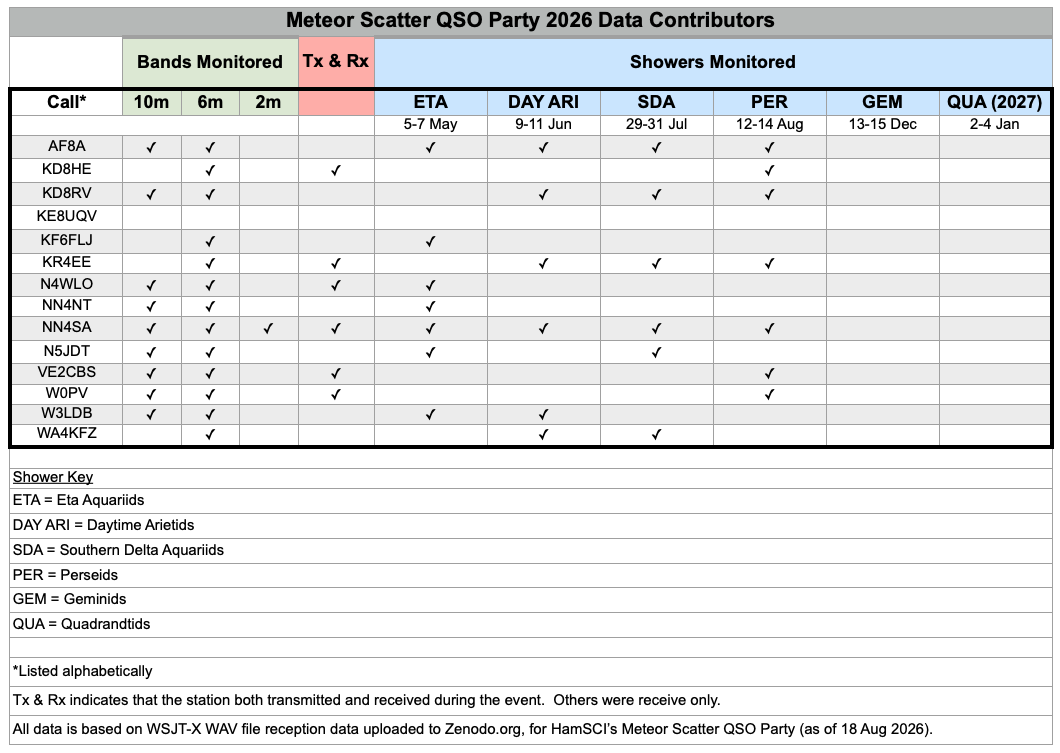
  • Meteor Scatter QSO Party Data Contributors: Who is making MSQP QSOs, analyzing their results and uploading their data? See below!


Are you new to meteor scatter?  Visit the How to Guide - for advice on monitoring and completing meteor scatter QSOs
Interested in contributing to science?  Visit the MSQP Operating Guidelines - learn how to gather and submit data for later scientific analysis
Curious about where meteors come from, when they can be seen, heard, and why?  View this presentation by a meteor scientist.
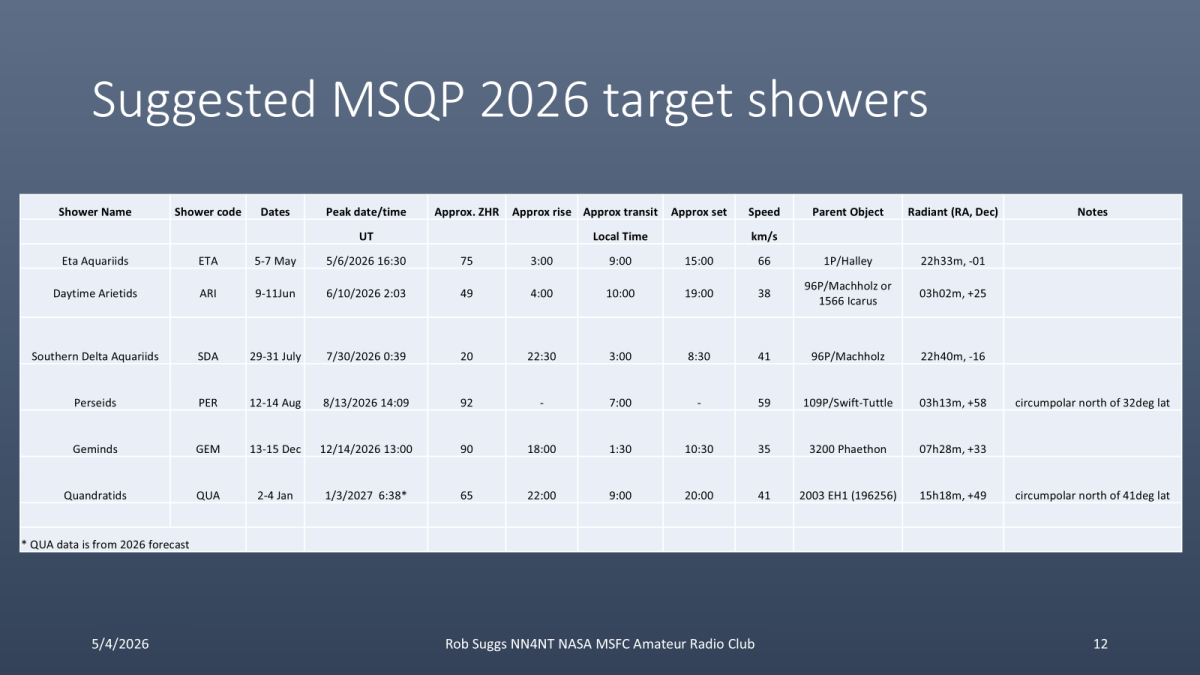
Targeted meteor showers (peak date range) (approximate zenithal hourly rate):

Eta Aquarius (5-7 May, 2026) (75)
Daytime Arietids (9-11 June, 2026) (49)
Southern Delta Aquariids (29-31 July, 2026) (20)

Perseids (12-14 August, 2026) (92)
Geminids (13-15 December, 2026) (90)
Quandratids (2-4 January, 2027) (65)

Open for a complete description (Dates, Peak Date/Time, ZHR, Rise Time, Transit Time, Set Time, Speed, Parent Object) for all of the above showers
August, 2025 (Perseid shower) MSQP Results
December, 2025 (Geminid shower) MSQP Results

2026-08-18 MSQP Activators.png


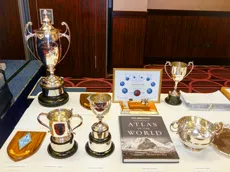
RSGB Trophies Awarded to HamSCI Members

The Radio Society of Great Britain*, at its April, 2026 Annual General Meeting, continued its tradition of announcing the previous years' winners of the RSGB Trophies.

Two well known members of HamSCI were awarded trophies for 2025:

Gwyn Griffiths, G3ZIL:  Wortley-Talbot Trophy - Awarded for the most outstanding experimental work in amateur radio. In particular, Gwynn was recognized for his RadCom article "Upper HF Openings at Night: One Effect of Traveling Ionospheric Disturbances”, which was based on material, and feedback, from his talk on the same topic at the HamSCI 2025 workshop (Newark, NJ).

Carl Luetzelschwab, K9LA:  Les Barclay Memorial Award - To recognize those who have made excellent contributions to propagation research and understanding, ranging from conducting original research, through to spreading knowledge about propagation and inspiring interest among amateurs, particularly citizen scientists.

Congratulations to Gwyn and Carl for earning this much deserved recognition by their peers!


Past Winners

HamSCI members have long been recognized by the RSGB for their contributions to radio science.  A list of past winners can be seen in a prior article.


*About the RSGB

The Radio Society of Great Britain (RSGB) is the national membership organisation for amateur radio enthusiasts. The society was first founded in 1913 and incorporated in 1926.  The Society is dedicated to the development of the science and practice of amateur radio. It works to increase awareness and understanding of amateur radio and to make the hobby accessible to everyone.

December, 2025 MSQP Contest Results Announced

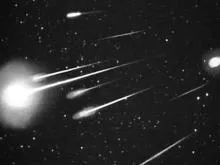
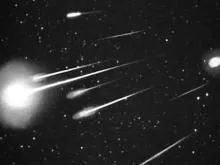
meteor scatter image

The complete results for the December 12-13, 2025 running of the Meteor Scatter QSO Party (MSQP) have been published.  They contain participants' scores, event statistics and a sampling of soapbox comments.  Finally, credits appear for those who helped make the MSQP possible.

Download the Complete December 12-13, 2025 MSQP Results

Note that scoring an event like the MSQP is a bit different than the typical ham radiosport event.  Most of the MSQP scoring effort revolves around interpreting PSKReporter data (spots) for a variety of entrants:  Some receive only, some who transmitted and made actual two-way QSOs, all of whom appear in the 280 million lines of PSKReporter data captured during the event.  Log submissions (ADIF files) were also used in the scoring process.
 
Every effort was made to be sure the reported numbers are accurate and reproducible, though it should be noted that the scores are for fun and enjoyment, a way to assess participation levels, and to help us plan for future events.
 
Most importantly, the scores recognize the many participants who contributed data which is just starting to be used for scientific analysis of 6 and 10 meter meteor scatter propagation.  A hearty 'Thank You' to all who participated and made it a successful event!


The December, 2025 'Top Spotters' and 'Top Spotted':

 
  Receive-Only Receive Spots   Transmit/Receive   Transmit Spots
 1   W3LDB
 Lee Butler
 Silver Spring, MD
 5,868 1 W6VJT
Pat Chambers
Los Cruces, NM
  20,091
 2   AA6AT
 Chris Harwood
 Richmond, CA
 5,121 2

CO8TW
Juan Carlos Veranes
Santiago de Cuba

  10,651
 3   WA5DJJ
 David Hassell
 Los Cruces, NM
 1,420 3 N4WLO
Tim Urban
Theodore, AL
  8,572


Visit the MSQP home page


Moving to MS Teams

Meeting created on March 24th:

teams.microsoft.com/meet/23172603111120?p=g6Ozdv7SAM0OalMjt2

CM test | Meeting-Join | Microsoft Teams


Meeting created on April 19th:

https://teams.microsoft.com/l/meetup-join/19%3ameeting_MDUxNjc5MWEtNWYxMS00NGRjLTg4MWYtNmQxYmNiOWFjMjM3%40thread.v2/0?context=%7b%22Tid%22%3a%22a8edc49a-41f1-4c69-9768-a7f6d7c3b8c3%22%2c%22Oid%22%3a%224f00a82b-f768-41e3-ba3e-808d3f85c4eb%22%7d


Three Papers Published by HamSCI Community Authors


Congratulations are in order for a number of HamSCI community members, performing their research at many different home institutions.  In chronological order, we'd like to recognize these principal authors and their co-authors....


February, 2026

Steve Cerwin and an international group of co-authors, from the University of Scranton, SSI and SERENE (Space Environment Radio Engineering Group, University of Birmingham) published "HamSCI HF multipath propagation mode analysis using amateur radios and audio waveforms sensitive to time difference of arrival" in Frontiers in Astronomy and Space Sciences.

Their study describes a method to deduce the ionization layer virtual height and propagation path geometry responsible for communication between two HF radio stations a fixed distance apart. The method measures the Time Difference of Arrival (TDOA) between multipath propagation modes involving the active ionospheric layers and reconciles the data with a virtual height model of the ionosphere.

DOI: 10.3389/fspas.2026.1723511


March, 2026

Maris Usis and 19 co-authors recently published  "Detecting changes in along-path HF propagation during the April 2024 total solar eclipse with radio amateurs and low-cost instrumentation" in the peer-reviewed journal Frontiers in Astronomy and Space Sciences.

The Case Western Reserve University (CWRU) team deployed GPS time-synced radio receivers, tuned to CHU, during the April 8, 2024 eclipse.  The receivers recorded changes in signal level which occurred during the eclipse transit. Credit is given to the amateur radio and citizen science communities for participating in the experiment.

DOI: 10.3389/fspas.2025.1720301


March, 2026

Sabastian Fernandes,  New Jersey Institute of Technology (NJIT) and a group of co-authors from NJIT, the University of Scranton, CWRU, and SSI, published an original research article entitled "Characterizing ionospheric variability through HF Doppler measurements: a statistical and numerical ray tracing analysis" in Frontiers in Astronomy and Space Sciences.

Sabastian and team presents a statistical analysis of Doppler shifts observed using GRAPE high frequency receivers, with their observations backed by PHaRLAP ray tracing simulations.

DOI:10.3389/fspas.2026.1713968


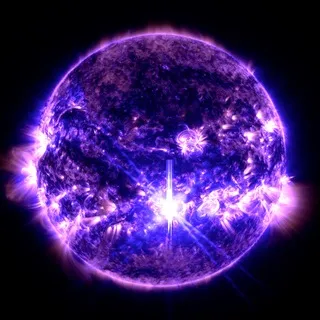
Solar disk image credit: NASA.gov, Solar Dynamics Observatory,10-03-24_1219UTC

HamSCI Home Page Goes Live!

The first preview of the HamSCI website is now online at http://www.hamsci.org. It is built using Drupal 7.41 and the Bootstrap base theme. It is hosted by the Hume Center at Virginia Tech.

The next step is to focus on the content we would like to have for when the website goes live to the general public.

Please send comments to Nathaniel at [email protected] or [email protected].

Science Traceability Matrix

Personal Space Weather Station Network Science Traceability Matrix

A science traceability matrix (STM) is a NASA-developed tool that shows how science goals and objectives “trace” (flow down) to instrument and mission requirements. You can read more here

Investigation Objectives

Science Questions

Functional Requirements

Objective 1:

Characterize the ionospheric and geomagnetic response to space weather events with sources both below and above the ionosphere.

•What are the characteristic temporal and spatial scales of magnetic fluctuations in near-Earth space during geomagnetic disturbances?

•How does ionospheric density vary as a function of location, altitude, and time in response to space weather disturbances associated with driving events such as solar flares, geomagnetic storms, substorms, and lower atmosphere perturbations?

•Determine the vector ground magnetic field for identification of geomagnetic disturbances and micropulsations (e.g. ULF variations).

•Receive transmissions from controlled sources (digital_rf-based) or signals of opportunity (e.g., WWV, WWVH, CHU).

Objective 2:

Characterize ionospheric variability and identify its sources during both quiet and disturbed times.

•What are the characteristics (wavelength, period, direction of travel, location, altitude) of traveling ionospheric disturbances (TIDs)?

•What is the location and nature of sources that drive TIDs, such as lower atmosphere winds/tides and upper atmosphere forcing?

•What is the location and nature of ionospheric variability that is not associated with TIDs?

•How do the location and nature of ionospheric variability sources change from quiet to disturbed times?

Make measurements on a minimum of two transmit-receive paths (three stations) with lengths >= ~100 km and with good spatial distribution for good orthogonality properties.


Objective 3:

Determine the impact of space weather events and ionospheric variability on terrestrial HF communications systems.

•What propagation paths are open/closed for given space weather conditions?

•What is the dominant propagation mode (i.e. single hop, double hop, ducting?) for given space weather conditions?

•What are ionospheric variability effects on HF communications signal parameters such as amplitude/phase scintillation, channel fading, and polarization?

Receive swept-frequency sounder signals from appropriate polarized or non-polarized signals of opportunity such as Digisonde or chirp sounders.

Objective 4:

Characterize the diel (day/night) and seasonal variability of the Earth-ionosphere waveguide as well as its response to solar and geomagnetic activity.

How do the Earth-ionosphere waveguide modes vary according to the season and time of day? How do they vary in response to solar flares, gamma ray bursts, and geomagnetic storms?

How do seasonal and diel effects of the Earth-ionosphere waveguide affect VLF wave propagation?

Can D layer electron density be mapped using ground-based VLF wave observations?

How do the influences of the previous question affect propagation and successful copy of VLF amateur transmissions in the 8270 Hz and 5170 Hz bands?


Sounding of the Earth-ionosphere waveguide using lightning sferics and Naval VLF transmitters.

A network of VLF receivers at various latitudes for comparison.

Monitoring various VLF signal attributes, including Naval VLF transmitter amplitude and phase.

Determination of received channel capacity of VLF amateur transmissions.


Objective 5:

Characterize the variability of the magnetosphere’s geometry and configuration during both geomagnetic activity and quiet times.

Does whistler activity correlate to sunspot number and if so, why?

Does the geometry and configuration of the magnetosphere affect whistler duct electron density? If not, is there some other influence?

Does whistler duct electron density vary by latitude during geomagnetic storms and quiet times?

Does the magnetospere's geometry and configuration have an effect on the geographic scale of the whistler's conjugate point reception footprint?


The ability to record whistler activity at various latitudes with a network of VLF receivers.

Determine statistical data of whistler dispersion for whistler duct electron density estimation.

A network of VLF receivers at various latitudes for comparison.

Lightning location network to monitor potential origins of whistlers and use them to estimate the source sferic of the whistler.


HamSCI Workshop 2026 Dedicated to VLF Master, Paul Nicholson, G8LMD

HamSCI wishes to dedicate the Workshop 2026 to Paul Nicholson's memory.  Paul, G8LMD, passed on 12 August, 2025.  Jonathan Rizzo, KC3EEY, details Paul's many accomplishments, both radio and community related, below.

Paul Nicholson G8LMD [SK] was a passionate VLF enthusiast, engineer, software author, amateur radio operator, and all around curious, intelligent, kind, helpful, and wonderful person and husband. Paul put his heart, soul, and brilliant mind into everything he did. One of Paul's biggest contributions is to the VLF community in VLF natural radio reception techniques, including his E-field and orthogonal H-field VLF receivers at his home in the countryside of Todmorden, UK, and his absolutely amazing vlfrx-tools software, containing 48 individual, scriptable, utilities for the application of data acquisition, timing, and signal processing of VLF natural radio emissions, sferics, VLF transmitters, VLF amateur radio reception, and VHF meteor scatter. vlfrx-tools allows any high-end computer soundcard with GNSS receiver to become a science-grade VLF data acquisition system.

His other software contributions include lcnetgen, a distributed capacitances and inductances calculator useful when setting up VLF receivers, and EbNaut, the very first digital amateur radio mode for the 8290 and 5170 Hz bands.

Paul's academic contributions include many natural radio emissions and man-made observations in the VLF band, collaboration with researchers on various topics including Q bursts, and his most ambitious project, the Indian Lightning Detection Network (ILDN), India's first domestic lightning location network run by Tripura University and other collaborating universities in India, which provides live lightning stroke data that saves countless lives. Paul designed a VLF reception system based on his E-field receiver at Todmorden and a soundcard-based data acquisition system using vlfrx-tools that provides real time processing of sferics at various locations in India to a central processing server that produces real time maps of lightning strokes and other data with location accuracy comparable to the WWLLN and commercial lightning detection networks, but using an open hardware, open software, and open data model that benefits researchers, students, and the general public.

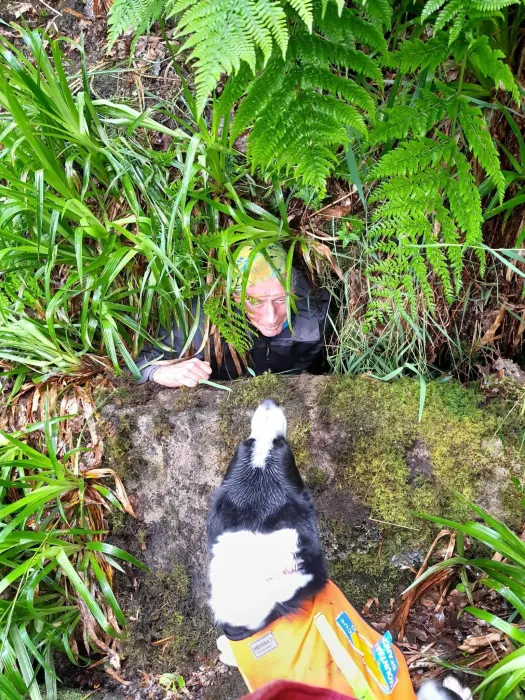
Paul also was selflessly involved in other endeavors, including serving as the chairman of the board and treasurer of the Gaddings Dam group whose purpose is to maintain and preserve Gaddings dam in Todmorden. Paul also loved dogs and served as a dogsbody for the Calder Valley Search and Rescue Team in the Calder Valley and Mid Pennine region. Being a dogsbody involves hiding yourself in inconspicuous places outside to train the search and rescue dogs.  Paul was active as a dogsbody for nearly 30 years. He contributed to training 33 dogs.  He was known to be extremely generous with his time, even in poor weather conditions. 

Many have pledged to carry on Paul's VLF work.  The HamSCI VLF Whistler Catcher Reception System will be one such example.

RIP, OM.  


Calling all HamSCI Artists

We're in need of a logo for the Personal Space Weather Station Network! Do you have any ideas?

You don't need graphic design experience to participate! We will work with the University of Scranton's graphics design team to create a logo based on the winning design.

Some things to consider:
A good logo should be simple enough that it can be quickly sketched. The final version may show up on T-shirts, mugs, circuit boards, stickers... The Open Source Hardware Association logo is a good example. You may want to consider incorporating elements of existing logos into yours, like how the OSHWA logo is incorporated into the MacGyver Session logo, or how elements of the NASA meatball are incorporated in the NASA worm.

Consider making multiple versions for different use cases. Feel free to design a minimal version and an elaborate version if you want - there's no limit to the number of designs you can submit!
Do you have an idea for a grand design that showcases the VLF Whistler Catcher, the Grape, the RX888 and the HamSCI magnetometer? You can design a logo for each!

Got an idea for HamSCI-related art that doesn't quite work as a logo? You can submit that too!


 Rules:
  - By entering your work in this contest, you agree that HamSCI can use it in the future under a Creative Commons ShareAlike license. You will receive credit, but not compensation, for the use of your idea or art. 
  - AI use must be declared, and is permitted for rough drafts only. We would much rather see a rough sketch from you than a slick AI rendering!
  - Entries must be submitted on our Google Form by February 6, 2026. We will announce the results at the 2026 HamSCI Workshop.

Any updates to the rules will be posted to this page. 


Click here to submit your art and ideas.

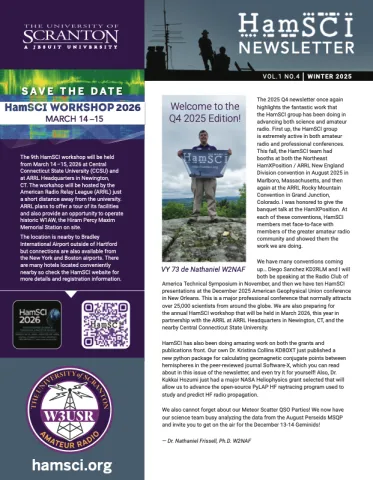
HamSCI Newsletter, Volume 1, Number 4, Published

The fourth HamSCI Newsletter, the Winter 2025 edition, has been published.  It is available on the HamSCI Newsletter page.

Articles include....

  • HamSCI at HamX, Rocky Mountain Convention, RCA Technical Symposium, Delaware Valley RA, Orlando HamCation
  • Amateur Profile:  Bill Mader K8TE
  • HamSCI Presentations at the AGU 2025 Conference
  • Contributor Column:  The 1921 New York Railroad Storm
  • HamSCI Literature Review
  • DX'ing Dashboard for the HamSCI Personal Space Weather Station
  • HamSCI Gets a Boost from NASA, Open HF Propagation Research...and more, including...a newsletter first, a crossword puzzle!
 

Thanks to the hard working Newsletter Editorial/Production Team: Ed Efchak WX2R, Mary Lou West KC2NMC, Vikki Lawhon (University of Scranton) and all of the article contributors.

HamSCI Award Recipients


Sample Cert_003.jpeg


2018 Workshop, New Jersey Institute of Technology

Phil Erickson W1PJE

Keynote Address:  Advancing Radio Remote Sensing and Geospace Science With The Help of Amateur Radio, Then, Now, and in the Future

Ethan Miller K8GU

Invited Tutorial: Space Physics for Radio Amateurs and Ham Radio for Space Physicists


2019 Workshop, Case Western Reserve University

Ward Silver N0AX

Keynote: Ham Radio 2.0 - Science, Service, Skill

Carl Luetzelschwab K9LA

Invited Talk: Ham Radio for Space Scientists

Larisa Goncharenko  

Invited Talk: Space Science for Ham Radio Operators

George Byrkit K9TRV

Providing AV & Video Recording Services at the 2019 HamSCI Workshop

Kristina Collins KD8OXT

Local Organizing Committee Chair for the 2019 HamSCI Workshop

David Kazdan AD8Y

Local Organizing Committee Advisor for the 2019 HamSCI Workshop

Nathaniel Vishner KB1QHX

Local Organizing Committee for the 2019 HamSCI Workshop

Phil Erickson W1PJE

Science Program Committee for the 2019 HamSCI Workshop

Ethan Miller K8GU

Science Program Committee for the 2019 HamSCI Workshop

Bill Liles NQ6Z

Science Program Committee for the 2019 HamSCI Workshop


2020 Workshop, Virtual

David Halliday K2DH

Invited Talk: Amateur Auroral Communications

Liz MacDonald KJ7RUB

Invited Talk: Aurorasaurus: Citizen Science Observations of the Aurora

James LaBelle  

Invited Talk: Observing Radio Signals of Auroral Origin

Tim Duffy K3LR

Keynote: Let’s Push the Exploration of the Ionosphere to The Next Level


2021 Workshop, Virtual

Elizabeth Bruton   Keynote:  The History of Radio
J. Michael Ruohoniemi  

Invited Talk: Midlatitude Ionospheric Physics

Joseph Dzekevich K1YOW

Invited Talk: Amateur Radio Observations and The Science of Midlatitude Sporadic E


2022 Workshop, Huntsville

Chen-Pang Yeang  

Keynote: Ham Radio and the Discovery of the Ionosphere

Jim Bacon G3YLA

Invited Talk: Evaluation of links between Terrestrial Weather and Sporadic-E

Tamitha Skov WX6SWW

Invited Talk: The Ionospheric Impacts of Space Weather and our Heightened Awareness of its Effects on Society


2023 Workshop, University of Scranton

Patricia Reif W5TAR

Keynote: Forging Amateur-Professional Bonds

Jesse Alexander WB2IFS

Invited Talk: The Ham Radio Project: Exploring the Electromagnetic Spectrum

Joseph Huba  

Invited Talk: Modeling the Ionosphere with SAMI3

Salisa Brown  

Special Appreciation for her outstanding contributions and efforts in making the March 17-18, 2023 HamSCI Workshop a success

Mary Lou West KC2NMC

The Outstanding Mentor and Scientist Award


2024 Workshop, Case Western Reserve University

Scott McIntosh  

Keynote: On Final Approach To Solar Maximum: Testing A Hypothesis In Real Time

Kate Zawdie  

Invited Talk: High Frequency Raytracing for Studying the Ionosphere and Radio Propagation

Phil Karn KA9Q

Invited Talk: The ka9q-radio SDR package

Matthew Canal KE8NZR

Student Mentorship and Logistics

John Gibbons N8OBJ

Expertise in Hardware and Viticulture

David Kazdan AD8Y

Student Mentorship & Outstanding Contributions

Rob Robinett AI6VN

WSPRDaemon and Advancement of the PSWS Project

Dave Witten KD0EAG

Development of the HamSCI/TAPR Magnetometer

Gary Mikitin AF8A

Outstanding Project Management Supporting the Festivals of Eclipse Ionospheric Science


2024 Hamvention HamSCI Forum

Bill Blackwell AB1XB

Outstanding Work in Grape 2 Firmware System Design, Implementation and Support

Bill Engelke AB4EJ

Excellence in Amateur Radio Data Systems Design, Data Processing, and Research


2025 Workshop, New Jersey Institute of Technology 

Bob Inderbitzen NQ1R

Keynote: Discovering Amateur Radio

Lynn Harvey  

Invited Talk: The Role of the Polar Vortex in Atmosphere-Ionosphere Coupling

Steve Cerwin WA5FRF

Invited Talk: Radio Wave Propagation and Antenna Fundamentals

Derek Kozel K0ZEL

Invited Talk: GNU Radio

Gene Niemiec K2KJI

Invited Talk: An Early History of Global Navigation Satellite Systems (GNSS)

Lou Lanzerotti  

Invited Talk: A History of Space Weather Research

Ed Efchak WX2R

Excellence in Public Relations and the Advancement of HamSCI

McKenzie Denton KO4GLN

Excellence in HamSCI Social Media

Gareth Perry KD2SAK

Local Organizing Committee Co-Chair for the 2025 HamSCI Workshop

Ryan Tolboom N2BP

Local Organizing Committee Co-Chair for the 2025 HamSCI Workshop

Hyomin Kim KD2MCR

Local Organizing Committee Member for the 2025 HamSCI Workshop


2026 Workshop, American Radio Relay League, Newington, CT 

Marc Kuchner  

Keynote: How I Almost Went to Jail

Rob Suggs NN4NT

Invited Talk: Meteor Scatter Tutorial

Kuldeep Pandey  

Invited Talk: Solar Eclipse Through Ham Radio:  What the Band Revealed

Phillip Jellison  

Outstanding Work Supporting the K3LR PSWS Installation

George Byrkit K9TRV

Outstanding Work Supporting the K3LR PSWS Installation

Paul Elliott WB6CXC

Outstanding Work Developing the WSPRSonde & PSWS Hardware

Jonathan Rizzo KC3EEY

Memorial Talk:  Remembering and Honoring Paul Nicholson, G8LMD, Passionate VLFEnthusiast and Master

Nathaniel Frissell W2NAF Wins Carole Perry Educator of the Year Award

The Orlando HamCation has recently announced that Dr. Nathaniel Frissell W2NAF, Tony Milluzzi KD8RTT, and Ambarish Nag Biswas VU2JFA are the 2026 recipients of its HamCation Awards.

Dr. Frissell is the recipient of the 2026 Carole Perry Educator of the Year Award. The award recognizes his outstanding work with the HamSCI education program he created, grew, and continues to expand.

The 2026 Gordon West Ham Ambassador of the Year Award goes to Tony Milluzzi, KD8RTT, located in Lenexa, KS. The award recognizes his focused, long-term support and promotion of the Collegiate Amateur Radio Program (CARP).

The Amateur Radio Hero Award goes to Ambarish Nag Biswas, VU2JFA, located in West Bengal, India. The award recognizes his outstanding support of local and national emergency operations and law enforcement during life-threatening events where lives were saved by his actions.

The Orlando awards committee noted that “Each of these nominees has demonstrated outstanding dedication to promoting Amateur Radio by using radio to share knowledge, educate, and provide vital communications. The HamCation team congratulates each of them for their award and the contribution they have personally made to Amateur Radio”.

Note: HamSCI is planning to have a booth/table at the 2026 Orlando HamCation, with volunteers from the HamSCI Community presenting at the HamCation Forum, meeting and greeting HamCation attendees at our booth.


HamSCI 2026 Program

Posters and presentations at the HamSCI workshop are made for community discussion and for exploration of new possibilities. Please note that these materials are not peer-reviewed.

Main Workshop Page

Most presentations and posters can be seen by clicking on the titles in the Agenda below.  Doing so will open a Publication record, scroll down, look for the PDF link or click on the poster image to view it full size.


A YouTube Playlist is available for all presentations, courtesy ARRLHQ

Saturday, March 14, 2026

Eastern Daylight Time UTC NR Title Presenter Modality Location
8:00 AM EDT 1200z   Facility opens with breakfast (Central Connecticut State University, Student Center)     Alumni Hall
8:45 AM EDT 1245z   Day 1 Welcome & Opening Remarks

Dave Minster, NA2AA, CEO, ARRL
Bob Inderbitzen, NQ1R, Director Marketing & Innovation, ARRL

In-person Alumni Hall

ORAL SESSION I - Personal Space Weather Station
Chair:  Kristina Collins

9:00 AM EDT 1300z O1

The HamSCI Personal Space Weather Station, Introduction and Updates

Dr. Nathaniel Frissell W2NAF
The University of Scranton

In-Person Alumni Hall
9:15 AM EDT 1315z O2

Development of a low-cost magnetometer system for a coordinated space weather monitoring

Dr. Hyomin Kim KD2MCR
New Jersey Institute of Technology 
In-Person Alumni Hall
9:30 AM EDT 1330z O3

The Personal Space Weather Network System and Its Development 

Christian Hirschey and Gavin Ward
The University of Alabama
In-Person Alumni Hall
9:45 AM EDT 1345z O4

Multi-Static HF Time Signal Analysis for Ionospheric Sounding and TEC Estimation

Michael Hauan AC0G
HamSCI Community

In-Person Alumni Hall
10:00 AM EDT 1400z O5

Radio Propagation Time Of Flight Measurements

Paul Elliott WB6CXC
Turn Island Systems
In-Person Alumni Hall
10:15 AM EDT 1415z   COFFEE BREAK     Alumni Hall

ORAL SESSION II 
Chair:  Nathaniel Frissell

10:30 AM EDT 1430z O6

INVITED TUTORIAL: Solar Eclipse Through Ham Radio: What the Bands Revealed

Kuldeep Pandey
New Jersey Institute of Technology
In-Person Alumni Hall
11:15 AM EDT 1515z O7

Did the Miyako earthquake affect Medium Wave broadcast reception on 9 November 2025?

Satoshi Miyauchi JP1SCQ
Nick Hall-Patch VE7DXR
HamSCI Community
Virtual and In-Person Alumni Hall
11:35 AM EDT 1535z O9

Uncovering the Complexity of WSPR Daemon Noise Through Kernel Density and Gaussian Mixture Models

Robert Gerzoff WK2Y
HamSCI Community

In-Person Alumni Hall
11:55 AM EDT 1555z O10

TUTORIAL: Introduction to Baseband Processing

Phil Erickson W1PJE, Bill Liles NQ6Z,
Ethan Miller K8GU
MIT Haystack, HamSCI Community, STR
In-Person Alumni Hall
12:30 PM EDT 1630z   LUNCH     Alumni Hall

Tours of American Radio Relay League
Offsite

1:45 PM EDT 1745z   Board busses to ARRL   In-Person CCSU
2:00 - 5:00 PM EDT 1800z to
2100z
  Tours of ARRL Headquarters, Laboratory, W1AW Hiram Percy Maxim Memorial Station ARRL Personnel In-Person Newington, CT
5:00 PM EDT 2100z   Busses return to CCSU Campus   In-Person  

Saturday Night Banquet
CCSU’s Constitution Room inside Memorial Hall (Campus Map PDF)

Chairs: Nathaniel Frissell and Bob Inderbitzen

6:30 PM EDT 2230z   Banquet Begins   In-person CCSU Hilltop Cafe
7:30 PM EDT 2330z   KEYNOTE:  How I Almost Went to Jail Dr. Marc J. Kuchner
Astrophysicist, Senior Science Officer, NASA
In-Person CCSU Hilltop Cafe

Sunday, March 15, 2026

Eastern Daylight Time UTC NR Title Presenter Modality Location
8:00 AM EDT 1200z   Facility opens, with coffee (Central Connecticut State University, Student Center)​      Alumni Hall

POSTER SESSION and DEMONSTRATIONS

8:30 AM EDT 1230z  

Poster Session and Demonstrations

Continental Breakfast 

  In-Person Alumni Hall
11:30 AM EDT 1530z   LUNCH     Alumni Hall

ORAL SESSION III
Chair:  Gary Mikitin

12:30 PM EDT 1630z O11

INVITED TUTORIAL: Meteor Scatter Science

Robert Suggs NN4NT
HamSCI Community

In-person Alumni Hall
1:15 PM EDT 1715z O12

An Amateur Radio HF Channel Sounder

Robert Johnk WB0VGD
Institute for Telecommunication Sciences  NTIA/ITS (Retired)
Virtual Alumni Hall
1:35 PM EDT 1735z O13

Real-Life RX antenna directional performance validation

Ashraf Chaabane 3V8SS/KF5EYY
ARAT Tunisia
Virtual Alumni Hall
1:55 PM EDT 1755z O14

A Python data analysis and synthesis toolbox for PSWS Doppler data:  A time-of flight case study

Gwyn Grffiths G3ZIL
HamSCI Commnity
Virtual Alumni Hall
2:15 PM EDT 1815z   COFFEE BREAK     Alumni Hall

ORAL SESSION IV
Chair: 

2:30 PM EDT 1830z O15

Personal Space Weather Station Observations of the Gannon Geomagnetic Storm

Rebecca Potter KE2EBI
University of Scranton
In-Person Alumni Hall
2:50 PM EDT 1850z O16

The third annual HamSCI book club: a discussion on shortwave radio as it was used in World War II.

Aaron Bilow W3WAM
Case Western Reserve University
In-Person Alumni Hall
3:10 PM EDT 1910z O17

MEMORIAL:  Remembering and Honoring Paul Nicholson G8LMD: Passionate VLF Enthusiast and Master

Jonathan Rizzo KC3EEY
University of Scranton

In-Person Alumni Hall
3:40 PM EDT 1940z O18

Phase Coding in Digital SuperDARN Radars to Observe Oblique Scattering

Allison Pitzl N4EON
Virginia Tech
In-Person Alumni Hall
4:00 PM EDT 2000z   COFFEE BREAK     Alumni Hall

ORAL SESSION V
Chair: 

4:15 PM EDT  2015z O19

The SoFIE CubeSat Mission: A Global Opportunity for Amateur Radio Operators as Citizen Scientists 

Jeffrey Mendenhall
Saint Francis University
In-Person Alumni Hall
4:35 PM EDT 2035z O20

New GOES Signal Application for Monitoring Ionospheric Irregularities: A HamSCI Collaboration Vision

Theodore Beach KA8YRU
Boston College, Institute for Scientific Research
In-Person Alumni Hall
4:55 PM EDT 2055z O21

CINEMA/MOVIE - A NASA research mission to study the Earth's magnetic tail, and its conjugate Citizen Science

David McGaw N1HAC
Dartmouth
In-Person Alumni Hall

5:15 PM EDT

1915z


Closing Remarks

Nathaniel Frissell W2NAF
Bob Inderbitzen NQ1R

In-Person

Alumni Hall

5:30 PM EDT 2130z    DINNER     Alumni Hall


DEMONSTRATIONS

    All demonstrations held in Alumni Hall
    D1 Understanding HamSCI Magnetometers Measurements and Observations Rachel Frissell W2RUF et al
University of Scranton
In-Person  
    D2 A Magnetometer Dashboard Jackson Conti
University of Scranton
In-Person  
    D3 Introduction to Baseband Processing Phil Erickson W1PJE and Bill Liles NQ6Z
MIT Haystack, HamSCI Community
In-Person  
    D4 Development of a Contesting and DXing Dashboard for the HamSCI Personal Space Weather Station Owen Ruzanski KD3ALD
University of Scranton
In-Person  
    D5 The DASI2 HamSCI Whistler Catcher VLF Reception System Jonathan Rizzo KC3EEY
University of Scranton
In-Person  


POSTERS

    All posters displayed in Alumni Hall
    P1

A Citizen-Science Path to TEC: Using GNSS Measurements to Track the Ionosphere

Jeremy McLynch
New Jersey Institute of Technology
In-Person  
    P2

HF Doppler Studies of the 2024 Total Solar Eclipse

Emma Moran KD3CKD
University of Scranton

In-Person  
    P3

HamSCI Link Budget: Observations and Modeling the Signal Strength of HF Radio Links from WWV to W2NAF

Gamal Zayed 
The University of Cairo

Virtual  
    P4

Study of HF Channel Conditions Using WWV/WWVH test Modulation Signals 

Jay Weitzen AC1SN
Billerica ARS, Police ARC

In-Person  
    P5

An Atlas of Forms Seen on HF Personal Space Weather Station Traces, to Help Users Recognize and Analyze Events

Bob Mattaliano N6RFM
HamSCI Community

Virtual  
    P6

Geographic Correlation Analysis of WWV Ionospheric Propagation: Phase Stability and Fading Statistics for Adaptive HF Radio

Obinna Modilim
Harvard University

In-Person  
    P7

The Observation of Sporadic E Using FT8 in Japan

Ryusuke Takata JI1VHV
The University of Electro-Communications

In-Person  
    P8

Crowdsourced Detection of Solar-Driven Ionospheric Disturbances Using Amateur Radio Weak-Signal Networks

Ron Milione W2TAP
Ormond Beach RC

Virtual  
    P9

Multi-Year Climatology of Large-Scale Traveling Ionospheric Disturbances Observed with High Frequency Amateur Radio Receiving Networks Using a Novel Automated Detection Algorithm

Diego Sanchez KD2RLM
University of Scranton
In-Person  
    P10

The DASI2 HamSCI Whistler Catcher VLF Reception System

Jonathan Rizzo KC3EEY
University of Scranton
In-Person  
    P11 Parametric Modeling and Analysis of Lightning Sferic Waveforms for D-Region Remote Sensing Mason Matrazzo
Auburn University
In-Person  
    P12

Development of a Contesting and DXing Dashboard for the HamSCI Personal Space Weather Station

Owen Ruzanski KD3ALD
University of Scranton
In-Person  
    P13

What is the ITU-R-HF Model and How Could it Be Used in a HF Contesting Dashboard?

Liam MIller KD3BVX
University of Scranton

In-Person  
    P14

VHF Contests as a Propagation Study Tool

James French W8ISS
HamSCI Community
In-Person  
    P15

Roadmap for the HamSCI Personal Space Weather Station Network (2026)

Kristina Collins KD8OXT
Case Western Reserve University
In-Person  
    P16

The Heliophysics Application Programming Interface on the PSWS

William Engelke AB4EJ
University of Alabama
In-Person  
    P17

Connecting Amateur Radio and Atmospheric Science: The CEDAR Madrigal Database

Katherine Cariglia 
MIT Haystack Observatory

In-Person  
    P18

Starting a Low‑Cost SDR Beacon Receiver Project for Studying Extended Tropospheric Propagation on 432/902/1296 MHz

Navid Shahrouzi
University of Scranton

In-Person  
    P19

Radioconda: Gateway to Software Radio

Ryan Volz 
MIT Haystack Observatory

In-Person  
    P20

A Low-Cost Low-Power Chirp Ionosonde for Studying the Ionospheric Impacts of Space Weather

Gerard Piccini KD2ZHK
New Jersey Institute of Technology
In-Person  
    P21 Electromagnetic Vector Sensor Ionospheric Sounder (EMVISS) John Swoboda
MIT Haystack Observatory
In-Person  
    P22

Meteor Scatter Statistics: Theory vs. Practice

Donald Rea K6ICF
HamSCI Community

Virtual  
    P23

Analyzing Meteor Scatter Communications Through Citizen Science and Data Driven Methods

Nina Tormann KD3BJV
University of Scranton
In-Person  
    P24

Understanding HamSCI Magnetometers Measurements and Observations: A Preliminary Report

Rachel Frissell W2RUF
University of Scranton
In-Person  
    P25

A Magnetometer Dashboard

Jackson Conti 
University of Scranton
In-Person  
    P26

Assessment of a Low-Cost Magneto-Inductive Magnetometer for Personal Space Weather Stations

Daniel Clancy
New Jersey Institute of Technology

In-Person  
    P27

Why You Should Attend the Youth on the Air Camp

Jack Roberts W9RFT
Youth on the Air
In-Person  
    P28

Unauthorized Use Of Military Satellites: Threats To Mission Security And Integrity

Alexandre Takio Kitagawa PU5KTA
Department of Education of Indaial

Virtual  
    P29

The Influence Of Solar Activity On High-Frequency Communications: A Systemic Risk To Global Communication

Alexandre Takio Kitagawa PU5KTA
Department of Education of Indaial
Virtual  
    P30

Communication, Education, and Radio Technologies Summit Teacher Training Model in Türkiye

Hanife Kilic 
Karabuk Science and Art Center School

Virtual  
    P31

Telling Radio Stories Through Stamps: Amateur Ham Radio and Project Magnet in Philately

Briti Deb VU3GMW
HamSCI Community

Virtual  
    P32 HamSCI PSWS Logo Brainstorming Kristina Collins KD8OXT
Case Western Reserve University
In-person  


HamSCI Glossary


Major support for the HamSCI Workshop 2026 is provided by NSF Grant 2517208 to the New Jersey Institute of Technology.

HamSCI 2026


HamSCI Logo Vertical.png


Workshop Agenda, Presentations, Posters

YouTube Playlist - Presentation Videos - by ARRLHQ

Program

The 9th annual HamSCI Workshop is upon us! Join us at Central Connecticut State University and the American Radio Relay League (ARRL) Headquarters in Newington, CT on March 14-15, 2026. We're excited to welcome you to this fast-growing meeting. Organizers have worked hard to put together a memorable two-day event.

This year's theme, "Discovering Science Through Ham Radio", celebrates the community's achievements, including Personal Space Weather Station deployments, meteor scatter propagation studies and the promotion of WSPR as a propagation sensing tool. The workshop is expected to feature more than 50 poster and oral presentations, plus invited tutorials, and a banquet with a keynote address by a prominent member of the community.

The program will focus on the latest findings, strategies, and best practices in ionospheric science.  It has been designed to bring together the amateur radio and professional science communities. Anyone with an interest in these subjects is welcome to attend. Most speakers and attendees will participate in-person. A virtual option is now available.  

Connect and share ideas with scientific industry leaders, peers, experts, and partners. Learn about the latest insights and best practices across different segments of ionospheric science. Get an in-depth look at what is coming next. Click on the 'Workshop Agenda' button above for details.

Venue, tours of ARRL, airport and hotel details appear below.


Saturday Keynote: Dr. Marc Kuchner, "How I Almost Went to Jail"

Marc Kuchner

Abstract: Don’t do what I did. But I think science is just about the best possible reason for getting into trouble. I’ll tell you some stories of how I got hooked on scientific mischief and sharing the experience of scientific research with the world.

Biography: Dr. Marc Kuchner is an astrophysicist and the Citizen Science Officer for NASA’s Science Mission Directorate. He oversees a portfolio of 38 NASA-funded participatory science projects, involving millions of volunteers. Marc received his bachelor's degree in physics from Harvard and his Ph.D. in astronomy from Caltech, then studied at the Harvard-Smithsonian Center for Astrophysics as a Michelson Fellow and at Princeton University as a Hubble Fellow. Kuchner is also known for his optical inventions, which are used the Webb space telescope.


Invited Amateur Tutorial: Dr. Rob Suggs NN4NT, "Meteor Scatter Tutorial"
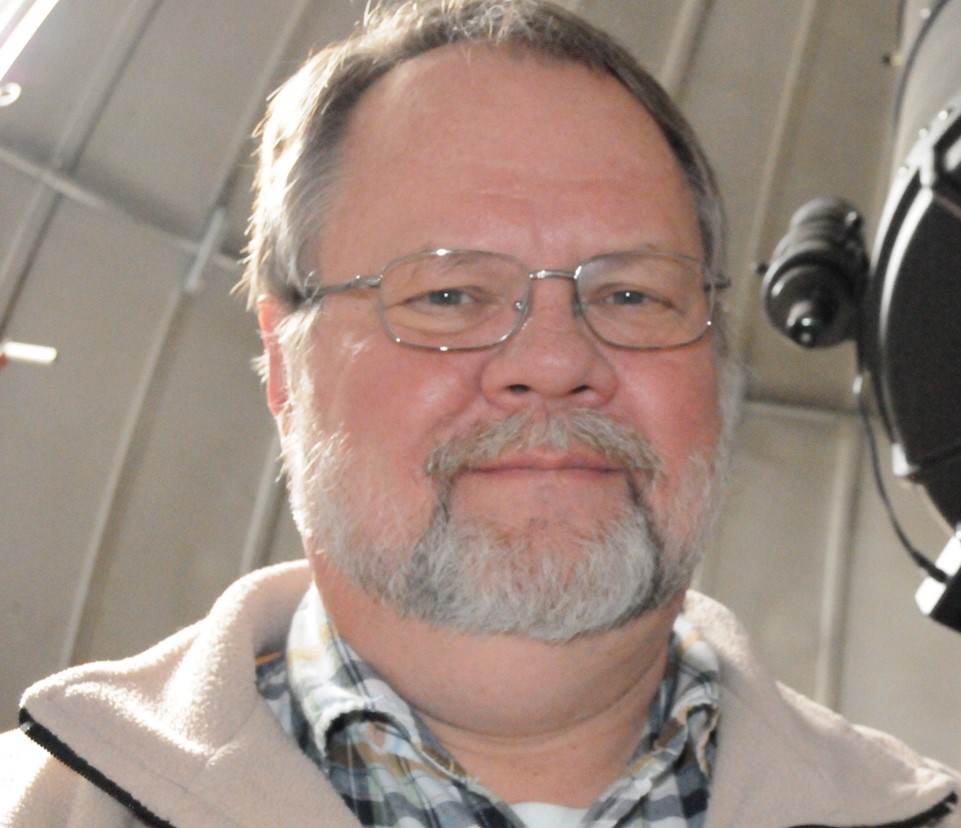
Rob Suggs

Abstract: Science goals of the Meteor Scatter QSO Party (MSQP) include testing the wavelength dependence of the amplitude and duration of the scattered meteor signals. This tutorial will describe the characteristics of the meteor “pings” and how they vary with wavelength of the radio frequency signals. The sources of the meteoroids, their physical characteristics, and the importance of scattering geometry will be described. The use of the WSJT-X MSK144 mode for meteor scatter communications and collection of data during the MSQP will also be discussed.

Biography: Dr. Suggs recently retired from NASA’s Marshall Space Flight Center in Huntsville, Alabama. He worked for 20 years as Space Environments Team Lead responsible for specifying the meteoroid, orbital debris, plasma, ionizing radiation, thermal and lunar surface environments for various NASA programs including Artemis and International Space Station. He also worked at Johnson Space Center in Houston in the Space Station Program Office responsible for space environments and effects and external payloads. His PhD research was on Saturn’s atmosphere during the Voyager missions. His work on meteoroids includes supporting NASA’s Meteoroid Environment Office and instituting the Lunar Meteoroid Impact Monitoring Program. Rob is an active member of the Marshall Space Flight Center ARC NN4SA.
 

Invited Scientist Tutorial: Dr. Kuldeep Pandey, "Solar Eclipse Through Ham Radio: What the Bands Revealed"

Abstract: Hundreds of amateur radio operators (hams) collaborated to monitor the impact of the April 2024 Total Solar Eclipse on radio communications. By integrating ham radio logs with PHaRLAP ray-trace modeling, we analyzed how the eclipse altered radio propagation and the Earth’s ionosphere. Our results demonstrate that the eclipse affected radio links variably across different frequency bands (1.8, 7, and 28 MHz) and propagation paths throughout North America and over the Atlantic Ocean to Europe. By combining real-world observations with simulations, we validated ionospheric model predictions (such as SAMI3) regarding eclipse-driven changes. These findings refine our understanding of how solar eclipses modulate the ionosphere and global radio communications.

Biography: Dr. Kuldeep Pandey obtained his PhD in 2019 from the Physical Research Laboratory in India. His doctoral and early postdoctoral works focused on electric fields, currents, and plasma distributions in the low-latitude ionosphere. In November 2020, Kuldeep joined the University of Saskatchewan–Canada as a Postdoctoral Fellow, where his research focused on HF radio polarization using ePOP satellite datasets and modeling. Since April 2024, Kuldeep has been a Postdoctoral Research Associate at the New Jersey Institute of Technology (NJIT). His current work focuses on understanding the effects of the April 2024 solar eclipse on the ionosphere and HF radio propagation using observations from ham radio, ground- and satellite-based instruments, and ray-trace modeling.


Workshop Dedication:  In Memory of Paul Nicholson, G8LMD

This year's workshop is dedicated to Paul's memory (he passed away on 12 August 2025), as he was truly one of the greats in VLF work.  Hardware, software, education, Paul could do it all.  Rest in peace, friend.


Memorial Talk: "Remembering and Honoring Paul Nicholson G8LMD: Passionate VLF Enthusiast and Master" by Jonathan Rizzo KC3EEY
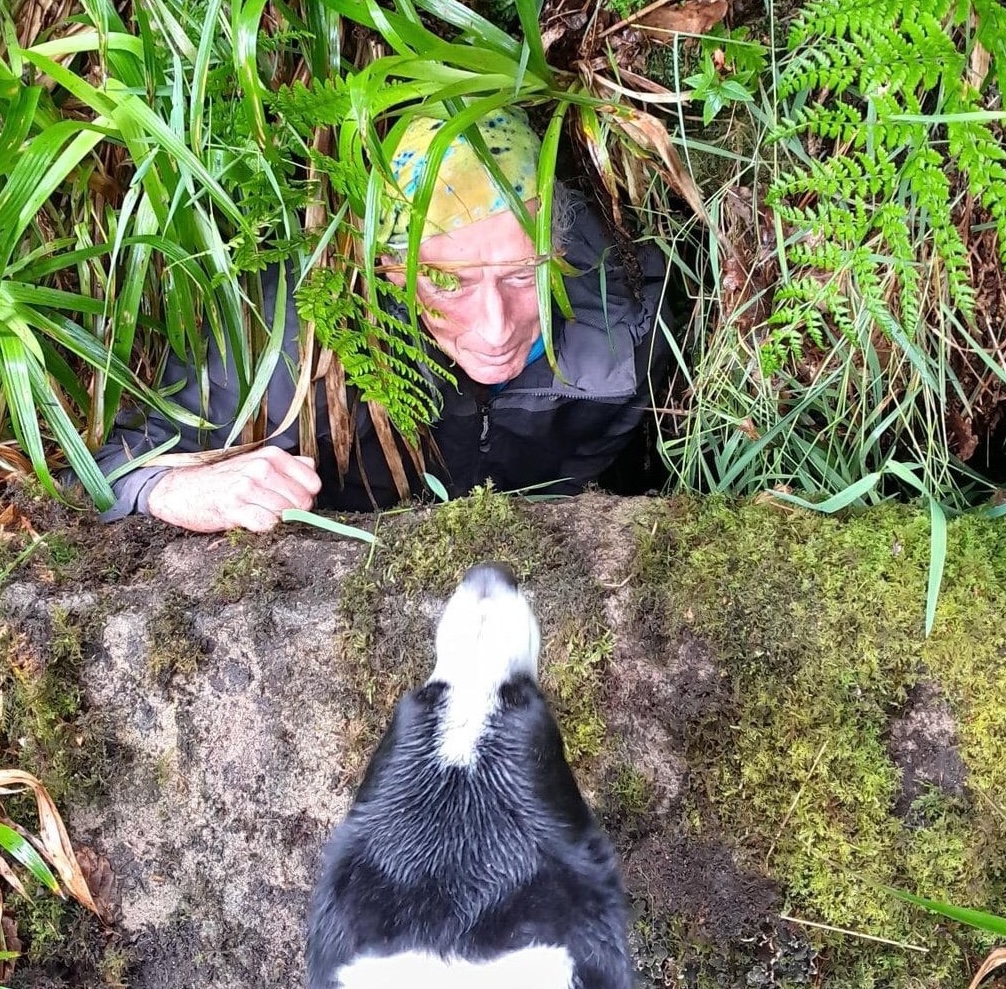
Paul Nicholson

Abstract: Paul Nicholson G8LMD (pictured), was a passionate very low frequency (VLF) enthusiast, engineer, software author, amateur radio operator, and all around curious, intelligent, kind, and helpful person. The HamSCI VLF project is only possible because of Paul's numerous contributions to the VLF Community. Jonathan followed Paul's projects very closely since 2013 and considers him his VLF "Elmer". To Jonathan, Paul was a rock star. Not only does Jonathan remember and honor Paul, but he also intends to continue Paul's amazing work through deploying a network of HamSCI Whistler Catcher VLF Reception Systems. These systems will make observations of VLF phenomena, QSOs with VLF amateur transmissions, and lightning stroke locations solutions for the HamSCI Lightning Detection Network and the Indian Lightning Detection Network (ILDN). The ILDN was a project close to Paul's heart. Paul became a silent key on 12 August 2025 after a courageous battle with cancer that he approached with stoicism and strength. The HamSCI Whistler Catcher VLF Reception System is dedicated to Paul's memory and honor.

Biography:  Paul Nicholson G8LMD [SK] was a passionate VLF enthusiast, engineer, software author, amateur radio operator, and all around curious, intelligent, kind, helpful, and wonderful person and husband. Paul put his heart, soul, and brilliant mind into everything he did. Pioneering VLF natural radio reception techniques which include his E-field and orthogonal H-field VLF receivers at his home in the countryside of Todmorden, UK, and his absolutely amazing vlfrx-tools software, containing 48 individual, scriptable, utilities for the application of data acquisition, timing, and signal processing of VLF natural radio emissions, sferics, VLF transmitters, VLF amateur radio reception, and VHF meteor scatter. His other software contributions include lcnetgen, a distributed capacitances and inductances calculator useful when setting up VLF receivers, and EbNaut, the very first digital amateur radio mode for the 8290 and 5170 Hz bands. Paul's academic contributions include many natural radio emissions and man-made observations in the VLF band, collaboration with researchers on various topics including Q bursts, and his most ambitious project, the Indian Lightning Detection Network (ILDN), India's first domestic lightning location network run by Tripura University and other collaborating universities in India, which uses a VLF reception system he designed based on his E-field VLF receiver and utilizes vlfrx-tools which provides live lightning stroke data that saves countless lives. Paul also was selflessly involved in other endeavors, including serving as the chairman of the board and treasurer of the Gaddings Dam group whose purpose is to maintain and preserve Gaddings dam in Todmorden. Paul also loved dogs and served as a dogsbody (being a dogsbody involves hiding yourself in inconspicuous places outside to train the search and rescue dogs) for the Calder Valley Search and Rescue Team.

Speaker's Biography: Jonathan Rizzo KC3EEY is an electrical engineer and a graduate of the University of Scranton and Luzerne County Community College. Jonathan became extremely interested in very low frequency (VLF) phenomena in 2013, both in the technical aspect of observation techniques, but also the physics. He has been an advocate of VLF study ever since.


Abstract Submission/Poster and Presentation Templates

The abstract submission window has closed. Thanks to all who submitted. 

If you submitted an abstract, and you have received notice from the Workshop Committee that it has been accepted as a talk or as a poster, you may wish to download and use the HamSCI templates (if your organization does not have its own standard templates):  https://doi.org/10.5281/zenodo.18623265.  The link will provide both Microsoft Power Point and LaTeX beamer templates.


Venue Details 

  • The 2026 HamSCI Workshop is being held at Central Connecticut State University (CCSU) – Student Center, 
105 Ella Grasso Blvd, New Britain, CT 06053. See virtual campus map.
  • The Workshop talks and poster sessions will take place in Alumni Hall, inside the CCSU Student Center.
  • Saturday night’s Banquet will take place at CCSU’s Constitution Room inside Memorial Hall, just across the way on-foot from the Student Center. Use the same parking (Welte Lot) as the workshop, but walk to Memorial Hall -- see campus map PDF).


Tours of ARRL 

  • Tours will be of ARRL, The National Association for Amateur Radio® and W1AW, will be held on Saturday, from 2 to 5 PM.
  • Late night W1AW operating hours have been arranged - so join us after the banquet on Saturday night.
  • Full details will be announced at the Workshop.


Airport Information​ 

Bradley International Airport in Windsor Locks, Connecticut, is the airport closest to CCSU. Other international airports near Central Connecticut State University:

  • 26 miles: Hartford, CT (BDL) Bradley International Airport
  • 103 miles: New York, NY (LGA) LaGuardia Airport
  • 110 miles: New York, NY (JFK) John F. Kennedy International Airport
  • 111 miles: Boston, MA (BOS) Boston Logan International Airport
  • 123 miles: Newark, NJ (EWR) Newark Liberty International Airport


Hotels 

There are many options for lodging at area hotels.

Courtyard by Marriott Hartford Farmington (2.3 miles away)
1583 Southeast Road, Farmington, CT 06032
Group reservation link for HamSCI 2026: Mariott Hartford Farmington (or call 1-860-521-7100)

Residence Inn by Marriott Hartford Rocky Hill (13 miles away)
680 Cromwell Avenue Rocky Hill, CT 06067
Group reservation link for HamSCI 2026:  Marriott Hartford Rocky Hill (or call 1-860-257-7500)

Organizing Committee

  • Dr. Nathaniel Frissell, W2NAF, The University of Scranton
  • Dr. Hyomin Kim, KD2MCR, New Jersey Institute of Technology
  • Dr. Gareth Perry, KD2SAK, New Jersey Institute of Technology
  • Bob Inderbitzen, NQ1R, ARRL
  • Gary Mikitin, AF8A, HamSCI
  • Ed Efchak, WX2R, HamSCI

Partners Supporting HamSCI 2026

Major support for the HamSCI Workshop 2026 is provided by NSF Grant 2517208 to the New Jersey Institute of Technology.



League_diamond_color_high.jpgccsu.png

August, 2025 MSQP Contest Results Announced

The complete results for the August 11-12, 2025 running of the Meteor Scatter QSO Party (MSQP) have been published.  They contain participants' scores, event statistics and a sampling of soapbox comments.  Finally, credits appear for those who helped make the MSQP possible.

 
Note that scoring an event like the MSQP is a bit different than the typical ham radiosport event.  Most of the MSQP scoring effort revolves around interpreting PSKReporter data (spots) for a variety of entrants:  Some receive only, some who transmitted and made actual two-way QSOs, all of whom appear in the PSKReporter data.  Log submissions were also used in the scoring process.
 
Every effort was made to be sure the reported numbers are accurate and reproducible, though it should be noted that the scores are for fun and enjoyment, a way to assess participation levels, and to help us plan for future events.
 
Most importantly, the scores recognize the many participants who contributed data which is just starting to be used for scientific analysis of 6 and 10 meter meteor scatter propagation.  A hearty 'Thank You' to all who participated and made it a successful event!


The August, 2025 'Top Spotters' and 'Top Spotted':

 
  Receive-Only Receive Spots   Transmit/Receive   Transmit Spots
 1   VA2CY
 Bernard Bastien
 Sainte-Famille, QC
 5,734 1 K1HTV
Rich Zwirko
Amissville, VA
  34,872
 2   KA2YRA
 Steve Rosman
 Johnson City, NY
 5,121 2

K2DRH
Robert Striegl
Albany, IL

  25,933
 3   W3LDB
 Lee Butler
 Silver Spring, MD
 4,639 3 W3USR
University of Scranton ARC
Scranton, PA
  24,307


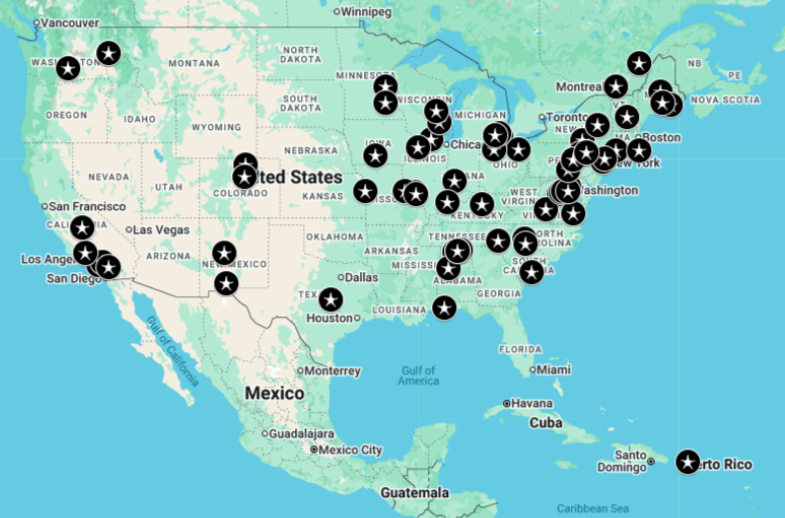
North American Participant Map

MSQP Participant Map Aug 2025.png

Visit the MSQP home page