News Articles

SEQP Contest Results Announced

Thursday, May 24, 2018 - 18:02

The question, “Will anybody participate in the Solar Eclipse QSO Party (SEQP)?” Was answered loud and clear on eclipse day, August 21st. The HF bands were busy from the first minute of the SEQP at 1400 UTC to the closing bell at 2200 UTC. Logs were received from 566 stations. Some operated on all bands, others concentrated on one or two. In total, the SEQP generated over 618,000 RBN spots, 630,000 WSPRNet spots, 1.2 million PSKReporter spots, and 29,000 logged QSOs. The Sun may have taken a lunar nap but the bands were full of life!
Solar Eclipse QSO Party First Results Published

Thursday, May 17, 2018 - 05:20

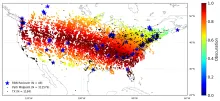
The first science results from the 21 August 2017 Solar Eclipse QSO Party have been published in the American Geophysical Union journal Geophysical Research LettersIn the paper, "Modeling Amateur Radio Soundings of the Ionospheric Response to the 2017 Great American Eclipse," Nathaniel Frissell, W2NAF, and team present Reverse Beacon Network (RBN) observations of the SEQP and compare them with raytracings through an eclipsed version of the physics-based ionospheric model SAMI3. On  14 MHz (20 m), eclipse effects were observed as a drop-off in communications for an hour before and after eclipse maximum. On 7 MHz (40 m), typical path lengths extended from about 500 km to 1000 km for 45 minutes before and after eclipse maximum. On 1.8 MHz (160 m) and 3.5 MHz (80 m), eclipse effects were observed as band openings 20 to 45 minutes around eclipse maximum.

HamSCI at Hamvention 2018

Saturday, April 28, 2018 - 20:12

UPDATE: Booth talk scheduled update 8 May 2018.

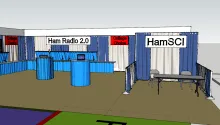
HamSCI will again be at the Dayton Hamvention, this year as part of the new Ham Radio 2.0: Innovation and Discovery area sponsored by the Yasme Foundation. Come visit the HamSCI Booth and Forum to learn about projects on the cutting of ham radio science and engineering research, including initial science results of the Solar Eclipse QSO Party (SEQP), the status of the Arecibo Observatory, the latest in understanding the causes of 6 meter sporadic E propagation, and how an inexpensive software defined radar for ionospheric studies works. Hamvention will be held May 18-20, 2018 at the Greene County Fairgrounds in Xenia, Ohio.

HamSCI Workshop 2018 Registration Open

Saturday, January 13, 2018 - 16:46

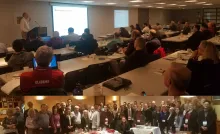
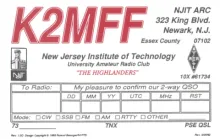
Registration for the 2018 HamSCI Workshop is now open! The workshop will be held February 23-24, 2018 at the New Jersey Institute of Technology in Newark, NJ and seeks to bring together the amateur radio community and professional scientists. Anyone interested in this workshop is invited to join. This year, the workshop will focus on results of the 2017 Great American Eclipse ham radio ionospheric experiments (including SEQP results) and the development of a Personal Space Weather station.

HamSCI Workshop 2018


"Upper-Level Lows and 6-Meter Sporadic E" Published in QST

Thursday, November 16, 2017 - 17:40
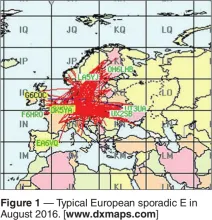
Using 6-meter QSO spot data from www.dxmaps.com, HamSCI member Joe Dzekevich, K1YOW, has found correlations of 6-meter sporadic E and Upper-Level Low pressure systems. His findings are now published in the December 2012 QST (reprinted with permission from the ARRL).
 
In his article, amateur radio is used to explore possible correlations between weather storm systems and sporadic E clouds to see if they are collocated. While some of the main causes of sporadic E propagation are wind shear, meteor strikes and upper atmospheric tides (ultimately coming from solar EUV energy inputs), radio operators have noticed that sporadic E propagation is also changed significantly by hurricanes and storms.  Specific cases where K1YOW used amateur radio to investigate the effects of low pressure weather storms on the formation and/or enhancement of 6 meter sporadic E clouds are presented. DX Maps and earth wide weather model charts combined with operations on 6 meters are used to examine possible correlations between the location of the sporadic E clouds and the low pressure weather storm systems.  Initial findings show a high degree of correlation when magnetic field strength is taken into consideration.

W2NAF and KM4EGE Win Yasme Foundation Excellence Award

Monday, November 13, 2017 - 14:35

The Yasme Foundation announced this past week that Nathaniel Frissell, W2NAF and Magda Moses, KM4EGE are winners of the 2017 Excellence Award for their role in starting HamSCI and organizing and promoting the Solar Eclipse QSO Party. From Yasme's Website, "The Yasme Excellence Awards are presented to individuals who through their own service, creativity, effort and dedication have made a significant contribution to amateur radio. The contribution may be in recognition of technical, operating or organizational achievement as all three are necessary for amateur radio to grow and prosper. These awards shall be given from time to time as the board feels appropriate."

HamSCI Workshop 2018 - Interest Survey

Monday, October 30, 2017 - 16:36

We are inviting all hams and scientists interested in ham radio science to come to the New Jersey Institute of Technology in Newark, NJ for a HamSCI workshop on Friday, February 23 and Saturday, February 24, 2018. This aim of this workshop is to foster collaborations between the ham radio and the space science and space weather research communities through presentations, discussions, and demonstatrations. This year's meeting will focus on solar eclipse analysis, ham radio data sources and databases, and the development of a "personal space weather station". This meeting is open to all interested persons. If you are interested in attending, please fill out the HamSCI Workshop Interest Survey. Final registration details will be posted by December 2017.

HamSCI UK Workshop 2017

Thursday, October 19, 2017 - 12:41

A meeting bringing together both radio amateurs and radio scientists was held in the UK on the 13 October 2017, before the Radio Society Great Britain annual convention. This 'HamSCI' event, the first such meeting outside of the USA, was organized by Professor Cathryn Mitchell, M0IBG, (University of Bath) in association with her Natural Environmental Research Council (NERC) Knowledge Exchange fellowship.