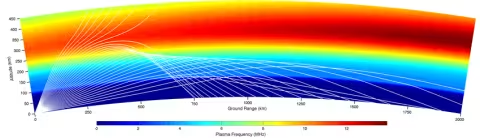
The HamSCI Ray Tracing Working Group currently covers (but is not limited to) two projects:
Project 1
Ionospheric Model Validation and Development of an Open-Source HF Ray-Tracing Toolkit Leveraging HamSCI Citizen Science Data
NASA HCSI, Award Number: 80NSSC26K0051, 3 years (2026-2029), PI: Kornyanat Hozumi, KM7GYX (University of Scranton), Co-Is: Nathaniel Frissell W2NAF (University of Scranton), Mark Fenner (University of Scranton)
1. Developing a 3D HF ray-tracing toolkit to model complex HF wave paths
2. Validating ionospheric models using HamSCI observational data
3. Studying space weather effects on anomalous HF communication, including disruptions caused by Equatorial Plasma Bubbles (EPBs)
4. Improving accessibility and engagement by providing documentation, tutorials, and opportunities for citizen scientists to contribute to research and toolkit development
Project 2
Crowdsourced Observations for Ionospheric Model Validation and a Diagnostic Approach for Forecasting Equatorial Spread F
ONR SUNDIAL, Award Number: N000142612000, 3 years (2025-2028), PI: Kornyanat Hozumi, KM7GYX (University of Scranton), Co-I: Nathaniel Frissell W2NAF (University of Scranton)
1. Developing a reusable validation framework for Navy-relevant ionospheric models using HamSCI HF observations and ray-tracing techniques
2. Investigating the initiation of Equatorial Spread F (ESF) using ionograms, ray tracing, and multiple background-ionosphere scenarios
Leader
Dr. Kornyanat Hozumi, KM7GYX
Mailing List
https://groups.google.com/g/hamsci-ray-tracing
Meeting Link
We plan to have a bi-weekly meeting. Meeting announcement will be sent out on mailing list.
Mission Statement
The mission of the HamSCI Ray Tracing Working Group is to bring together amateur radio operators, citizen scientists, software developers, and professional researchers to advance HF propagation and ionospheric science.
The group promotes the development and use of open-source HF ray-tracing tools, the validation of ionospheric models using HamSCI observations, and collaborative studies of space weather and unusual HF propagation. It also provides a forum for tutorials, technical discussions, software feedback, and community research projects.