Optimizing Location Estimation with Novel Numerical Solution using Real-Time Transmitting Beacons WSPRlive, Weak Signal Propagation Reporter Protocol, and Friis Propagation Model
| Publication Type | Conference Proceedings |
|---|---|
| Author | |
| Conference Name |
HamSCI Workshop 2024
|
| Date Published |
03/2024
|
| Year of Conference |
2024
|
| Publisher |
HamSCI
|
| Conference Location |
Cleveland, OH
|
| Abstract |
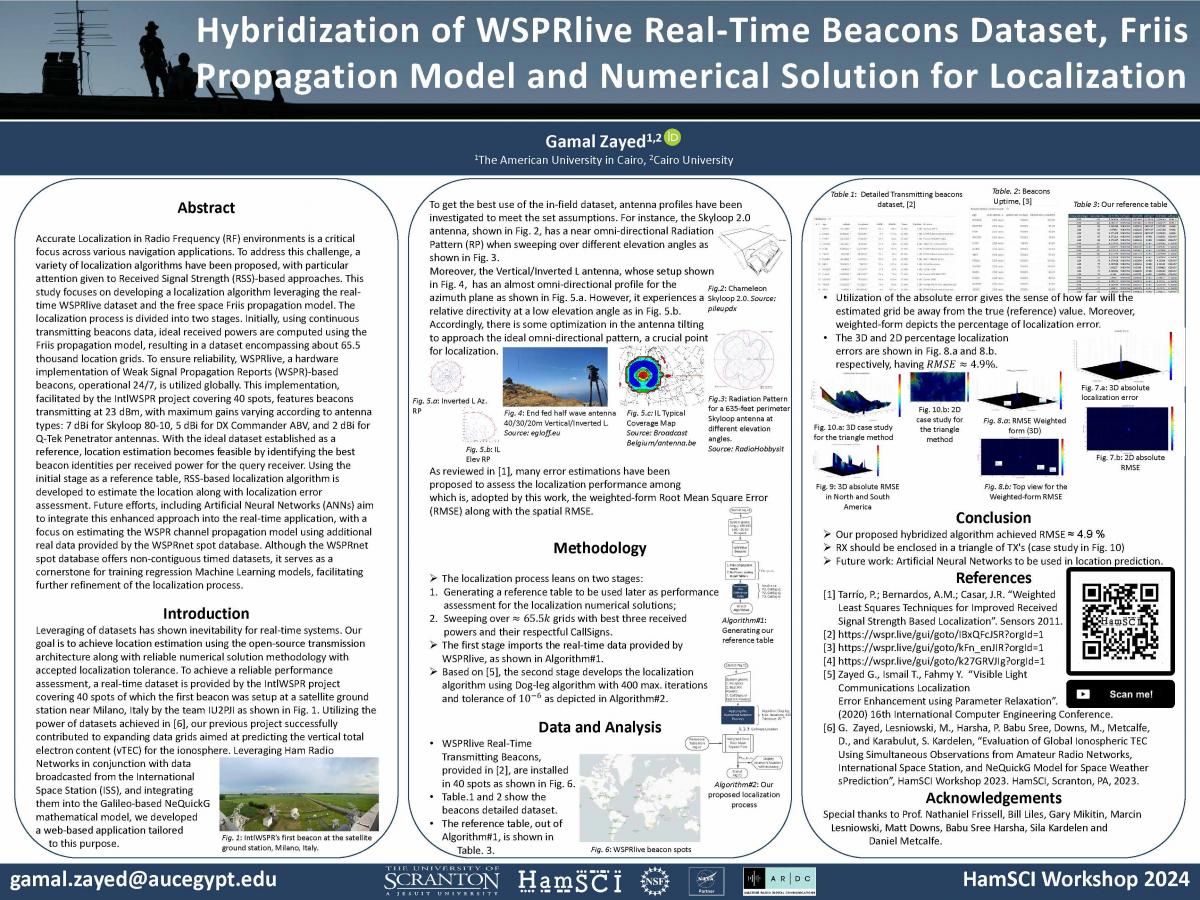
The proliferation of real datasets has become indispensable for implementing various processes in real-time scenarios. Our previous project successfully contributed to expanding data grids aimed at predicting the vertical total electron content (vTEC) for the ionosphere. Leveraging Ham Radio Networks in conjunction with data broadcasted from the International Space Station (ISS), and integrating them into the Galileo-based NeQuickG mathematical model, we developed a web-based application tailored to this purpose. In this study, the focus is on generating new data grids for location estimation within a Radio Frequency (RF) environment, relying solely on transmitter identities and measured received powers. The localization process is divided into two stages. Initially, ideal received powers are computed using the Friis propagation model, resulting in a dataset encompassing over 25,000 locations per received power. To ensure reliability, a hardware implementation of Weak Signal Propagation Reports (WSPR)-based beacons, operational 24/7, is utilized globally. This implementation, facilitated by the IntlWSPR project covering 40 spots, features beacons transmitting at 23 dBm, with maximum gains varying according to antenna types: 7 dBi for Skyloop 80-10, 5 dBi for DX Commander ABV, and 2 dBi for Q-Tek Penetrator antennas. With the ideal dataset established as a reference, location estimation becomes feasible by identifying the best beacon identities per received power for the query receiver. However, numerical solutions for the localization system involve relatively lengthy processing times and exhibit mean square localization errors, motivating the second phase of this work. A novel numerical solution enhancement technique, coupled with a designed radius of convergence, significantly accelerates the convergence of the localization system's equations with improved accuracy. Future efforts aim to integrate this enhanced approach into the real-time application, with a focus on estimating the WSPR channel propagation model using additional real data provided by the WSPRnet spot database. Although the WSPRnet spot database offers non-contiguous timed datasets, it serves as a cornerstone for training regression Machine Learning models, facilitating further refinement of the localization process.
|
| Refereed Designation |
Non-Refereed
|
| Full Text |
|
| Publication Language |
eng
|
| Download citation |