Lunar Dust Particle Simulation in the (12-6) Lennard-Jones Potential Approximation
| Publication Type | Conference Proceedings |
|---|---|
| Author | |
| Conference Name |
HamSCI Workshop 2023
|
| Date Published |
03/2023
|
| Year of Conference |
2023
|
| Publisher |
HamSCI
|
| Conference Location |
Scranton, PA
|
| Abstract |
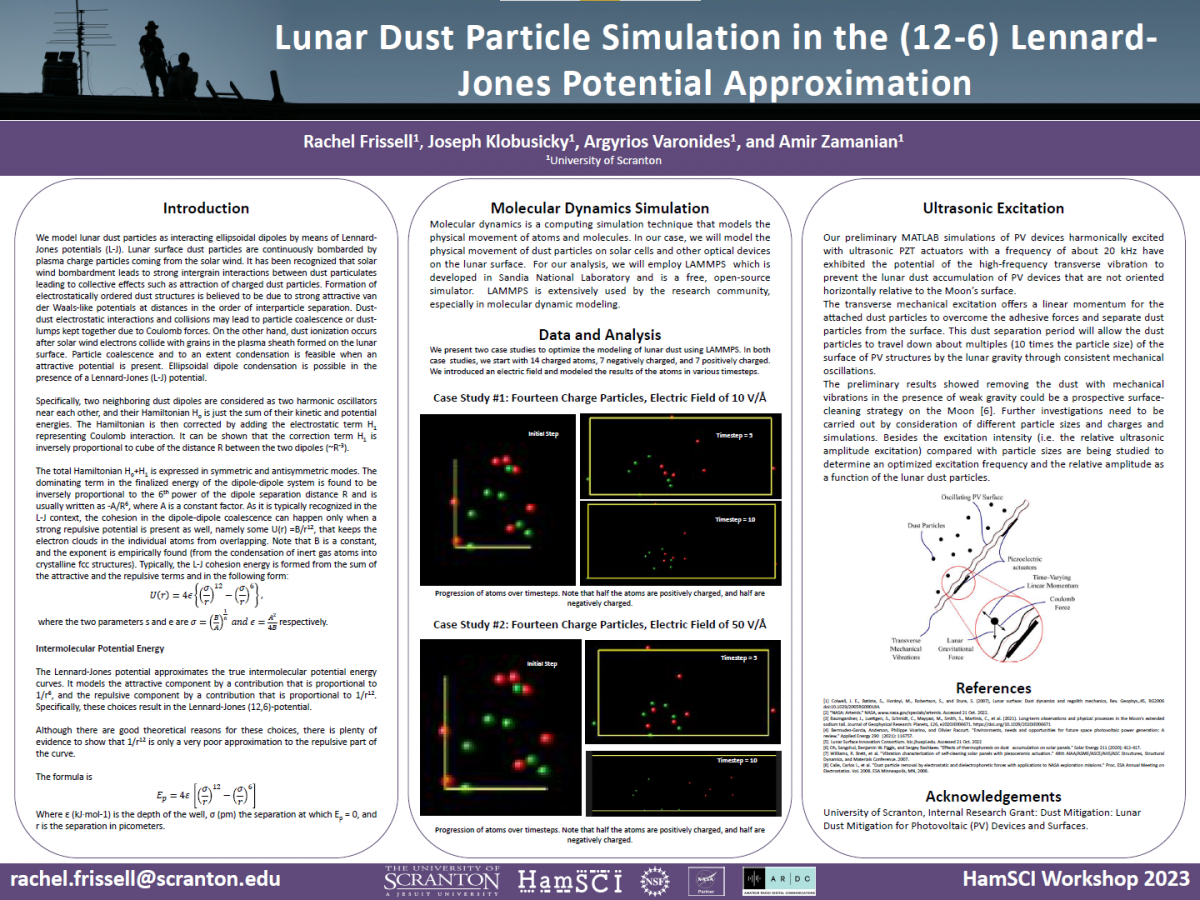
We model lunar dust particles as interacting ellipsoidal dipoles by means of Lennard-Jones potentials (L-J). Lunar surface dust particles are continuously bombarded by plasma charge particles coming from the solar wind. It has been recognized that solar wind bombardment leads to strong intergrain interactions between dust particulates leading to collective effects such as attraction of charged dust particles. Formation of electrostatically ordered dust structures is believed to be due to strong attractive van der Waals-like potentials at distances in the order of interparticle separation. Dust-dust electrostatic interactions and collisions may lead to particle coalescence or dust-lumps kept together due to Coulomb forces. On the other hand, dust ionization occurs after solar wind electrons collide with grains in the plasma sheath formed on the lunar surface. Particle coalescence and to an extent condensation is feasible when an attractive potential is present. Ellipsoidal dipole condensation is possible in the presence of a Lennard-Jones (L-J) potential.
|
| Refereed Designation |
Non-Refereed
|
| Full Text |
|
| Publication Language |
eng
|
| Download citation |