FDTD for Geophysical Applications
| Publication Type | Conference Proceedings |
|---|---|
| Author | |
| Conference Name |
HamSCI Workshop 2023
|
| Date Published |
03/2023
|
| Year of Conference |
2023
|
| Publisher |
HamSCI
|
| Conference Location |
Scranton, PA
|
| Abstract |
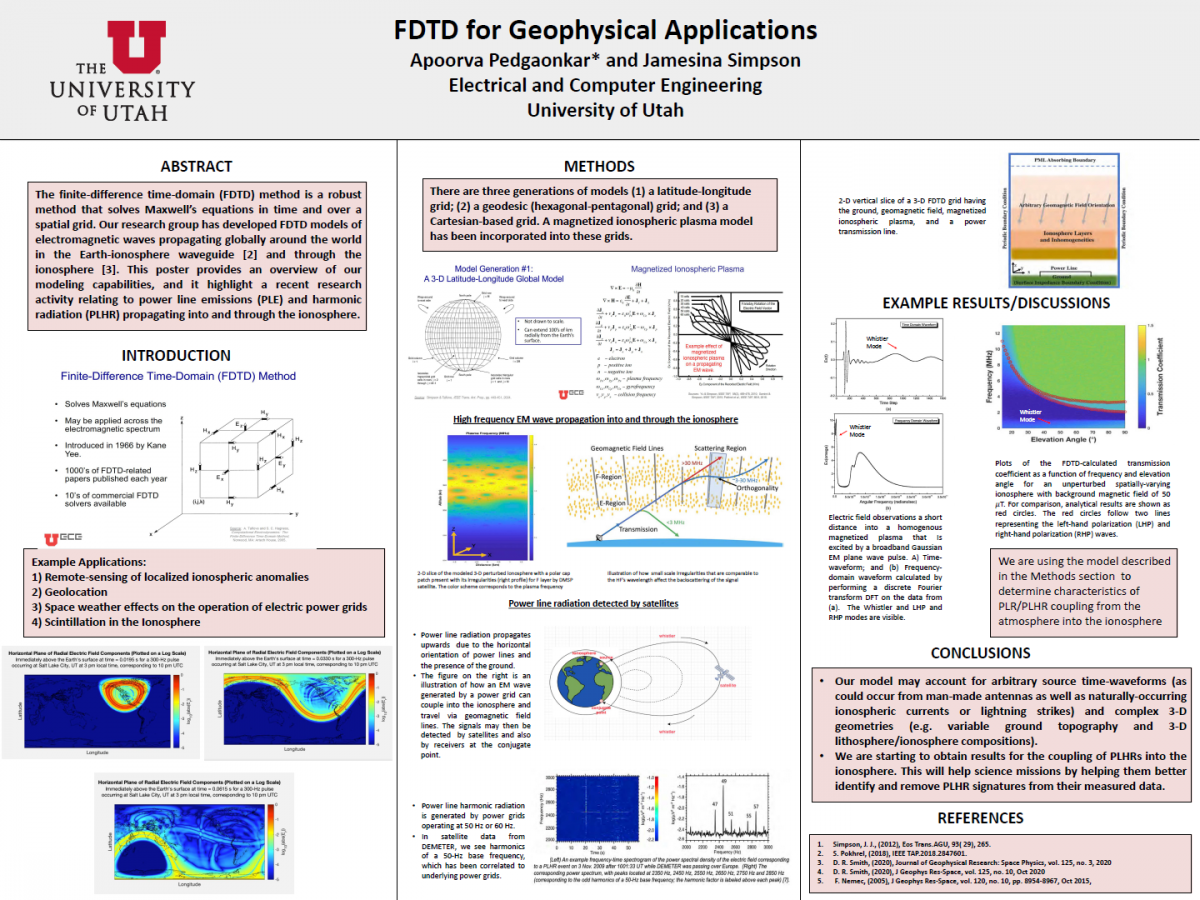
The finite-difference time-domain (FDTD) method [Yee, IEEE TAP, 14:3, 1966] is a robust method that solves Maxwell’s equations in time and over a spatial grid. It can account for arbitrary source time-waveforms as could occur from man-made antennas as well as naturally occurring ionospheric currents or lightning strikes, etc. The FDTD method can also account for complex 3-D geometries, including for example a variable ground topography and 3-D lithosphere/ionosphere compositions. By coupling Maxwell’s equations to the plasma momentum equation, FDTD models may also be constructed to account for the physics of electromagnetic wave propagation through magnetized ionospheric plasma. Over the years, our research group has developed FDTD models of electromagnetic waves propagating globally around the world in the Earth-ionosphere waveguide [Simpson, Surveys in Geophysics, 30:2, 2009]. Three generations of models have been developed: (1) a latitude-longitude grid; (2) a geodesic (hexagonal-pentagonal) grid; and (3) a Cartesian-based grid. These models have been applied to remote-sensing of localized ionospheric anomalies, remote-sensing of oil fields, geolocation, Schumann resonances, space weather effects on the operation of electric power grids, scintillation in the ionosphere, etc. In this presentation, we will provide an overview of our modeling capabilities, and we will also highlight a recent research activity relating to power line emissions (PLE) and power line harmonic radiation (PLHR) propagating into and through the ionosphere. For this project, the FDTD models are solve the full-vector Maxwell’s equations coupled with the plasma momentum equation over a fully 3-D grid while considering the complex inhomogeneities of the ionospheric magnetized plasma (ducts, plasma bubbles, etc.). Our algorithm is highly efficient, allowing us to study the long timespans of the very low-frequency waveforms of interest as well as their long propagation paths from the ground to satellite altitudes. Although we have not collaborated with Ham radio operators yet, we are very interested in doing so. Our models are ideally suited for investigating a number of interesting problems. |
| Refereed Designation |
Non-Refereed
|
| Full Text |
|
| Publication Language |
eng
|
| Download citation |